

THE SUNLIGHT TAX BLOG:
Tax and Money Education for Creative People, Freelancers and Solopreneurs
search A TOPIC
Categories
- Business Management 22
- Creative Specific 3
- Estimated Quarterly Taxes 8
- General Economy; Tax Policy and Legislation 52
- Get to know Hannah Cole 8
- Interviews and personal stories 36
- Personal Finance 26
- Personal and Career Development 22
- Practical and Tactical Tax 57
- Retirement and Future Success 28
- Sunlight Podcast 149
- Tax Deductions for Freelancers and Self-Employed 9
- the Sunlight Tax Podcast 66
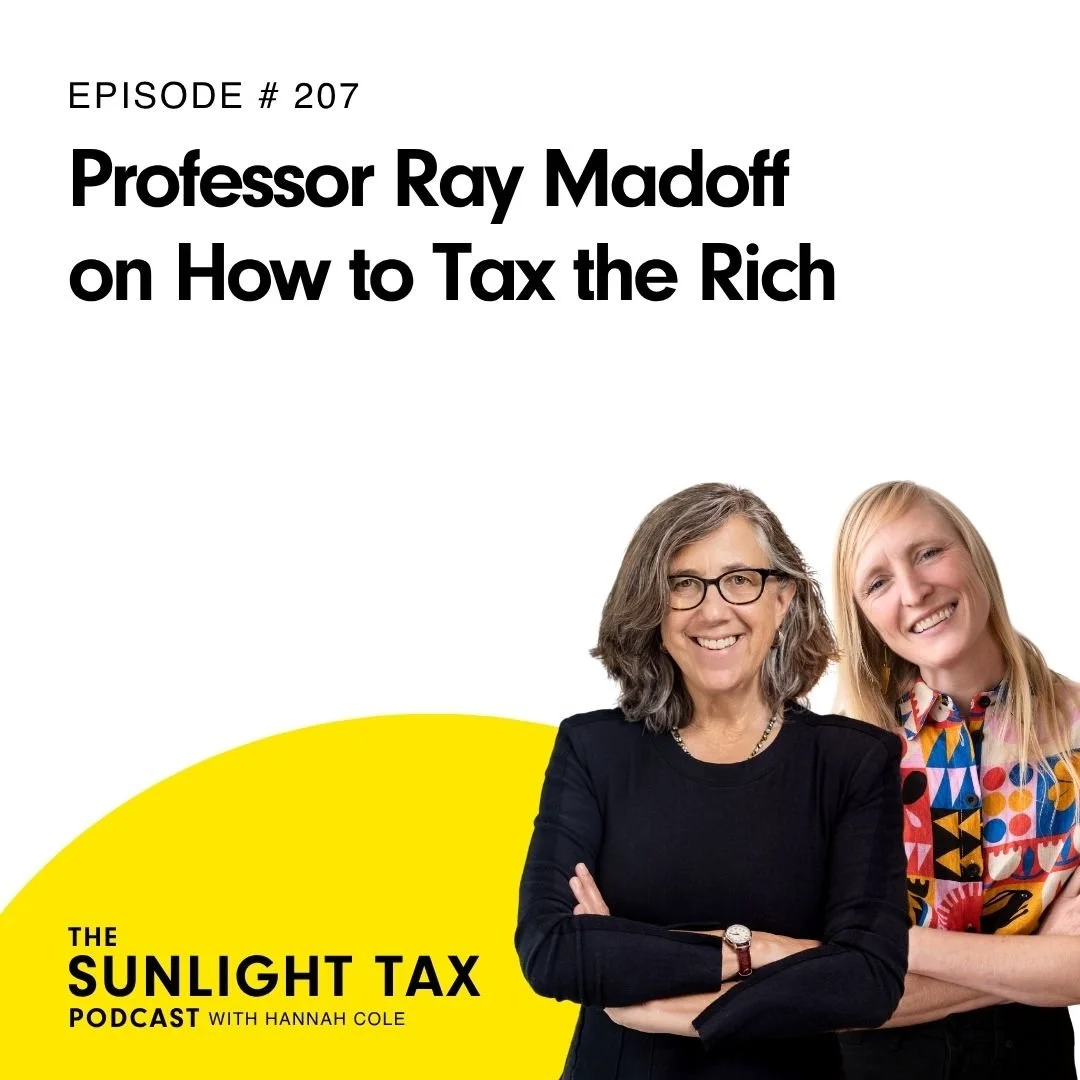
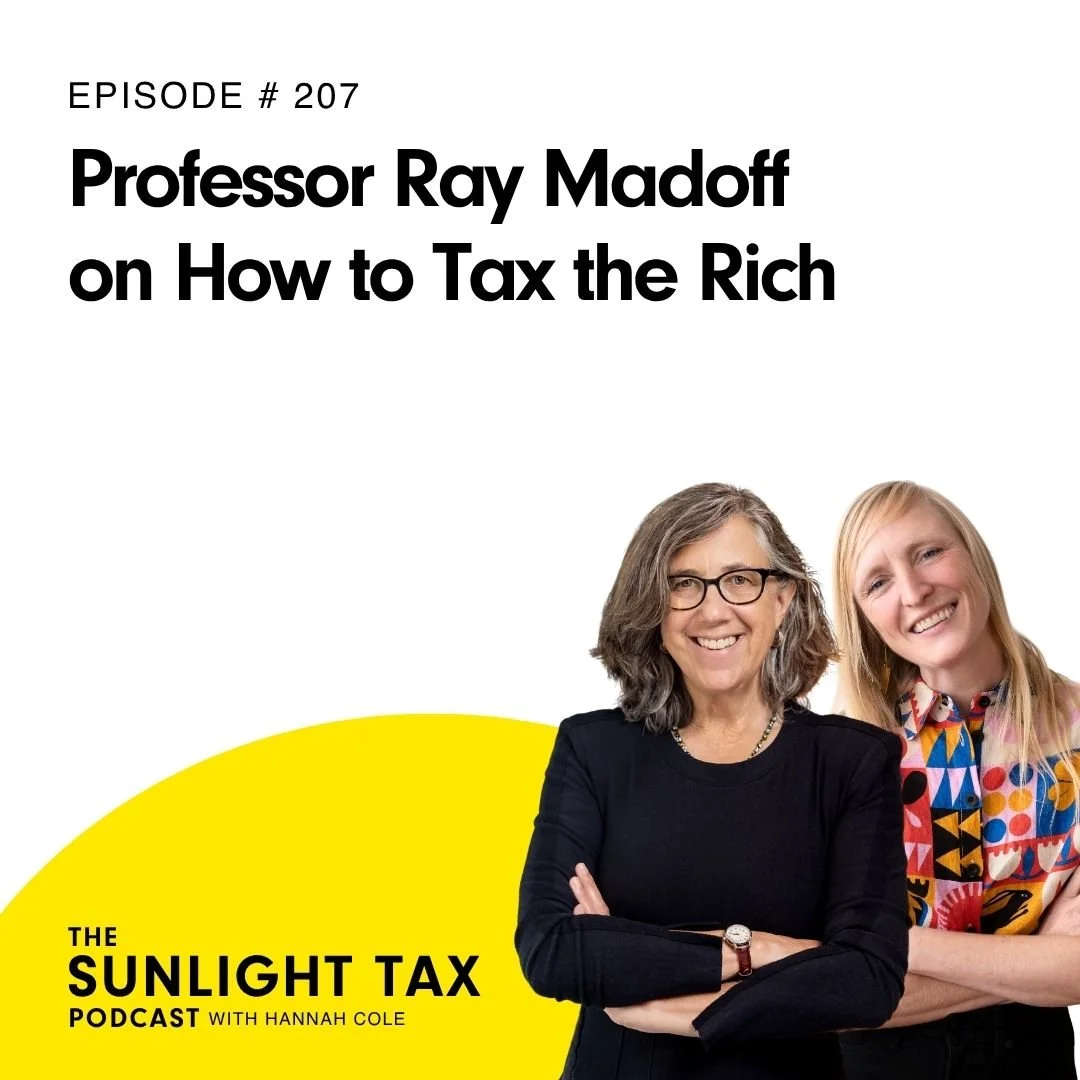
Professor Ray Madoff on How to Tax the Rich
Listen and Subscribe Here
Why do billionaires often pay lower tax rates than working Americans?
In this episode of the Sunlight Tax Podcast, I sit down with tax policy expert and professor, Ray Madoff, to explore how income, wealth, and inheritance are taxed in the United States, and why the current system often favors the ultra-wealthy.
We discuss wealth inequality, estate taxes, billionaire tax strategies, and the most promising proposals for tax reform. If you've ever wondered how the tax code shapes who builds wealth in America, this conversation offers a clear and accessible look at what a fairer tax system could look like.
“Somebody who is self-employed and earned sixty thousand dollars will pay about thirteen thousand dollars in income taxes and payroll taxes.”
Why do billionaires often pay lower tax rates than working Americans? In this episode of the Sunlight Tax Podcast, I sit down with tax policy expert and professor, Ray Madoff, to explore how income, wealth, and inheritance are taxed in the United States, and why the current system often favors the ultra-wealthy.
We discuss wealth inequality, estate taxes, billionaire tax strategies, and the most promising proposals for tax reform. If you've ever wondered how the tax code shapes who builds wealth in America, this conversation offers a clear and accessible look at what a fairer tax system could look like.
“Let’s say that you’re Mark Zuckerberg. What he has is a growth in value of his stock. And even though that growth in value of his stock has made him very, very rich, it is not treated as taxable income.”
Also mentioned in today’s episode:
02:30 Background on Professor Ray Madoff and her work
05:40 How the tax system favors the wealthy
07:19 The impact of growth in stock value and tax treatment
09:02 Living off wealth, not income
10:04 Inheritance, gifts, and the lack of taxation
12:15 The estate tax and loopholes
16:20 Public perception and fairness in the tax system
17:21 How the wealthy avoid taxes: borrowing against assets
23:02 Political feasibility of tax reforms
25:46 Wealth taxes and their challenges
29:56 Legal and constitutional issues with wealth taxes
31:46 Potential benefits of well-designed tax policies
If you enjoyed this episode, please rate, review and share it! Every review makes a difference by telling Apple or Spotify to show the Sunlight Tax podcast to new audiences.
About Professor Ray D. Madoff:
Ray D. Madoff is a professor at Boston College Law School and the cofounder and director of the Boston College Forum on Philanthropy and the Public Good. She is the author of Immortality and the Law: The Rising Power of the American Dead and lead author of The Practical Guide to Estate Planning. Her writing has appeared in The New York Times, The Wall Street Journal, The Washington Post, and The New York Review of Books, among other outlets.
Episode Links:
Professor Ray Madoff’s Book: The Second Estate: How the Tax Code Made an American Aristocracy
My FAQ page on how to Tax the Rich
Get your FREE visual guide to tax deductions
Order my book: Taxes for Humans: Simplify Your Taxes and Change the World When You’re Self-Employed

How to Tax the Rich and Studio Fundraiser
Listen and Subscribe Here
This week on the Sunlight Tax podcast, I share why tax fairness matters and how current tax policies disproportionately benefit the wealthiest Americans while placing a greater burden on working people and small business owners. I break down the growing gap between wealth and taxation, explain how these policies affect everyday life, and discuss why a more equitable tax system is essential for a stronger economy and society.
I also share the story behind my latest art project – a fundraiser to rebuild my Helene-destroyed studio that doubles as what I do best: Helping you understand & spread the word about a key issue that’s complex, fact-based, and offering real solutions. With a touch of handmade vibes. And spread the word (before the midterms), and buy a hand-printed tote that helps me rebuild.

“Everyone should feel that their taxes are fair.”
This week on the Sunlight Tax podcast, I share why tax fairness matters and how current tax policies disproportionately benefit the wealthiest Americans while placing a greater burden on working people and small business owners. I break down the growing gap between wealth and taxation, explain how these policies affect everyday life, and discuss why a more equitable tax system is essential for a stronger economy and society.
I also share the story behind my latest art project – a fundraiser to rebuild my Helene-destroyed studio that doubles as what I do best: Helping you understand & spread the word about a key issue that’s complex, fact-based, and offering real solutions. With a touch of handmade vibes. And spread the word (before the midterms), and buy a hand-printed tote that helps me rebuild.
Also mentioned in today’s episode:
00:10 Introduction and Personal Reflections
02:49 The Taxation Debate: Fairness and Advocacy
08:30 Understanding Wealth Inequality
10:09 Misdirection in Taxation
20:02 Strategies of the Wealthy
22:25 Systemic Failures in Taxation
25:27 Proposed Solutions for Tax Fairness
If you enjoyed this episode, please rate, review and share it! Every review makes a difference by telling Apple or Spotify to show the Sunlight Tax podcast to new audiences.
Episode Links:
Support me in rebuilding my studio
Ray Madoff, author ofThe Second Estate: How the Tax Code Made an American Aristocracy.
Katherine Anne Edwards, economist, and co-host of the podcast The Optimist Economy
Get my Tax Help onSubstack.
Get your FREE visual guide to tax deductions
Order my book: Taxes for Humans: Simplify Your Taxes and Change the World When You’re Self-Employed
A Solution for Fairer Taxes
LISTEN AND SUBSCRIBE HERE
This week, I’m chatting about a topic that’s important to me: how we can create more fairness and equity in our tax system. I’m sharing an op ed written by William Gale, an economist from the Brookings Tax Policy Center that talks more about creating more fairness in tax policy, stopping tax cheats and how we can get there.
Join me in this episode as we head toward the election season to learn about why equity in our tax policy is so important.

LISTEN AND SUBSCRIBE HERE
This week, I’m chatting about a topic that’s important to me: how we can create more fairness and equity in our tax system. I’m sharing an op ed written by William Gale, an economist from the Brookings Tax Policy Center that talks more about creating more fairness in tax policy, stopping tax cheats and how we can get there.
Join me in this episode as we head toward the election season to learn about why equity in our tax policy is so important.
Also mentioned in today’s episode:
The importance of giving the IRS the tools it needs to enforce tax rules 2:45
Proposed tax policies to combat wealth inequality and reduce tax evasion 8:13
If you enjoyed this episode, please rate, review and share it!
Links:
William Gale's article: https://www.brookings.edu/articles/give-irs-the-tools-it-needs-to-enforce-tax-rules-and-catch-cheaters/
What are your money concerns?
Suggest a blog topic for Hannah here.