
“The parts that allow me to feel connected to other writers... that’s not a conversation I can have with many people in my life.”
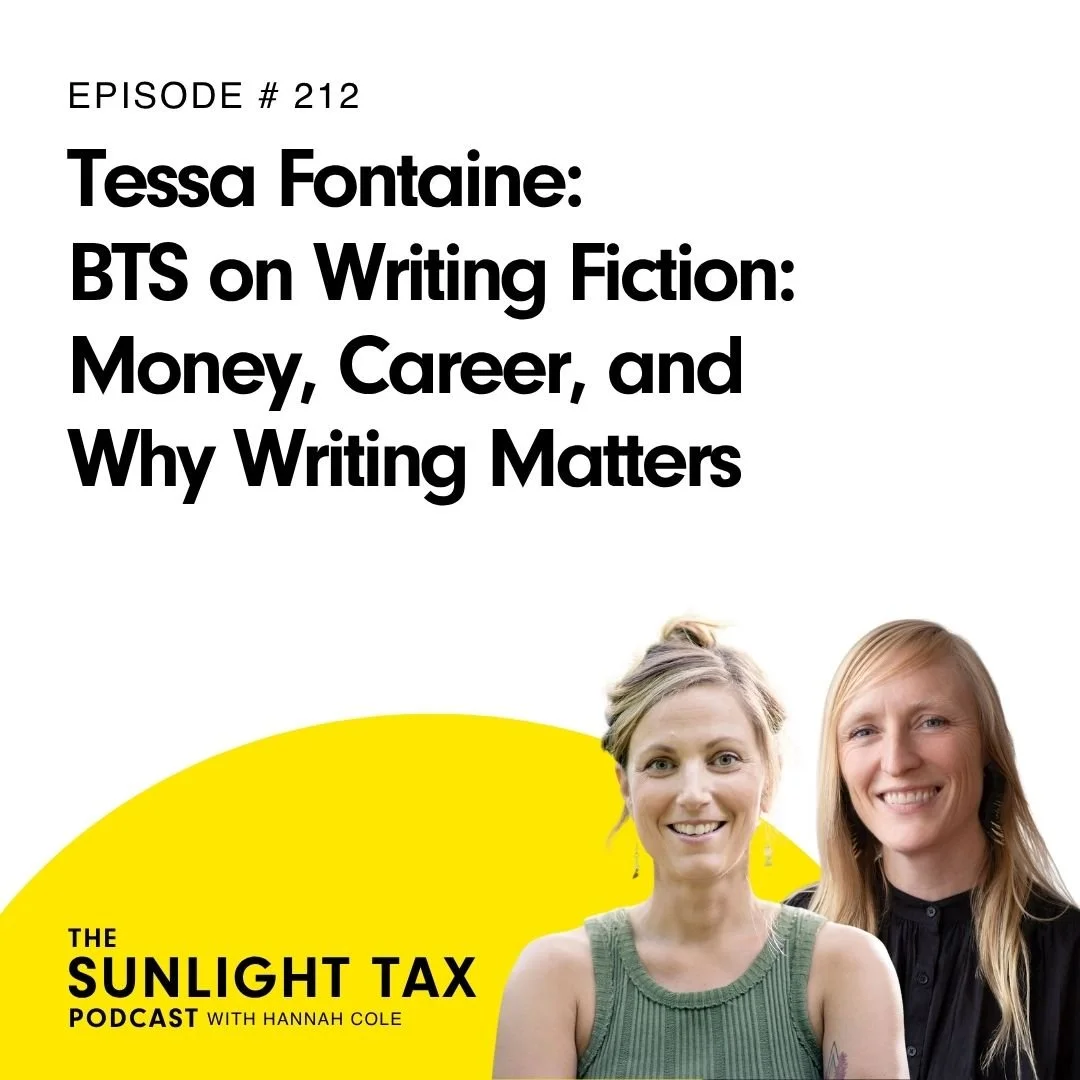
This week on the Sunlight Tax Podcast, we go behind the scenes with writer Tessa Fontaine as we explore the realities of building a fiction writing career. We talk about money, publishing, creative community, balancing art with financial stability, and why most authors rely on multiple income streams to keep writing.
We also discuss the deeper purpose of writing—how stories help us make sense of the world, why art matters beyond profit, and what it means to create work that truly connects. Whether you're a writer, artist, or creative entrepreneur, this conversation is an honest look at the intersection of creativity, career, and purpose.
Also mentioned in today’s episode:
00:10 Introduction to Tessa Fontaine's Writing Journey
03:18 The Role of Income and Writing as a Creative Outlet
04:18 The Joy of Reading and Audiobooks for Writers
06:36 Balancing Practical Career and Artistic Spirit
11:36 Building Community and Accountability in Writing
22:34 The Fickleness of Writing Income and Artistic Freedom
27:54 The Incompatibility of Capitalism and Art
36:36 The Gift Economy and the Purpose of Art
46:06 Why Do You Write? Personal Motivations
50:40 Diverse Careers and Income Streams for Writers
54:29 Misunderstandings About the Financial Side of Writing
01:00:02 The Enduring Power of Art and Literature
If you enjoyed this episode, please rate, review and share it! Every review makes a difference by telling Apple or Spotify to show the Sunlight Tax podcast to new audiences.
About Tessa Fontaine:
Tessa Fontaine is the author of THE ELECTRIC WOMAN: A MEMOIR IN DEATH-DEFYING ACTS (FSG 2018), a New York Times Editors' Choice; Barnes & Noble Discover Great New Writers pick, and best book of the year by Southern Living, Refinery29, Amazon Editors', and The New York Post.
THE RED GROVE (FSG 2024), her debut novel, was named a best book by Amazon Editors’ and People Magazine, and was currently longlisted for the Center for Fiction’s First Novel Prize.
Other writing can be found in Outside, The New York Times, Glamour, AGNI, The Believer, People, LitHub, Creative Nonfiction, and more. Raised outside San Francisco, Tessa is a former professor and has taught in jails and prisons. She co-founded and teaches the Accountability Workshops with writer and pal Annie Hartnett, and lives in Asheville, North Carolina, with her daughter, goofy dog and sassy cat.
Check Out Tessa’s Work:
Accountability Workshops website
Instagram: @accountabilityworkshops
Episode Links:
Check out my program, Money Bootcamp
Get your FREE visual guide to tax deductions
Order my book:Taxes for Humans: Simplify Your Taxes and Change the World When You’re Self-Employed
Transcript:
Tessa Fontaine (02:14)
Thank
you. Thanks, Hannah. Thanks so much for having me. I'm so delighted to get to talk to you here.
Hannah Cole (02:20)
Me too. True confession, all I ever want in life is to talk about books and when I when we met
Tessa Fontaine (02:27)
Ha ha ha.
Hannah Cole (02:28)
at a mutual friends party, I was like, I just wanna corner Tessa at every party and talk about books, which I have actually followed through on sometimes.
Tessa Fontaine (02:37)
Yeah, but it you know, the reason that we got along is 'cause it's all I also want to talk about. I just wanna
Hannah Cole (02:42)
Yeah.
Tessa Fontaine (02:43)
like geek out with people about how good books are. And so that's we're kindred spirits.
Hannah Cole (02:48)
I love it. I also like I remember we had a drink one time and I remember asking you about books and talking about books and realizing that you are reading so much like I get the luxury of reading whatever I like because it's just pleasure for me. And you as a professional writer and coach and editor have so much student work that you have to read that you have less time than I do for like novels.
Tessa Fontaine (03:14)
Yeah, I just had this funny experience actually where someone someone was like, what are the top three books you read that you loved in the last year? And I am reading all the time, but I was like, I don't even know if I've read three books I would say I love. Not because I haven't read three great books, but I just like as you're saying, so much of my time is like reading for blurbs or reading for an event I'm gonna do with someone, or reading student material, or you know, doing an editorial project. And so
It's all great and I love it, but my mind really goes blank in those moments. I still do get to read a lot for pleasure. And actually the thing that my reading pleasure crossover is I'm a huge audiobook fan. And
Hannah Cole (03:51)
Hm.
Tessa Fontaine (03:52)
like at the end of a day, sometimes I'm like, I don't think I can read more. My eyes are too tired. And so I'll listen to a book while I'm like doing the dishes or doing something in the garden or something. And that feels like I can still be swept away with the story without having to sit still or
trained my eyes in and so that's my like little pleasure zone of reading these days.
Hannah Cole (04:12)
I love that. Yeah, that's really cool. audiobooks do feel like a gift to the world. They unlock so much.
Tessa Fontaine (04:17)
Yeah, yeah. Thank you. Thank you, people who've
I know. It's so great.
Hannah Cole (04:21)
Yeah. Like being
able to yes, like pull weeds or wash dishes, pack lunches. It's so good.
Tessa Fontaine (04:27)
I know. While while
someone just t like really beautifully narrates a story to you, like, it's just like it's like childhood dreams coming true. It's the best.
Hannah Cole (04:35)
Kinda
kinda is. Also like the New Yorker fiction podcast is also that is life to me. there
Tessa Fontaine (04:39)
Yes, totally, totally.
Hannah Cole (04:43)
I don't love every story, but sometimes one just hits me so hard I feel like my whole day gets turned on its head.
Tessa Fontaine (04:50)
Yeah,
I'm with you. And that you get to hear what other writers geek out on that you're like hearing you kinda get two different brains in on it 'cause it
Hannah Cole (04:58)
For sure.
Tessa Fontaine (04:58)
it's like a writer who's like, Here's my favorite story.
Hannah Cole (05:01)
I think part of what I love about that so much is exactly that part, like where the writers saying what they were attracted to in the story and pointing out moments they thought were genius. It just helps me appreciate the craft of writing so much. Yeah.
Tessa Fontaine (05:15)
Totally. Yeah.
Hannah Cole (05:17)
I think I would go back to school and try to get an MFA in fiction writing, like just so that I could talk about books all the time if practical reality was not a factor in my life.
Tessa Fontaine (05:28)
Yeah.
It is so fun. Yeah.
Hannah Cole (05:32)
so I wanna kind of sandwich this conversation. Like this is a podcast people come to for practical stuff and the career side of creative life. but I wanna talk about the spirit too. So I wanna ask you actually a practical question up front. I wanna orient people to kind of I mean I read your official bio, but I'm really interested in like
just the facts kind of of like, well you run this coaching group, you have this retreat like what is your kind of writing life career look like? And then maybe talk spirit and then go back to practical. So nuts and
Tessa Fontaine (06:07)
Yeah.
Hannah Cole (06:07)
bolts, spirit, nuts and bolts again.
Tessa Fontaine (06:10)
Great. Yeah. You know what? It's it's funny actually, as you were reading that bio, I was thinking like, this is the bio I send when I'm doing like a literary event, but it's actually not the bio that has my actual larger work life in it really. because
Hannah Cole (06:23)
Mm-hmm.
Tessa Fontaine (06:24)
it doesn't mention what I actually do most of the time, which is writing related, as you say. So so my life so I have done a lot of things, I think as many creative folks have. And I I kind of first went down the academic road and so I was a
professor of creative writing and always honestly knew that that was not the right road for me. I I love teaching, but not really in academia that that traditional undergrad academia wasn't exactly the right fit. And so I left that and so I started real like kind of immediately after leaving that, I started something I had a I had a writing partner, really who she was just a friend, Annie Hartnett. And we had been writing
writing partners really for years and and the way that that started is we both had our first books come out and then we both got really, really, really stuck writing our second books. I think it was a little bit of the Cheryl Crow like the first cut is the deepest. Like we had written our first books and we were both kind of like, well we've said everything there is to say like what how do you write another book? How do you do this? And so she had found this Amy Bender essay.
That was published on Oprah.com, which I recommend to everybody, where she basically talks about, I think it's called the way to get productive is to make rules. And it was about making this kind of contract, this like binding legal contract with another writer friend, where they agreed to certain stipulations, like I'm gonna write a thousand words a day, four days a week. Here, you know, if I'm traveling, here's what I'm gonna do instead. Here's how much reading I'm gonna do. Here are some things I need to remind myself, here are the conditions I'm gonna.
Keep the internet off. I'm gonna have light a candle, whatever. And so they put all these things in this contract. Then when you do it for the day, you just simply tell your writing partner, done, and then they write back check. So you're not ever turning anything into them. You're just sort of saying, I did my contract for the day. Annie and I started doing that years ago with each other. And it really, really, really helped. It really helped to have an accountability partner. It really helped just to have somebody
Who I didn't have to sort of explain all the things to, but I could kind of be in my weird world and then have a little touchstone to the outside with her. And so we started that together. And then that at at one point years in, we were like, What do you think other people would like this? should we try to like invite a few people in and see if we can like make it a business? We you know, we were like artist people were like, we don't have businesses, we don't even know, you know, who has a who has a bank account, right? Anything.
Hannah Cole (08:50)
Yes.
Tessa Fontaine (08:50)
But we're like, okay. And we started
it and that was in 2022. And it has since grown and grown. And so this is really the the center point of my working life is I run accountability workshops. And they are I think we have eight cohorts right now of about 15 people each, and they're folks who want to be finishing their books and want to be working on their projects, and so they meet in individual cohorts.
And then we have a lot of other systems of support around them monthly speakers, book clubs, online cave writing sessions. Everybody makes this contract and does the daily check ins. So this is a big part of my work life right now, of my business life. that came just out of something that I had been doing for myself. So that's a big piece of my puzzle. I also teach in an MFA program now in Warren Wilson's MFA program. and that I like
a lot that is a better fit for me than kind of teaching in traditional undergrad classes. I'm working with older writers who are kind of more serious and more excited and that that that feels really fun. and then I do some kind of editorial work sometimes on the side and I run, as you kind of mentioned, a writers camp every fall, which
has about forty participants and four faculty and two agents and we do it in New Hampshire among the fall leaves and it's like five days of intensive writing time and craft classes and meetings with agents and and faculty and it's so fun dance parties fires it's great. So my working life and then I write. So my working life is very much like lots of puzzle pieces moving together and I'm really grateful for it.
Hannah Cole (10:32)
Yeah. Wow. It does it sounds like a lot, but I the community sounds to me wonderful.
Tessa Fontaine (10:39)
Yeah. Yeah. The community is amazing. I think like I think, you know, this isn't it isn't true for every creative practice that you are alone. But there are a lot of creative practices that you c you kind of do the thing alone. Like I feel really jealous sometimes when I talk to screenwriter friends who are in a writer's room and are like in this kind of collaborative space all the time. But like that's not what I do as a novelist or memoirist or essayist or when I'm writing for the paper and stuff. I I'm I'm like in this little
I don't know, I it just like this little cave. And so the parts that allow me to feel connected to other writers and to I mean, kind of what we were just talking about at the beginning, like geek out on books, like where we're like, my gosh, here's this life-changing thing, here's why it's life-changing. Like, that's not a conversation I can have with many people in my life. Mm, you know, not a lot of people feel that same way. And so it does feel really special to be part of it and to kind of I guess have also helped just create the space for
a lot of folks to get this kind of connection that they didn't have before. It it's felt really great.
Hannah Cole (11:42)
That's beautiful. I mean, you know, honestly, the analogy to visual art is perfect. you know, I I other visual artists mostly make work alone in a studio. And you need a critique group I mean, I think there is objectively kind of more expert work.
But it's also subjective and you don't always see everything that's in your own work and it really does. It is so helpful. Like just that same way that you need to talk about your writing with other writers. You also need to
Tessa Fontaine (12:11)
Mm-hmm.
Hannah Cole (12:12)
analyze and sit with artwork, I think, in a in a group setting and hear the way other people react to it to know if you're getting across what you mean to.
Tessa Fontaine (12:21)
Yeah. Yeah. Totally. And and and so I have also like my own writing group. So I have accountability workshops that I kind of run for a lot of other writers. And then I have my own writing group that is three other writers and I that's maybe,
Hannah Cole (12:33)
no.
Tessa Fontaine (12:33)
you know, similar to the critique group too, where we do exchange full drafts and but even more than really the thing that I think is the most valuable, you know, on top of like exchanging full drafts is we just meet and just talk about
like norm things with each other. It was the first time I ever, I mean, here we are in a creativity and money podcast. So this is perfect. We got we got together and we're like, let's be honest with each other about all of it. Like let's say how much money we got for advances, which I had never happened. I had never encountered anyone being forthright about money or about what your contract was like. There's like this veil of secrecy that I think really benefits the publishers. And I think this is true
Hannah Cole (13:13)
yeah.
Tessa Fontaine (13:14)
in
you know, many areas of of art or the capitalism. and so it was like revelatory just to norm things, to be like, where am I? And, you know, what does this amount of money mean? And what is it, what and what did that amount of money mean for you? And like just the norming
Hannah Cole (13:29)
Yeah.
Tessa Fontaine (13:29)
of that, the openness of it was has been really, really helpful, really great.
Hannah Cole (13:33)
my gosh,
that's awesome. I mean, I I'm also an author, I mean a a baby author, but I I published a book and a work.
Tessa Fontaine (13:40)
Yes.
Hannah Cole (13:41)
So I feel like I get to I get to call myself part of this club a little bit.
Tessa Fontaine (13:44)
Hundred percent. You're not a baby, you're a whole grown up author, Hannah.
Hannah Cole (13:49)
Thank you for that. I but I I do feel absolutely sort of dropped down into a dark forest. Like, here you go, here's your money, here's your timeline, we hope you sell books. And I'm like
Did I do good? Like I just don't even know.
Tessa Fontaine (14:04)
Yeah. Yeah. Totally.
Yeah. And like like w w what were we expecting to happen and did it happen? And should like there's just there's so much yeah, you get these little pieces of information and then they're like and then you just are off in the world and and that's kinda it. It's it's really bizarre. And I think like the people who are selling, you know, a million copies of their book know they're doing well because they have a billboard up of the book. But I think
Basically everyone else is kinda like, what where am I? How how's this going?
Hannah Cole (14:37)
Yeah. Well can I a okay, so I was gonna ask these later, but I'll ask you now. Like, is there a big difference between a first time author deal expectation versus it's your fifth book, you have a track record? Like does it does it really shift?
Tessa Fontaine (14:54)
Kind of in two ways that are sort of oppositional actually. there there often is like people love a debut. People love the story of a first time writer. So there so oftentimes people may get a bigger chunk of money and more attention for their debut, for the sort of promise of the new new talent on the scene. at this but then there's also
the beauty of sort of being an author who has put out a handful of books already. You have a readership built in. You have fans who are excited about your book. and so there can be more to build on at that point. So there's sort of like a, you know, sometimes you get more sort of more attention, more support later on.
Hannah Cole (15:38)
Mm-hmm.
Tessa Fontaine (15:39)
But it also is always so dependent on how your last book sold. So there's always this sort of and I think that's like part of why the first book can
be such a big splash because they don't have any data yet on how well your books are selling. And then later, you know, you you might be beloved, but if you didn't, if your blast book didn't do that well, they're like cr they're putting that into the magical number system behind the scenes where they're figuring out how much money and support to give you.
Hannah Cole (16:07)
That's interesting. You know, Taylor Swift has a line about that. You're only as hot as your last hit, baby. She gets it.
Tessa Fontaine (16:12)
Yes, Tay-Tay, she gets it. She's just one of us. I knew it. Yeah.
Hannah Cole (16:22)
I do imagine if you are Tay Tay that the pressure feels pretty intense when you put out an album.
Tessa Fontaine (16:27)
my god. Yeah, yeah.
Hannah Cole (16:29)
so like I do I do respect that, you know, people people at Olympian levels still do have problems.
Tessa Fontaine (16:35)
Yeah, I do too. I would maybe
like choose those problems over these ones, but yeah. It's real.
Hannah Cole (16:40)
Yeah, I know. People are mad
when you have Mount Olympus problems, but you know.
Tessa Fontaine (16:46)
Yeah, that's right.
Hannah Cole (16:48)
so yeah, I was speaking to this nonfiction book coach who I'm in her like she has a I don't know, an author circle. And she was talking about authors who I just attended like a session she did on writing your second book or you know, second plus, and she
Tessa Fontaine (17:06)
Mm. Mm-hmm.
Hannah Cole (17:08)
was saying that nonfiction
authors, she had just read a study who live entirely off of writing their books have on average like between nine and thirteen books out in the world. That's the point
Tessa Fontaine (17:21)
Mm.
Hannah Cole (17:22)
at which they start living off of the book sales.
Tessa Fontaine (17:25)
Wow.
Hannah Cole (17:27)
I yeah, I that one really kind of got me in the gut. I was like,
Tessa Fontaine (17:32)
a lot of Ucks.
Hannah Cole (17:33)
that whole three year process I just went through that was like felt like much more than a marathon.
maybe more like an Iron Man like that. I have to do that nine to ten times before we start getting But does that
Tessa Fontaine (17:45)
To th to thirteen, yeah. But just go ahead and I
Hannah Cole (17:50)
track that was for nonfiction. I have no idea if that relates. I I have come to learn that nonfiction and fiction are two very different worlds.
Tessa Fontaine (17:57)
They are different worlds and even within nonfiction, there are so many different kinds of nonfiction books. So like a self-help book is a really different beast than a a memoir or a collection of essays. So I'm curious about if that's just nonfiction as a whole or if there's a subgenre within there. But I don't know I have no idea what the n what the number would be if we're tracking it to the average
point at which a a fiction writer could live entirely off of their books. But I I'll just say that I barely know anyone who does it. and
Hannah Cole (18:31)
Hmm.
Tessa Fontaine (18:32)
I know a lot of pretty successful writers. And and there are people who do and there are people who have many books out or who have hit it really, really big really quickly. And there are a couple of people for whom that's true. or people whose books get optioned and made into movies or TV.
And then they get the sort of Hollywood money that comes with it.
but yeah, it's it's hard. And I think the and I guess the one of the reasons that it's hard to like put anything specific on this is like, you know, So say say your friend is like, Hey, I just published a novel. You're like, so great. That could mean anything from someone self-published it on Amazon and is paying for it to come out to
Hannah Cole (19:13)
Mm-hmm.
Tessa Fontaine (19:14)
Going through a vanity press, which means it's an independent press, but you are paying them to put your book out, to going through a small press, which is you are not paying them, but but they're maybe giving you either nothing or $500 or $1,000, and the print run is really small, to being at a major publisher with something like a $10,000 advance, to being at a major publisher with like a million dollar advance or or above. So the range is just it's incomparable, right? Like like someone who's
Putting out a small press book and someone who's putting out a book with a $500,000 advance, the just the difference in the number of books that you're gonna sell in your kind of financial life, like it's just it's such an enormous thing. And as we all know so well, like it does not necessarily track on the genius of your book. It, you know, like there are
Amazing works that come out with tiny presses. There are amazing works that never come out at all. I I have like so many writer friends who have projects that are just still living in their computers. And and there are amazing books that come out and get a ton of money, and really not so amazing books that come out and get a ton of money and you know, all of the things in between. So I guess that's all to say like I that's such an interesting number to know that average for nonfiction. And I
Hannah Cole (20:31)
Is that
Tessa Fontaine (20:32)
have no idea what it is for fiction, but I'll say like even my most successful
fiction writing friends, almost everyone is doing multiple things. Everyone's doing
Hannah Cole (20:42)
Mm-hmm.
Tessa Fontaine (20:43)
a a couple kinds of stuff. And I think part of it is like probably just the like little bit of anxiety a lot of us have that like like what tremendous luck. For me I feel this all the time, like what tremendous luck that I get to make a good portion of my income on writing. It is so incredibly lucky. It is not
Hannah Cole (21:00)
Mm-hmm.
Tessa Fontaine (21:01)
the majority of my income, but it but it, you know, it's a it's a significant portion.
And I'm also so aware of how fickle it is. Like all it would take is for me not to sell the next book, which feels as possible as anything else, for that to go away or for it to, you know, go to a small press or something else. And so I think like and I'm a solo parent and I have a four-year-old and you know own a house and all these things where like I actually don't have I can't have my life ha take have my income go away. It's not a possibility for me.
Hannah Cole (21:30)
Yeah. Yep.
Tessa Fontaine (21:30)
You know, and
this is true for most of us in in, you know, unless we were really smart and married really rich, which I regret every day not doing. But that
Hannah Cole (21:37)
Yeah.
Tessa Fontaine (21:39)
my mom was right. but but like so so having other income streams, in some ways it just like frees up the anxiety, the heart clenching anxiety to be like, actually I can kind of write what I want to write right now.
And
I really, really, really hope that it gets published and I really hope I get a good check that goes along with it, but I will not starve and I will you know, my child will have a roof over her head if that doesn't
Hannah Cole (22:07)
Mm. Wow. You know, writing and visual art are really twins. Like they're that that
Tessa Fontaine (22:12)
Mm.
Hannah Cole (22:12)
is the same story. I fe I feel every bit of that as an as a visual artist. I I actually like made a very conscious decision at a certain point. It was actually the point where I had a baby. I was living in New York City, I had my first of two kids, and you know, shit's expensive.
Tessa Fontaine (22:30)
Yeah.
Hannah Cole (22:30)
everywhere, but in New York very especially.
you know marriage and finance kind of hit the fan. we had a lot of fights over money and so I it was like it was clear the writing on the wall was clear to me I needed to make more money. Like just point blank. That was the issue. So I like went on this journey trying to find another source of income. Like do I triple down on my art career and try to like make this go? And ultimately I just kept coming up with exactly what you just said. Like I could hit it big
for one, two, three, five years. And then it all collapses. And this also
Tessa Fontaine (23:02)
Yeah.
Hannah Cole (23:03)
didn't feel like kind of a a steady foundation to raise a child with. It was not like you can
Tessa Fontaine (23:07)
Mm.
Hannah Cole (23:09)
not have the child anymore. Like it just it was justn't gonna work. I was like, I can't
Tessa Fontaine (23:13)
Yeah.
Hannah Cole (23:13)
do that. So I made a conscious decision to separate, you know, to start sunlight tax and to keep it separate from my art practice. And my art has never been better. I mean, I'm I made
Tessa Fontaine (23:24)
Hmm.
Hannah Cole (23:25)
less of it. Like time is finite.
but you know, the last show that I had in twenty twenty-four, I think, twenty twenty three, I had a show at my gallery and the Tracy Morgan gallery, and it's the best show I've ever put on. It's like the best art I've ever made. And I'm so proud
Tessa Fontaine (23:39)
Mm. Mm.
Hannah Cole (23:42)
of it. And it was partly because like I did not need those pieces to sell. That's why they're
Tessa Fontaine (23:47)
Yeah.
Hannah Cole (23:47)
so good.
Tessa Fontaine (23:49)
Yeah. Yeah. That's right. And it it's such a I I love that story. It's such an interesting paradox that there is it's like it's so lucky and amazing. And I try to remember this part too. It's so lucky and amazing to have a creative career where there is money involved, as in people do sometimes spend money because they believe that your art has a certain value to it. Like I don't
I don't want to say like I only create art and I don't care about money and there's no relationship to selling my books. Like I write books and I hope people read the books and that is transactional and there is money involved, you know? sometimes, not always, but but there also is this thing about being unattached but being not dependent on, not entirely dependent on the sort of income that you're making from it, that yeah, I think it just like it it opens up your
I mean, not to sound so cheese ball, but it kinda like opens up your heart a little bit or opens up something inside you to be able to just kind of be like, what is it that I really want to write and make right now? And like there's all these jokes among writers about like I can't even think of the word romanticy. Everyone's just like, I just should write a romanticy, because you know, the like sexy fantasy books are just like those who the people are writing those are just swimming in it right now, swimming in the money.
And and like, you know, and there's all you know, there's like I get occasional moments where I'm like, maybe I should just take a few months and just bang out some, you know, some commercial book and like I, you know, maybe I will at some point, who knows? But but I also just like really, really value being able to follow my own weird brain down its own weird projects and to feel like, yeah, I really, really hope that this gets to go into the world in a way that my other books have. And
All will not be lost if something else happens.
Hannah Cole (25:37)
Yeah, I really appreciate that. By the way, you did you did get a little weird in the Red Grove, I will say. And I it's that's a compliment. It absolutely is a little weird. And I love it about it.
Tessa Fontaine (25:42)
Yeah. Yeah, it's a little weird. Thank you. Mm-hmm.
Hannah Cole (25:49)
It feels like there's something that feels like free and real and cool about that. It's not predictable.
Tessa Fontaine (25:56)
Yeah, it's a little weird. My my next book is I I think it's like somehow it's weirder. It's weird. It's really weird. And it I mean, I think it's like I hope it feels readable and like has a a wide readership. But it also like I just was rereading it 'cause I'm about to get notes from my agents and I was just like, You are a f you are a funky person, Tessa Fontaine. What are you what is your brain doing here? Who why why
Hannah Cole (26:20)
No.
Tessa Fontaine (26:21)
are the beavers having this conversation? Like what are we do what's happening?
Hannah Cole (26:26)
that makes me really happy.
Tessa Fontaine (26:28)
Okay.
Hannah Cole (26:29)
I've really been thinking about this. Like I think we I previewed for you that this is on my mind, but I'm having a real moment. all my life I have reckoned with this, the spirit of art versus the economics of art. you know, even sunlight tax, though it's meant to be my bread and butter and largely is, like it's still dealing with that.
I deal with it both ways. But
Tessa Fontaine (26:50)
Mm-hmm.
Hannah Cole (26:52)
but this recent, you know, in Asheville that they had this big grant that went out and you know, it's like a government block grant distributed through Mountain Bizworks. And it it forced me so I lost my studio, as you know, and twenty years of work. And the grant forces you to put it into a capitalist lens.
And first
Tessa Fontaine (27:12)
Mm-hmm.
Hannah Cole (27:13)
of all, I didn't qualify on the face of it because my art didn't make enough income. I make my art makes maybe almost enough income, but it really didn't. they told me I should apply anyway, just to be fair to them. but ultimately I still didn't apply for this grant because all the questions are about your capitalist case. And I was like, there isn't one. Like honestly.
They wanted me to show comparative months showing the loss in income that I have because of Hurricane Helene. And like honestly, my numbers don't s tell that story. Like
Tessa Fontaine (27:45)
Yeah.
Hannah Cole (27:45)
my income has always been in art pretty unrelated to my effort and my output. It's like, sometimes I hit it big and I make a great sale. I had in one of, you know, in a recent year I sold twenty-five pieces to a corporate c collection and had like a delicious payday.
Tessa Fontaine (28:00)
Gosh. Yeah.
Hannah Cole (28:02)
And then I'll have three years where it's, you know, close to crickets. Like
Tessa Fontaine (28:06)
Yeah. Yeah.
Hannah Cole (28:07)
Hurricane Helene did not particularly do anything to that dynamic in my art. So basically I found that this like kind of last pot of money is floating down the river without me because
Tessa Fontaine (28:19)
Mm.
Hannah Cole (28:20)
like my art doesn't fit in a capitalist metric. and you know, to lose twenty years of work and just kind of feel
I know this is not true, but in my bad moments I say like it's not valued. and I'm not worthy of getting any money to rebuild. Like it's just it's it's hurt. It's hurt my heart.
Tessa Fontaine (28:39)
Of course it has.
Yeah, of course it has. I mean, it's so awful to have to make the case for why it matter. I mean, it's awful to have to make the case for why it matters at all. But to to to say like the only way to assess it is to find this the the sort of like regular system of money is I mean it like on a much, much tinier scale. It's making me think about like I got
divorced last year and had co-owned a house with my ex-husband and I was buying him out of it. Like I'm so lucky to have the money to be able to do that. And I got denied because my income is not consistent. It's pr it's high enough. It's well high enough, but it it
Hannah Cole (29:23)
Mm-hmm.
Tessa Fontaine (29:23)
isn't exactly consistent year over year because it varies, because, you know, and it doesn't vary by it doesn't go below any any markers of alarm. But it just I think it's like
We are in this incompatibility, which is capitalism and art, and it shows up in so many complicated ways all the time. The example that you're giving is such a devastating version of this. I had this professor in my MFA program who kind of amazingly, given the context, was was always like
Hannah Cole (29:54)
Right.
Tessa Fontaine (29:57)
again, he was teaching in an MFA program, and he was like, We should not be teaching writing or any art.
in school at all because school is a place like you're here and you're paying to be here. So there's necessarily this this financial transaction that's associated
Hannah Cole (30:13)
Mm-hmm.
Tessa Fontaine (30:14)
with it. And so his approach was to say on the first day of class he said, okay, everybody in the class, you have an A. You have an A. Doesn't matter what you do. Like semester closed. If you want to never show up again and never, never be present, fine. I don't care. Art is not transactional in this way. So you have an A, forget about it.
Now, given that the, you know, the financial part is like you're you're not gonna fail out of this class and have a sort of financial consequence, you're gonna get
Hannah Cole (30:42)
Mm-hmm.
Tessa Fontaine (30:42)
a good grade. So given that, what how do you choose to spend your time in this semester? What I and he's like, what I'm gonna do is show up every week and we're gonna, you know, discuss fiction, we're gonna write stories, we're gonna critique it. If you wanna participate that in that solely for the sake of the writing and the stories, wonderful. And if you
Hannah Cole (31:01)
Mm-hmm.
Tessa Fontaine (31:01)
don't want to.
I could care less. Go do anything else that you want. And I thought it
Hannah Cole (31:05)
Yeah.
Tessa Fontaine (31:06)
was so such an interesting reframe. And I mean, I've heard this a lot, like in I mean that, you know, this connects to like sort of higher education and art too, where you're sort of like trying to slam like of course there are hard skills you can learn in visual arts and in writing, there's hard skills. And also there's so much of this that's like esoteric and and really hard to explain or just comes from practice or rhythm or whatever it is. And so I
Like I just think we're always trying to make sense of art and an artistic career in a way that is really hard to track onto like this sort of social systems that we already have in place.
Hannah Cole (31:42)
Yeah.
Yeah. I have multiple thoughts here. Like I think
this very week, like I was in a bit of a dark place because of this. And I I literally had to coach myself, like, well, why is my work valuable? Why does it matter? Why does my last
Tessa Fontaine (31:57)
Mm-hmm.
Hannah Cole (31:57)
20 years matter? which is ridiculous. but I was just I was thinking like I was trying to explain it to my husband. I was like, What tell me your favorite song? Like this a song that like moves your heart.
Like you feel feelings whenever you hear this song. Now tell me how much money that that songwriter made from that song, how much, you know, income they derive from their music. Does it have a relationship to how that song moves you? And like, what's the answer? Of course not. It has no. It's not even a little bit of relation, it's zero relationship. And like
Tessa Fontaine (32:34)
Yeah. Yeah.
Hannah Cole (32:35)
sometimes it's Taylor Swift who moves my heart. And you know what?
Like good job, Taylor, for making money off of it. Like a congratulations.
Tessa Fontaine (32:42)
Yeah.
Hannah Cole (32:43)
I have I have no bad feelings. Like, please. But
Tessa Fontaine (32:46)
Same, same. Great.
Hannah Cole (32:48)
sometimes it's this little indie songwriter busking on the streets of Asheville who I'm sure makes nothing, right? Or very, very close to nothing. And it does not matter. Art is not about we have to eat, we have to put a roof over our children's heads.
But art is about moving the spirit. Art is about connecting to our fundamental humanity. Like
Tessa Fontaine (33:10)
Mm hmm.
Hannah Cole (33:11)
that's its purpose.
Tessa Fontaine (33:12)
Do you do you know the book The Gift by Lewis Hyde?
Hannah Cole (33:17)
not only do I know that book, I s I did
Tessa Fontaine (33:19)
Ha ha.
Hannah Cole (33:20)
a I did like a project where I sent someone a twenty dollar bill in the mail based on his gift circle idea. And and it was like a you know, so you and it was like you have to now send something to somebody else. This is all artists, so someone painted a beautiful painting on the twenty dollar bill and then someone
Tessa Fontaine (33:38)
Mm.
Hannah Cole (33:38)
wrote a poem. So we had this like you know what, I had it all
document it online at some point, but that website is twenty-five years old. Anyway, yes, the gift.
Tessa Fontaine (33:48)
I love that you did that. That's so cool.
Hannah Cole (33:50)
Tell us about the gift. It is an amazing book.
Tessa Fontaine (33:53)
Yeah, it is an amazing book. I mean y maybe you remember it better than I do now. I read it a long time ago, but it comes up in my mind a lot. And and I think so it's sort of about this question of art meeting I mean, kind of art meeting capitalism and and the relationship between money and making things. And
Hannah Cole (34:14)
Mm.
Tessa Fontaine (34:14)
and he from what I remember and correct me or add in here, but what from what I remember, he's kind of like positing
this idea that actually like when you're making something, it should be and is part of a gift economy. It's like this free, it it has to be this sort of free exchange. It has to be this in this kind of world of gift giving. And that unfortunately right now it's in a world that has money associated with it. And, you know, I I think he like calls for this sort of like radical change in how we're considering creative work entirely, which, you know, ha hasn't happened and I don't know if it will, but
Hannah Cole (34:50)
Mm-hmm.
Tessa Fontaine (34:51)
But what
my takeaway from that book was from so many years ago is like, consider this, like when I'm writing something and making something, to consider it as something that I am putting freely out into the world, like this little bird that you're letting go out into the
Hannah Cole (35:05)
Mm-hmm.
Tessa Fontaine (35:05)
world as a gift to be like, how can this connect with other people? How what will other people think about and be moved by? Or, you know, what will they take from it? And that just I think is just like this fundamental reframe of
the purpose of what we're doing and the kind of human connection piece of it that is outside of the money connection piece.
Hannah Cole (35:27)
That's beautiful. I haven't thought about that since I did that project and I needed it. So thank you. I'm gonna go
Tessa Fontaine (35:32)
Mm.
Hannah Cole (35:33)
buy myself a copy if I can't locate one. So
Tessa Fontaine (35:35)
Yes Yes
Hannah Cole (35:38)
right. I've I've thought of it before as a spiritual practice, but I
Tessa Fontaine (35:42)
Mm.
Hannah Cole (35:42)
like the gift because this is another like twisted knot that I have been in since losing my studio and my work. Is like, why do I feel such a need for acknowledgement? Like
Tessa Fontaine (35:57)
Mm.
Hannah Cole (35:57)
I can tell myself my work has meaning and worth, but why do I feel so strongly that I need others to tell me that? But I do. my god, I'm gonna cry. But
Tessa Fontaine (36:06)
Mm, mm-hmm, mm-hmm. It's okay.
Hannah Cole (36:11)
it's because it is not like I may make it solo, I may make it in isolation, but it is meant to be received. Like
Tessa Fontaine (36:18)
Yeah, yeah.
Hannah Cole (36:19)
it's not w who who is it who said this? Marcel Duchamp. I think the work of art is completed by the viewer.
Tessa Fontaine (36:25)
Mm, I love that.
Hannah Cole (36:26)
And I think in writing you would say the same if you don't have a reader like it's completed by the reader received.
Tessa Fontaine (36:32)
Yeah.
Well, and at the time when it it's like sort of how I would feel about losing every draft of everything I've ever written, right? Like at the time that all of your work is in the studio, it's still pure potential. It's like all still the potential to connect. Not not the potential like it's the potential to connect. So there's always just like an act of connection, that act of giving that can happen from it. And with the loss of the studio, it like I'm imagining if I lost every draft of everything I've ever written, it's like
that potentiality goes away because the work is gone. And like that, you know, it I don't know, the the the idea of that is so hard to reckon with that like all of this so much of yourself like it it has reached an endpoint and its end point was just with you. And I don't know, that seems I'm sorry. Yeah,
Hannah Cole (37:22)
It's too lonely. It's unbearably lonely.
Tessa Fontaine (37:26)
yeah, that's right. That's right.
Hannah Cole (37:29)
so it makes me want to ask you though, because 'cause really this purpose, like it is that that song that moves you, that that piece of art that you cannot shake out of your brain. It is that novel that like changes your life. But like
Tessa Fontaine (37:44)
Mm.
Hannah Cole (37:44)
do you have a book like that in your life, Tessa?
Tessa Fontaine (37:48)
One that I've read that has moved me in that way. Gosh, yeah.
Hannah Cole (37:51)
Yeah. It could be a small weight.
That was a heavy pressure question. It could be a little weight.
Tessa Fontaine (37:57)
You know,
s so many books really is the answer. So many books. I'll just like I'll I'll say one that came to mind when you asked that, and it's one I haven't actually reread in quite a few years. I think I actually read it when I was in my MFA, and it's it's a book by the writer Michael Undachi, who's a
Canadian Sri Lankan writer. He's best known for The English Patient, which got turned into a movie. But he has this book called Coming Through Slaughter. It's a really brief book. And it is imagining it's it's a novel. It's fiction. And it's imagining the life of this jazz singer or jazz a jazz musician, not singer, a trumpet player, I think, from New Orleans in like, I want to say it was like the twenties-ish. And
the the actual facts known about this trumpet player Buddy Bolden are this he was really young, like 17 or 18. He just sort of showed up out of nowhere. No one knew him or knew anything about him. He just showed up like in in one of the marching music parades and forgetting the name of it. And just showed up in the middle of the parade, started playing and everyone was just like, this is the most amazing musician we've ever heard. It like shook New Orleans.
And there is just there's like there are snippets of documentation about this guy. There is one photo that exists. And so he he was there. He would like new all of New Orleans just like, who is this most amazing musician who's ever been born? He very quickly started to maybe lose his mind a little bit, and then he
Hannah Cole (39:39)
Mm-hmm.
Tessa Fontaine (39:39)
disappeared completely. And that is all we know about like maybe the greatest musician who ever lived, who just appeared so briefly in New Orleans. And so this book by Michael Ondachi.
imagines this entire life around him and sort of like fictionally fills in all the gaps. And and I remember, I mean the writing is incredibly lyric and poetic and it's so interesting. But what I remember so much was like this feeling of the possibility of like, you know, I I had already been writing some nonfiction essays. I had been writing fiction, I'd been writing poetry
And here is this sort of blended moment of kind of taking
Hannah Cole (40:19)
Mm-hmm.
Tessa Fontaine (40:20)
something from real life that we don't know about and lending your imagination to build out the story and doing it in this really beautiful and evocative way. And it just felt so so moving. And here is a book. I mean, when I when I tell people about this book, I have to say, by Michael Andachi, the guy who wrote The English Patient, because that is the that is the book that has money attached to it, right? It was made into a movie. That's how he pay he's legit, he's legit, he's a real writer.
Hannah Cole (40:42)
Yep. He's legit. Yeah.
Tessa Fontaine (40:47)
And this is and this brilliant book is very unknown. Like it is not a book it is not it's hard to find. It's not one of his popular books. And and it but it you know, it was the song that floored me and and has probably very little money attached to it. I don't know, but it doesn't matter. Yeah.
Hannah Cole (41:04)
Fascinating. Interesting. Will you
repeat the name, the title again?
Tessa Fontaine (41:08)
Coming through slaughter. Slaughter is like the name of a town somewhere maybe where he came from or something. Coming through slaughter. Yeah.
Hannah Cole (41:14)
Mm, okay. It
was very evocative though.
Tessa Fontaine (41:18)
Very
evocative, very sort of scary title. But yeah. What about you?
Hannah Cole (41:21)
Yeah. Wow.
Tessa Fontaine (41:22)
What is what is that book for you?
Hannah Cole (41:25)
I've a million, truly a million. I will say that like of late Elizabeth Strout, hardly unknown. though I've met her.
Tessa Fontaine (41:38)
Ooh.
Hannah Cole (41:39)
my my dad runs an author series in Maine, like it's called An Evening with Maine Authors. So I've read I've met and read a lot of Maine authors, and that is how I discovered Elizabeth Strout. But once I started reading her, I was like holy shit, this woman is a
Tessa Fontaine (41:54)
She kills
me. She's a genius, yeah. Yeah.
Hannah Cole (41:57)
She's a genius.
her way of like getting into getting you into somebody else's head, which I think is what like some of our human empathy is attributed to the invention of the novel, because it was really
Tessa Fontaine (42:10)
Mm.
Hannah Cole (42:11)
the first time you could engage that deeply into somebody's interior life. Although I though I've heard that, I actually think if you read letters like old letters between historic figures, like hmm.
say people were writing a lot of deep internal stuff in their letters. So I'm not sure that's true.
Tessa Fontaine (42:28)
Yeah. Yeah. Totally.
Hannah Cole (42:32)
But she's she's incredible. Just the way she describes like the little secrets that spouses keep from each other in a marriage. like the little assumptions you make that are wrong about people. I just love her. Like I
Tessa Fontaine (42:48)
I agree with you. Yeah. Yeah. I I think she I totally. I think she she help she makes us know the people she's writing about who are make believe people so quickly and so deeply and makes us care about them. And really like I I've tried to describe Elizabeth Strout novels to friends and I'm like they're like, Well what happens? And like, I not a lot I don't know. People go for walks and
Hannah Cole (43:16)
I know.
Tessa Fontaine (43:17)
I don't
someone has a cr secret crush. I don't know. You know, there's like not they're not really plot driven and yet feel so I don't know, they feel so I yeah, I agree with you. Also okay, so this means that your dad also knows Lily King. Is this true?
Hannah Cole (43:32)
Yes, yes. She was actually invited to be the author this year, but she was on she's become so popular. Rightfully, holy cow, that book blew
Tessa Fontaine (43:38)
Yeah, yeah.
Hannah Cole (43:39)
my mind. but she's was on tour in Europe at the critical date. So sh I think she may be next year's speaker, possibly. Fingers crossed. Yeah.
Tessa Fontaine (43:47)
Amazing. Yeah, yeah. Cool. Yeah.
Hannah Cole (43:52)
yeah, but she's amazing. I think I don't know. I c you know what? I think we've established that I could probably spend
three hours on this podcast or p potentially three weeks just telling you about all my favorite books.
Tessa Fontaine (44:04)
That would
be a fun series of episodes. Just Hannah talks books.
Hannah Cole (44:09)
I mean, you know, it
is my newsletter like in my newsletter I do actually just my newsletter itself makes me read more because I try to almost every single week have a book recommendation. I feel crushed when I read a book that I didn't like because I don't wanna I don't put up a book that I didn't like.
Tessa Fontaine (44:27)
Mm-hmm.
Hannah Cole (44:28)
I don't wanna do that to an author. They will speak to someone else. It's just not me. but anyway.
Tessa Fontaine (44:32)
Yeah, yeah. Yeah, I'm with you.
Yeah.
Hannah Cole (44:35)
So I do talk
about books too to my newsletter.
Tessa Fontaine (44:38)
Great.
Hannah Cole (44:40)
but I love it because then people write me back and they're like, have you read this one? I'm like, and so I get to talk books with anybody who hits the hits reply in my newsletter. I'm talking books.
Tessa Fontaine (44:48)
Yes, yes.
Hannah Cole (44:50)
this is like secretly scratching the edge. so this is sort of a maybe a hard question, but do you have a why? Like a why
With why you write.
Tessa Fontaine (45:02)
Yeah, totally, totally.
Hannah Cole (45:03)
Okay. Can we share?
Tessa Fontaine (45:06)
I f from my eart from the time I was really, really little, like as early as I can remember, I have found it difficult to articulate what I think and what I feel. And like in this context where we're we're you know, we're talking here, like I I don't mean to say that I don't think I can like form a sentence or talk to you, but I find
Having emotional conversations extraordinarily difficult. I just I like nothing for me is externally processed. Everything is really deeply internally processed. And it turns out I figured out really, really early that the way that I can make sense of anything the the best is by writing it out. So something about it's not just that I think about it, but something about having to
put words to the scramble of feelings and thoughts inside me and to articulate them on the page, it helps me understand humans, situations, the world in a such a fundamentally deeper and better way. And like I understood it in this like, you know, being young and like having a lot of traumatic stuff happen. I understood it in this way that like I did it when I was young to be like, I think I need a right to like survive childhood.
And then it turns out that that has just been maybe what I always have to do. Like I have to write to f to make sense of anything that's going on. And so it feels so deeply merged to be with how to like be okay in the world, like how to put all of the things that happen into some
sort of coherence and I don't even mean to like make it into I don't mean like that I make it into a clean story, but like in some way that I that it becomes it becomes a story and so it becomes something I can hold on to. Or or I'm able to get past the first layers of how I was thinking about something and get to something that actually something else that feels truer. there there is a there's a Joan Didion quote from one of her essays where she says, I write
entirely to figure out what I'm thinking. And so that's what it feels like to me. It's like
Hannah Cole (47:22)
Mm.
Tessa Fontaine (47:23)
I don't think I would know my own mind or how to navigate the world without like figuring it out on paper. And the the it's it feels so lucky to me to have found that. It also sometimes feels incredibly vulnerable because, you know, it's this thing that I have such deep attachment to and
feel the need for. And I have been extremely lucky that that has intersected with like a professional life. And also it's really weird to have like, I'm like, here, here's this book that's just me like, you know, surviving surviving life and making sense of these things. And then it's a commercial property that is, you know, then it then then everyone is like, great, let me tell you how much I hate it on Amazon because it arrived with a
ripped book cover, one star, you know, and you're like, but but or whatever it is. And it it's okay. Like I understand this is the nature of putting, you know, anything that you make out into the world. And also
Hannah Cole (48:23)
No.
Tessa Fontaine (48:24)
it is just so it's so inherently vulnerable at the same time, you know.
Hannah Cole (48:30)
I guess. I'm sorry. I'm so sorry
Tessa Fontaine (48:32)
You don't. You know.
Hannah Cole (48:34)
for that one star review. I get it. I get it. yeah.
Tessa Fontaine (48:36)
Yeah, yeah. I mean, you know.
Hannah Cole (48:40)
I mean the internet is the worst kind of place to be vulnerable. Writing was already vulnerable. Ugh.
Tessa Fontaine (48:45)
Yeah, yeah, that's right. That's so real.
Hannah Cole (48:49)
so I'm curious if we could shift gears a little bit. though I could talk all day about this part. I'm curious from you just
I maybe like you were talking about sharing honestly with this like writers group that you have and just kind of as a baseline and a little as a compare-contrast because I'm also speaking with a nonfiction author this month on the podcast. So it could you kind of paint what it looks like a writer's career? Like you are one writer and it's lovely to hear how you do it, but also like what's the range? How how do people who are your clients, people who are
Teach with you in your writers' group how how do people kind of put it together and make it work? Like what does a writer's life look like? What's the range?
Tessa Fontaine (49:36)
Are you the financially or in terms of of their jobs
Hannah Cole (49:39)
Well
Tessa Fontaine (49:40)
or what?
Hannah Cole (49:41)
I mean I do mean financially, but I mean a little more career wise. Like are they teaching at a university, teaching in an MFA program? Are they writing for a journal? Are they like I mean of course there are these
Tessa Fontaine (49:54)
Yeah, okay.
Hannah Cole (49:55)
people who write for the New Yorker who are like the best writers on the planet and everybody buys their
Tessa Fontaine (50:00)
Mm-hmm. Mm-hmm.
Hannah Cole (50:01)
book and I I bet it's nice to be in that position. But like what are what are what are other writers doing?
Tessa Fontaine (50:08)
Yeah. Yeah. I mean the range is extensive. So a lot of writers in that I know are also teaching and the teaching comes in many forms. So some folks are in academia, like you know, teaching at universities. some folks are teaching in there are lots of like literary organizations, literary nonprofits that are offering classes all the time. So some folks are teaching
in places like that. some folks are working regular human jobs. Like like there's this there's this like horror, literary horror writer named Paul Tremblay, who has had I mean, he might be a great case study because I bet he has
Hannah Cole (50:50)
Okay.
Tessa Fontaine (50:51)
had maybe eight books. he's published a lot of books. And
Hannah Cole (50:56)
Yeah.
Tessa Fontaine (50:56)
he's not like, you know, he's not selling books like Stephen King, but he's like a
well respected, well selling r horror writer. And
Hannah Cole (51:03)
Mm-hmm.
Tessa Fontaine (51:04)
and he has been a high school physics teacher all of this time. And and just now, this like last month, he announced that he was gonna step back from teaching physics. And he's yeah, like I think maybe eight books in.
Hannah Cole (51:19)
No.
Tessa Fontaine (51:20)
and so, you know, so there are lots of people who are just working
work and jobs and you know something like being a teacher, it gives you these big chunks of time off when you're not teaching. And so that can be a really great balance for, you know, having sort of more space to write. in in terms of my clients, like the people I'm working with in the accountability workshop, it really ranges. There there are a lot of people who are kind of working full-time regular jobs. There are also a lot of people who do sort of freelance stuff, a lot of people who do like
communications or marketing or publicity or somehow are in kind of like a writing adjacent field. So they're they're like doing some copy. They're writing
Hannah Cole (52:04)
Mm-hmm.
Tessa Fontaine (52:05)
copy as part of their job, but but not like sort of cr creative writing if you are.
I'll be I feel worried for it, like it's actively happening now that like someone came on a couple weeks ago and is like, well, my job is gone to AI and I don't know how to find any other job. So I, you know what I think some of those jobs are in tricky places with AI now. same with friends of mine who are in journalism, the same thing has been happening to them. Not necessarily because of AI, but just with all of the papers and magazines closing, journals closing and stuff. So
Yeah, it's it's a it I think it's a really wide range. I think like as I mentioned before, I don't know many people who are only writing books. I know a couple, like I know Curtis Sittenfeld and she is only writing books, like Huzzah for her and you know, Queen as she should be. She's doing great. but but like yeah, it most people are are doing a lot of stuff.
Hannah Cole (52:58)
Yeah. Yeah. It's hard. It's hard to do that. Man, throw a kid on top. It's crazy. my gosh.
Tessa Fontaine (53:03)
Whew, yeah, yeah. I know it's a it's a busy life. Yeah. I'm ready for a vacation, I'll tell you what.
Hannah Cole (53:12)
Amazing. so I guess this kind of dovetails with that, but like do you feel like there's something that people misunderstand about the financial side of being a writer?
Tessa Fontaine (53:25)
Yes, I think so. I mean and this kind of I actually kind of from both directions. I know a lot of people who sometimes I'll work with who when they're first getting into writing, they'll be like brand new writers really excited about their novel idea and sort of have this idea that like once they finish the book, they'll be able to publish it and a lot of money will be attached to that process. And
It's it's a possibility, it's always a possibility. But you know, it's like i it's it's a really hard it's a really hard road. And I think it's like, you know, it's kind of like if someone had j was a brand new painter and were like, Well, paintings can sell for a lot of money. All I have to do is make this one great painting and I'll just sell it for a million dollars and it's like I that'll be great. What's the big deal? So it's it's like I there's and it's a hard conversation to have 'cause like of course the stories exist of people who are
kind of new writers and write one book and sell you know and make a lot of money. But
Hannah Cole (54:26)
Yeah.
Tessa Fontaine (54:26)
it that is not the common story. That is not what happens most of the time. And so I think like helping people find the joy and the sort of excitement and the passion for the writing itself and like having that be the thing that drives the engine, drives the boat, as opposed to the like kind of fantasy of the payday.
Because that is out of our control. It is unknowable. so that I think that from the starting point. On the flip side, I know so many people who who I think because of the range I was talking about from sort of like self-publishing to where there's no where, you know, you're not making any money, you're paying some money, to like sort of making a lot of money.
There's such a range and and this isn't part of polite conversation. So we don't talk about, you know, when I tell people I'm a writer, I'm not like, I'm a writer at this level, making this amount of money, right? Like it's not, it's not something I'm saying. So there's also a lot of people, most people in my life, I don't actually think I don't think that they think I make any money from writing. like my family, when I was first getting divorced, was like, You're gonna be destitute. You've what are you gonna do without a husband? And
It like, I have made more money than my spouse for every second we've known each other. Like what d did you not think this was like a biz I so what? Very confusing. And you know, we can read all sorts of other things into there, but but I think there's like I mean, I think it's it's both like it's just a it's a it's a career, it's an art form that has such a r like anything, right? Like musicians, like painters, it just has such a range attached to it.
and it is not something to do because you're like, I would love to just make a bunch of money quickly. Like, let me write a book. It's definitely not that. But it's also not something that like all of us are doing. I mean, many of us are doing it just because we love it. And fuck yeah, excuse me. But like, also some people do make money. So I don't know. It's like you know, it both is and isn't part of the sort of working world and
Yeah, it's it's so nuanced.
Hannah Cole (56:42)
So so nuanced, yeah. And I I was thinking about the there's a art supply company called Daniel Smith. I don't even know if they're still in business, but their motto was Vita Brevis Ars Longa, which means life is short, art is long. And
Tessa Fontaine (56:56)
Mm.
Hannah Cole (56:57)
I think about that all the time. It is one of my favorites because that like my my why feels like that. It feels so much more like connected to like rooting down into the like
fundamental building blocks of being a human.
Tessa Fontaine (57:13)
Mm.
Hannah Cole (57:14)
and like sharing with other humans in these like sometimes what you need it for and the purpose of art is actually for these horrible, difficult moments. Sometimes they're for a great party also, like doesn't have to be sad.
Tessa Fontaine (57:28)
Mm-hmm.
Hannah Cole (57:31)
Curtis Sittenfeld's Romantic Comedy was an awesome, super fun, just gratifying book, right?
Tessa Fontaine (57:37)
Yeah, yeah.
Hannah Cole (57:39)
But there's war and peace too. and I feel like I I have tried to explain to people because we live in a town, you know, in Asheville, it is the the artist model here looks very different from the one that I was trained up in in my MFA program and in New York City, which is
Tessa Fontaine (57:54)
Mm-hmm.
Hannah Cole (57:54)
that, you know, artists here open their doors to
tourists and so people are more familiar with the artists who are working here and like even what that looks like and what their studio means because they open their doors. but also the art you make when you're selling to somebody who's stepping into your studio for the first time and making a quick decision that's worth the money for them to buy that art, it's gonna be a lower price point. It's gonna be a much more accessible subject matter. I say with no judgment, like wonderful. Make your living
Tessa Fontaine (58:21)
Yeah. Yeah, yeah, yeah.
Hannah Cole (58:25)
that way.
Hell yeah. but I'm I'm from and I not because I think it's better, it just happens to be the school I went to, but it I feel like this one that's about like trying to live forever. Trying to like climb
Tessa Fontaine (58:40)
Mm. Yeah.
Hannah Cole (58:44)
Mount Olympus and see if like I can shout loud enough from the rooftops with a painting that is that profoundly moving to someone that
Tessa Fontaine (58:52)
Mm.
Hannah Cole (58:52)
When I'm dead it's still living, you know.
Tessa Fontaine (58:55)
Mm-hmm,
mm-hmm. Mm. What a beautiful way to say that.
Hannah Cole (58:58)
Yeah. I mean, I think I think novels do that too. I think it's why writing speaks to me so particularly. it's like the everyday you know, you have to get to a museum. You have to get to a place to see art as I it's much less accessible. But a book is the art that you can see every day. And I do.
Tessa Fontaine (59:15)
It's true. It's true. It's so fun.
Hannah Cole (59:20)
Yeah, it's awesome. Well Tessa, it's just been
Just a personal joy for me to talk to you. Thank you so much and thank you for sharing about like your world, your work. It's awesome. I definitely
Tessa Fontaine (59:31)
Mm.
Hannah Cole (59:32)
encourage everybody to go pick up your novel, The Red Grove, and also your memoir, The Electric Woman. but can you just tell everybody where they can find you?
Tessa Fontaine (59:43)
Yeah, yeah. And Hannah, thank you so much. This is really such an honor to get to talk to you. and sort of I don't know, I think I I always have really interesting conversations with you about about this very thing, like how we figure out how to be artists in a world and both s you know, hold true in our heart what we want to do and also survive as humans who have to feed their children. So I appreciate that holding that space. yes, you I have a website, Tessafontaine.com.
I am on Instagram, the accountability workshops that I was mentioning also on Instagram and we have a website and so is the camp. It's all all there. All there.
Hannah Cole (1:00:20)
I
love it. I love it. I'm coming to that camp one of these years. I have a novel in me
Tessa Fontaine (1:00:23)
Yes, please, yes, please.
Hannah Cole (1:00:27)
and we're gonna talk when I start to write it.
Tessa Fontaine (1:00:29)
I cannot
wait. That'll be the best.
Hannah Cole (1:00:32)
Awesome. Well thanks
for joining us. Thank you for sharing you. It's been delightful. Awesome. All right.
Tessa Fontaine (1:00:36)
Yeah, my pleasure. Okay.
Bye.