
“If you really focus on the reader and creating something meaningful and impactful and excellent... it has longevity and shelf life and continued work to do out in the world well beyond you.”
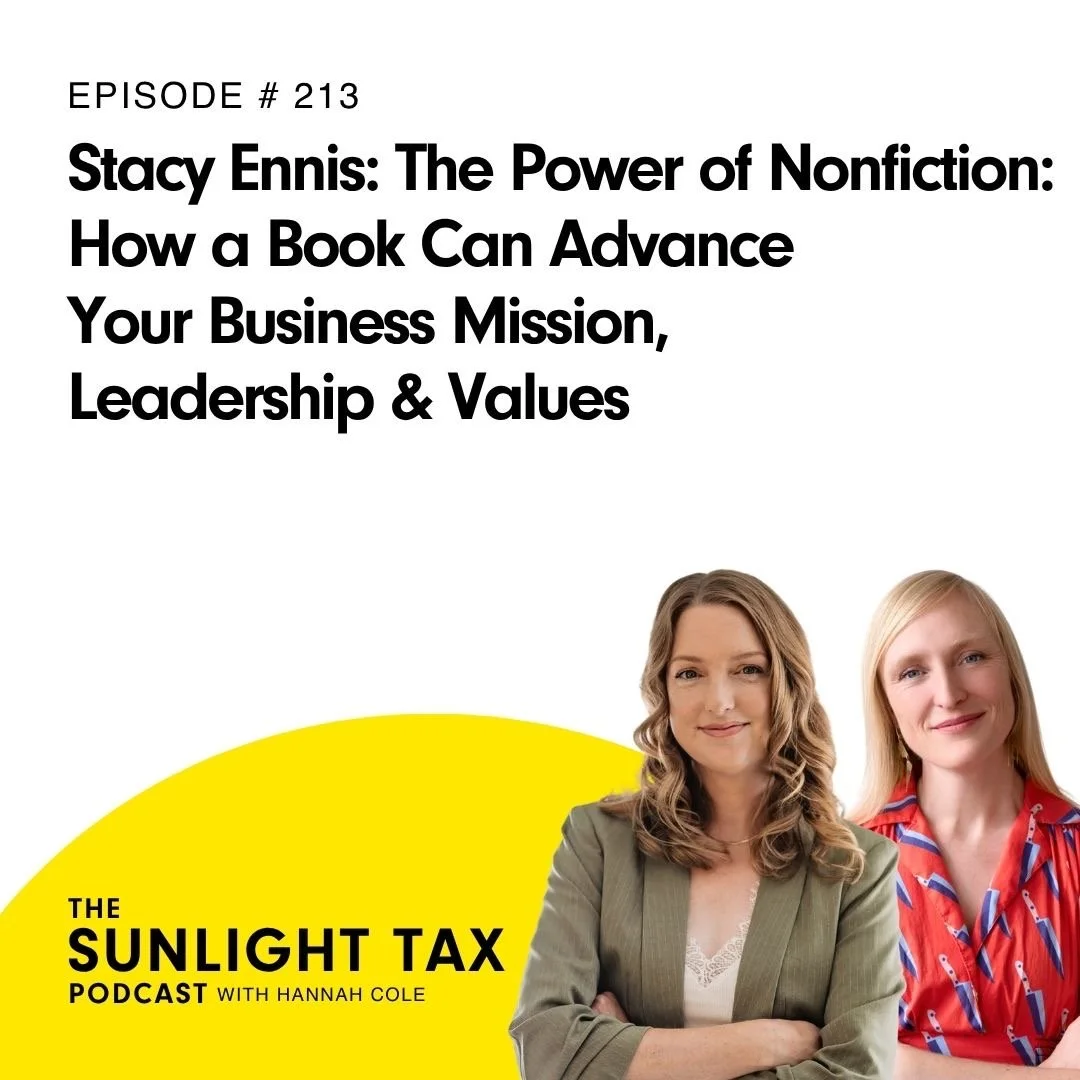
In this episode of the Sunlight Tax Podcast, I sit down with Stacy Ennis to explore what it really takes to write and publish a nonfiction book that grows your business, strengthens your brand, and creates lasting impact. We discuss the publishing process, book coaching, traditional publishing vs. self-publishing, and why integrity, strategy, and a clear message matter more than simply getting a book into the world.
Stacy shares practical insights from years of helping authors craft books that not only sell, but also make a meaningful difference—offering valuable guidance for anyone considering writing a business book or becoming a published author.
Also mentioned in today’s episode:
00:10 Introduction to Stacy Ennis and her background
01:00 Stacy's journey from childhood reading to publishing expert
02:36 Her experience in publishing and ghostwriting
03:24 Working with authors with a bigger mission
04:49 The ROI of writing a book and trust building
05:56 Trusting Stacy's expertise after a trust-breaking experience
07:43 The importance of mission and impact in writing
09:04 The strategic value of a book for influence and marketing
10:33 Shelf life and longevity of well-done work
12:24 Reflections on the author journey and publishing routes
14:36 Exploring traditional, self, and hybrid publishing
16:36 The evolving landscape of publishing and author education
18:24 Why hybrid and self-publishing are viable options
20:28 The role of a book in business, trust, and influence
24:18 The transformative process of organizing ideas
27:37 The impact of writing on personal and business growth
28:58 The importance of creative health and deep thought
31:16 Rebuilding self-trust through the writing process
32:44 The societal and professional importance of authorship
33:01 Stacy's resources and podcast
If you enjoyed this episode, please rate, review and share it! Every review makes a difference by telling Apple or Spotify to show the Sunlight Tax podcast to new audiences.
About Stacy Ennis:
Stacy Ennis is a best-selling author, book coach, and speaker on a mission to help leaders clarify their ideas and harness their unique story to make an impact. Her background includes impacting more than 100 books in her 17-plus years in publishing; ghostwriting for a Nobel Prize winner in medicine; and leading as executive editor of Sam’s Club’s Healthy Living Made Simple, a publication that reached around 11 million readers. Stacy’s work and writing have been featured in Yahoo!, Inc., Insider, Publisher’s Weekly, Katie Couric, and the TEDx stage. Stacy is also the host of the podcast Beyond Better and holds a master’s in writing and editing from the University of Cincinnati.
Check Out Stacy Ennis’ Work:
10 Things You Should Know Before Writing a Nonfiction Book free resource
Direct link to book a call with Stacy to chat about their book
Instagram @stacyennis
LinkedIn: Stacy Ennis
Study mentioned on the episode
Episode Links:
Check out my program, Money Bootcamp
Get your FREE visual guide to tax deductions
Order my book: Taxes for Humans: Simplify Your Taxes and Change the World When You’re Self-Employed
Transcript:
Hannah Cole (00:07)
Stacy, welcome to the Sunlight Podcast. Stacy Ennis is a best-selling book author, book coach, speaker on a mission to help leaders clarify their ideas and harness their unique story to make an impact. Her background includes impacting more than a hundred books in her 17 plus years in publishing, ghostwriting for a Nobel Prize winner in medicine.
And leading as executive editor of Sam's Club's Healthy Living Made Simple, a publication that reached around 11 million readers. Stacy's work and writing have been featured in Yahoo! Inc., Insider, Publishers Weekly, Katie Courick, and the TED X stage. Stacy is the host of the podcast Beyond Better and holds a master's in writing and editing from the University of Cincinnati. Stacy, welcome to the Sunlight Tax Podcast.
Stacy Ennis (00:56)
Thanks, Hannah. I've been really looking forward to talking with you.
Hannah Cole (01:00)
Yay, me too. What a delight. Will you just give us a little bit of the journey? Like how we've we've heard your bio and where you are now. Can you tell us a little bit about that journey and how you got to where you are today?
Stacy Ennis (01:15)
well, like most people in publishing, I have a a love story with books and writing that started when I was seven. with reading The Chronicles of Narnia. That was my like fall in love with books series. of course The Babysitters Club, all kinds of different books that at the time I didn't really realize this, but growing up in Boise, Idaho, which people call Whiteho, it's 87% white, very affluent.
It was a very homogeneous space to grow up and my books gave me a sense of the world. It helped me develop a mindset beyond where I was, empathy through other people's stories. So it was kind of my first world exploration was through reading books. And you know, fast forward a long time, I went and got my bachelor's in in writing. And then shortly after that, my husband and I moved to the Dominican Republic. We weren't
married at the time, but we moved to the Dominican Republic and then Vietnam, came back and went to grad school for writing and editing. And along the way I was I started working in publishing. I as you mentioned I I ghostwriter for a Nobel Prize winner for four years. I also used to run Sam's Clubs magazine, Healthy Living Made Simple. We had about 11 million readers. I was executive editor of that publication, which of course was a a huge and important role and taught me so much about the publishing industry.
and so I've spent most of my career in well, I spent all of my career, I should say, in the written word in some capacity, and as an editor, as a ghostwriter, and today as a book coach. So I I work with authors or future authors who want to write a nonfiction book. That's a space that I operate in. And I would say, you know, particularly in work with authors that have a vision beyond the book. So
The book is not their end all be all goal. They have a reason they're putting this book out into the world, whether it's a business goal or a social mission or something that's bigger than the book. And I get to work with really amazing people. It's it's the coolest work.
Hannah Cole (03:24)
I love it. I agree with you. It is. and I've noticed because I am in your membership program, the author's influence circle, and the other people in there are really cool. Like everybody is trying to make the world a better place in their from
Stacy Ennis (03:37)
Yeah.
Hannah Cole (03:37)
their specific vantage point and that makes me thrive.
Stacy Ennis (03:42)
Yeah, and the and they're actually doing things to do that. You know, like they're out there, you know, doing their good work, whatever shape that takes in the world. And I think that is a a real hallmark of the kind of clients that I love to work with. They're action takers, they're big dreamers, but they're not just talking about what they'd like to do. They're actually taking action toward toward their dreams and their bigger vision.
Hannah Cole (04:07)
Mm, I love it.
So Stacy, I did mention this in our session together, the ROI of writing a book. But I do wanna just say for those people who are listening to the podcast and weren't in that session, by the way, if you wanna get
the recording for that ROI of writing a book. If you just join my Substack, it's free for subscribers. So you can either send me a note through Substack that you're a subscriber and you'd like that recording, or you can send an email to hello@sunlighttax.com So everybody who missed the ROI of writing a book session with Stacy, you're so welcome to have it. Okay, so what I wanted to say is just like I had this experience with you, Stacy, that I want to say to everybody because
It made it really made me trust in your expertise, like trust in your deep wisdom. You're n not only are you an incredible writer, I mean you cannot how many books have you written? Seventeen.
Stacy Ennis (05:01)
Yeah, eight
eighteen. Yeah. I'm working on the nineteenth right now. Yeah.
Hannah Cole (05:05)
Good Lord. yeah, you can't do that without being
of a not just a good writer, but somebody who's really mastered the process, right? but I had this experience because I had a book deal, I suddenly had a book deadline, super exciting, and I went out and I hired a book coach just on somebody's recommendation. She was kind of new and a little green, I think.
and I had an awful experience. I'm not gonna name her, but I had an awful experience, very trustbreaking, very yucky. and I called you Stacy because you know, you you had a lot of experience, and I just I had like an SOS call with you. And I just want to say for everybody listening, like Stacy's generosity was unbelievable. She was just like, just there to kind of hold my hand through one of frankly many.
book crises. and it was so evident to me that not just is she a fantastic writer, but that she really knows the publishing world and the book writing journey and process and also the strategy around like placing your book in the world. and I just can't tell you how held I felt by just that SOS call with her, which is why I then joined her membership. And like, so I just wanna, I just want to put that out there because I really think you're
Work is incredible, Stacy.
Stacy Ennis (06:24)
Thanks, Hannah. I don't even know what to say, but thank you. That was so kind.
Hannah Cole (06:30)
yeah, no, I think it I think it's important. I mean, I know y you have to build your own trust with people, but I really do feel like, wow I I like saw you when it was hard for me, through a crisis and and it mattered. It made a difference.
Stacy Ennis (06:44)
Maybe, you know, one thing I'll I'll layer into that experience. yeah, I'm sorry that you had experience with the the first coach and I think that like this is a problem in our industry that we have a lot of people out there that are not qualified really to be guiding people on these journeys or make kind of big
promises or just give bad advice. And that's not the standard. Like like most places, most people have really good intentions and care a lot. But it is it is tough when you have those experiences and
I think that that's why conversations like this and the episode that you did also on your journey, Hannah, which you you published a little bit earlier, these types of things that we're doing are so important for people that are considering this journey so they can avoid some of what you went through. But then I also just wanna lift up your resilience and like ultimately with your work.
you came back to your service through your work. And I think that's what really held you through that period because this is why I mentioned at the top, I work with authors whose end goal is not the book. The the the go the book is a a vehicle, a catalyst to do something in the world.
And I
Hannah Cole (08:00)
Mm.
Stacy Ennis (08:00)
think part of why you were able to, you know, dust yourself off and find your way forward is because you had a mission that was bigger than that road bump.
Like you were going to traverse that road bump because you cared deeply about the reader on the other side of that. And you cared so much about making it useful and excellent. And that's the that is really what
makes a great book at the end of it. Of course there's people that support you and guidance you can get, but I think that the mindset that you had is ultimately why your book ended up becoming great at the at the when all is said and done.
Hannah Cole (08:41)
I appreciate that so much. you know, I really I felt like going in. You tell me how good this strategy is, but my strategy going in was like, I'm not Michelle Obama. I do not have a massive platform. It's gonna be uphill the whole time to kind of get the word out about this book. PS is still available and it's still great. Everybody.
Stacy Ennis (09:04)
Yeah.
Hannah Cole (09:05)
but I just figured like
really my best friend in this process, the only way this book was really gonna do as well as I think it deserves to do is if it was so good that people would want to tell their friends. And so I
Stacy Ennis (09:20)
Yeah.
Hannah Cole (09:20)
really felt focused on this has to be the best book to teach a self employed person how to manage their taxes, like how to set up their business and like not get tripped up by the IRS. so that
Stacy Ennis (09:32)
Yeah.
Hannah Cole (09:33)
that really was my vision and
Yeah, it just was like I wanna be able to also like when you're marketing and doing the sales stuff, if like me, that's not your favorite part of the company you run.
Stacy Ennis (09:47)
Why ever not?
Hannah Cole (09:50)
I feel like I do a much better job marketing something that I know is actually the best, right? And so I just wanted to be able to feel that way about my book, which I'm ha happy to say that I do. But I don't know, you
Stacy Ennis (10:05)
That's huge.
You gotta be in love with the the work or else you're not yeah, you're not gonna wanna show up. And I think just to feel really proud of what you did is important, an important result of all of this. And your book, I mean, I know tax code changes, so there's probably gonna be updates and iterations that you'll provide, probably also on your website, which is a great way to keep people engaged with your platform. But even, you know
Even books that have some aspect of them with a shelf life can serve you for so long. I just, my co-author Ron Price and I just won an award, I think it was either earlier this year or the end of last year, for a book that we published in 2018. So I mean it gives you a sense of
Hannah Cole (10:51)
Wow.
Stacy Ennis (10:52)
the the longevity of well done work. If you really focus on the reader and creating something meaningful and impactful and excellent.
Like it has longevity and shelf life and, you know, continued work to do out in the world well well beyond you.
Hannah Cole (11:09)
Hm. Yeah, I appreciate that. Also, congrats on your award. How exciting.
Stacy Ennis (11:13)
Thanks. It was so cool. I was like,
wow. You know, it was very unexpected.
Hannah Cole (11:18)
That's awesome. Yeah, I did a lot of strategizing about how to write an Evergreen tax guide. I didn't I knew I didn't want it to go out of date in a year and it does not. I
Stacy Ennis (11:26)
Yeah. They need some shelf life.
Hannah Cole (11:28)
yeah, it needs shelf life. So I put QR codes to get the updated number on every single thing where I actually name a number. I give ballparks where it's not necessary to give an exact number. So it is evergreen.
Stacy Ennis (11:41)
It's wonderful.
It's so smart. And I it's especially in the financial space, that's very hard to do.
Hannah Cole (11:47)
Mm-hmm.
Stacy Ennis (11:47)
but you you know, you approach that really thoughtfully. It also brings people into your ecosystem so you can serve them better through, you know, a future book or future offerings or anything that comes up.
Hannah Cole (11:59)
For sure. So tell me, I it y I know you listened to my episode where I talked about how I broke down the like the author journey of publishing a book. And you know, of course I'm an I'm an experience of one and you have experience. You have so much more exponentially more author journey experience. So I'm kind of curious reflecting on my interpretation of that journey, what you would what you would add to it.
Stacy Ennis (12:24)
Hmm. I listened with great interest. I was very interested in hearing your experience and you know, insights from there there is something to be said also about having been in this so long and having such a wide range of experience that I n will never get to approach it for the first time again. Like you get to have that experience. So I also get to learn from you in in your journey and your experience. It helps me help.
other authors as well. So I got a lot out of it. I highly recommend everybody to go listen to that. I think that the layer that I would maybe add to your experience is that you took the traditional publishing route. And that is definitely not all that's available for authors to to consider as their pathway to publishing. And I would particularly highlight underrepresented authors. We have a very white
not very diverse industry that gatekeeps books. And although there's been a lot of growth and change within publishing, it's still a very antiquated industry like many are, and has a lot of room to grow. So, you know, authors of color, queer, disabled authors, you're just gonna have a harder time than like a white female or a white male who's out there
Trying to get picked for these opportunities. And so I I think that it's really important for authors to know that the gates can be opened by you through different routes. And yet, while we have more access through self-publishing and hybrid publishing, you as an author, especially if you're not working with a really reputable publishing partner like a hybrid publisher.
you now need to take on many of the things that Hannah talked about, that Hannah that you talked about in your episode, around your positioning, really understanding your reader, your market research, your planning. And where I see a lot of authors frankly quit or fail is that they don't do a lot of that early planning outlining. And part of what a book proposal can be really useful for is that planning process.
Hannah Cole (14:36)
Mm-hmm.
Stacy Ennis (14:36)
It's not
always necessary to do that f in the way that you did it, Hannah, if you're going the self-in hybrid publishing route, but you do components of that to prepare yourself for the writing process. So I think that that's just one layer I would add is that there's other routes that you can take. It doesn't have to be the traditional route. Certainly there are pluses to that. There's also minuses to the traditional route, pluses and minuses to self-publishing and hybrid publishing, which is
You know, if that's a new term for people, that's like a kind of middle ground between traditional publishing and self-publishing, where you pay a partner publisher to produce your work. So they are really creating the product, often engaged in the marketing. so there's a lot of routes and I I think that that might be something that's an interesting layer to dig into.
Hannah Cole (15:27)
Yeah. you know, that wasn't my experience, but a lot of people in the author's influence circle which you run are are approaching it that way. And you have a lot to share on that. So I will like those of you listening who resonated with Stacy's message about, you know, if you're hi in a historically marginalized group or just maybe the economics or time, of a book feels
scary to you, I definitely recommend that you go look on Stacy's website and poke around at what she offers because she's really good at this, like, you know, laying out what the journey looks like for the different types like hybrid and self publishing, which are definitely viable viable options and becoming more viable. Would you say
Stacy Ennis (16:09)
Mm-hmm.
Hannah Cole (16:09)
that's correct?
Stacy Ennis (16:11)
yeah. I I recently did a an interview on my podcast, which you've been on, Hannah, Beyond Better. And I interviewed Emma Lowe, who's the director of the London Book Fair, which is one of the largest industry conferences in the world. And one of the things that I thought was really interesting about this fair that I attended back in March, and we talked about on the episode, is that they they have this whole author education.
Component of the London Book Fair. And as part of this kind of wider trade show that they do, they provide author education and they had a lot of authors on stages. They had a lot of education around publishing. What I thought was really interesting is that they had many self-published authors on stage alongside traditionally published authors. Many of them had started traditional and went self-publishing, which I thought was very interesting that they
Hannah Cole (17:03)
That
is.
Stacy Ennis (17:04)
And I really appreciated the way that they gave the space to vr a variety of publishing routes because, you know, especially with a trade show like that that's for it's a deal making conference for traditional publishers. Like that is the the heart of it, especially for translation rights. So by all, you know, accounts, they have every right to highlight and focus on traditional.
But self-publishing, hybrid publishing had a big imprint there. Like imprint, I I guess is a publishing term, but I mean like in a different way. you know, they had
Hannah Cole (17:37)
Yeah. Yeah.
Stacy Ennis (17:40)
a big footprint and were very visible. And in fact, Ally, which is an independent authors organization, ran that whole stage. So I I think that it's, you know, it it's growing, but it's also becoming a preferable route, actually, especially for
genre writers, which Emma mentions in that podcast episode, but for nonfiction, definitely, because a lot of the authors I work with have an integration in their business. And there's a lot of things that you don't get to control in the traditional route. And the time to market is very, very long. So if you have some, you know, business or brand or social impact growth goals, they might not want to wait three years to get the book out into market. They'd rather
you know, take it into their own hands and work on more of like an 18 month timeline, let's say. So there's, you know, there's again always pros and cons. And there's never one right route that I could say is like, this is the way I recommend for every single person. Budget comes into play, goals come into play. you know, do you have like the interest in exploring the traditional route? And like,
Hannah Cole (18:49)
Mm-hmm.
Stacy Ennis (18:49)
is that exciting to you?
And and
Hannah Cole (18:51)
Yeah.
Stacy Ennis (18:52)
if it is, then and you want to go that route, that's wonderful. But I also recommend that people put parameters around that and have a mindset of I'm gonna do this no matter what, like I'm gonna get this work out into the world no matter what. Because if we're always just waiting for somebody else to deem us worthy or to give us an opportunity, like what? We have so much availability to us now to be able to create our own opportunity and and to put our own work out into the world.
Hannah Cole (19:21)
Yeah.
Stacy Ennis (19:22)
so I I just like authors to know that that there's a lot of routes and one is not better or more worthwhile than another. and that you can explore all the different ways to get a book out.
Hannah Cole (19:37)
That's awesome. So to the person who's listening to this who doesn't identify as a writer, but who's, you know, a thought leader, somebody who's built some expertise in their business, presumably serving a population, kind of like me, right? I didn't identify as a writer, but I do a lot of writing and I do have a mission and a thing to teach. Like I think there's a lot of people like that where they might play with the idea of a book, but they feel very uncertain kind of
Does this make any sense? Does it make any sense financially? Does it make any sense like audience wise or business wise? So one of the things I love about you, Stacy, is how you are able to kind of place that within the ecosystem of a business, of somebody who is kind of a leader in their field. Can you talk a little bit about like what kind of a role a book can play and and ROI in terms of yes, money, but audience or other benefits?
Stacy Ennis (20:28)
Yeah, yeah. it's interesting. I I'm prepping for presentation I'm going to provide a speakers group tomorrow. And as
Hannah Cole (20:36)
Mm-hmm.
Stacy Ennis (20:37)
part of that prep I I always like to see what data points I can bring in because that can be really useful. And I came across this report, the name of the the company that did the the
analysis is escaping me, but I can send it to you later, Hannah. Maybe we can link to it if you if you want to. But it's
Hannah Cole (20:53)
Yeah, I thought.
Stacy Ennis (20:54)
on visible experts. So the idea of a visible expert is it's somebody that is, you know, out there creating in a visible way. So they're becoming known in their space. You would be a visible expert, I think, from their definition. And they had these two charts. One chart is most popular marketing things that they do. So it's like
this list of, you know, social media, speaking, referrals, all of these things. And at
Hannah Cole (21:22)
Mm-hmm.
Stacy Ennis (21:23)
the very bottom is writing a business book. Like that was or writing a book on their topic or something like that. The bottom of popularity. But then they had a chart of most effective marketing strategies. And number one was speaking and number two was writing a book on your topic.
Hannah Cole (21:44)
Amazing.
Stacy Ennis (21:44)
and the referrals
were three, I think, in that list. And so while I think in the original list it was like social media was pretty high up, and these other these other things that are maybe a little easier, a little more accessible, they are not the necessarily the most effective when they surveyed this group. I think it was two hundred and fifty visual visible experts. And I thought that was such a cool
data point because it's like anything else. Often the thing that is the effort, it's the bigger thing that's the heavier lift. they're really unpopular. Not everybody wants to do it or will do it. Maybe they want to, but they won't follow through. we know that, you know, about 80% of people want to write a book, but less than 1% of people actually do. And so I think that, you know, a book is such a
Completing and publishing a good book, I think that that's a really important note there. It has to be a good quality, well-done book, can be
Hannah Cole (22:44)
Mm-hmm.
Stacy Ennis (22:45)
such a powerful differentiator for you as whatever you are, a coach, a consultant, a creator of some kind, a service provider, you know, whatever you're out there doing in the world.
so there's there's that one piece from a
just simply a marketing perspective. We know that it's effective and it's long-term effective. It's it has a much higher shelf life, as you know, we talked about that earlier, than a viral reel or even a s a a really great workshop or talk. You have to keep delivering those over and over again as marketing strategies. But a book,
Hannah Cole (23:17)
Mm-hmm. Yeah.
Stacy Ennis (23:19)
of course you have to market it, of course you have to do the work of getting visibility around it, but it's completed and it's out in the world.
And so there's these pieces that we know a book can deliver. Status, I hate I hate might be a strong way, I strongly dislike that this is part of our human experience, but it is. And we as humans take in signals about people to decide if we can trust them. And a really strong trust status symbol is an author, because you've done that work. it is an access point to rooms and stages that
would previously be hard to get into because you lack that status. there it can be used as a marketing tool, a lead gen tool, you know, podcast pitching tool. Like there's all these things that you can do to really leverage it. And we know
Hannah Cole (24:04)
Yeah.
Stacy Ennis (24:04)
all that stuff, but I I think that the thing that gets talked about less or maybe is less well known is that the experience and journey of organizing your ideas
Not just to organize your ideas, but then translate those in a way that other people can understand, remember, and use. That is a process that you grow in such a deep and profound way and you arrive on the other side of this changed. You you're clearer, you're more confident.
Hannah Cole (24:38)
yeah.
Stacy Ennis (24:39)
Yeah, I'd love to hear from you, Hannah, if that was your experience with your work.
Hannah Cole (24:43)
Yeah, I mean it's the workout of your life. I mean, I kept thinking of it
Stacy Ennis (24:46)
Yeah.
Hannah Cole (24:47)
in terms like that. Like I I I do weight training. I've been like
Stacy Ennis (24:50)
Love that.
Hannah Cole (24:51)
and it it is that it is like you can't do it all in one day. It is a way bigger project. Like you're kind of building your strength over daily writing or or weekly, you know, I mean your pace is your pace. But yeah, it's it's strengthens what you are already expert in. It strengthens and clarifies and
I think I remember a business coach, somebody huge, like Alex Hermozzi or something, was talking about like a little metric of like what you should do in your business. There's like high impact, easy to do, high impact, hard to do, low impact, easy to do, low impact, no impact. you know, doesn't do anything for you. So obviously we forget that quadrant altogether. And he's like, Well, as a business owner, what's left for you?
You've already done this stuff that's high impact and easy to do. The only thing left is either to go to things that won't move the needle or to start doing the hard stuff. Like, and so like
Stacy Ennis (25:49)
Mmm. that's so good.
Hannah Cole (25:51)
high impact, hard to do is something that separates you from the pack. I mean, it is easy to put up an Instagram reel, relatively speaking. And it is not easy to write a book. So of course it's a differentiator.
of course it tells people you're serious, you're committed, because you you can't, you cannot write a book without that. Not to mention the book process itself makes you better at what you do.
Stacy Ennis (26:19)
Yeah, a hundred percent all of what you said. And I and I I think that, you know, because also it's a long journey of introspection and and particularly in this time that we're in globally with the you know AI and all of that, I won't I'm not gonna take us down that rabbit hole. But you know, it is a trained intentionality. Like you have to really show up in deep thought.
And you have to sit with your thoughts and you have to work through those thoughts. And and this is if you do it with with integrity, if you go through this process with integrity, because we now have tools that can steal some of your integrity and your creative process. but if you go through this process with integrity and with a real quest of service and creating something lasting and meaningful and useful and
You know, Hannah, in your episode that you recorded, you talked about, you know, not wanting it to be a big long sales book that's like just sending people to all the things you sell, really making
Hannah Cole (27:19)
Mm-hmm.
Stacy Ennis (27:19)
it an all all contained useful thing. Like that is hard work. That is not an easy thing to do. It requires so
Hannah Cole (27:28)
Mm-hmm.
Stacy Ennis (27:28)
much thought. And so that process of thinking and organizing, I imagine that also impacted other things that you do in your business.
Talks that you're giving, interviews you're giving, maybe I don't know if you've grown any new products or any new like service items out of some of that thinking I I or maybe will. but
Hannah Cole (27:47)
Yeah, a little.
Stacy Ennis (27:48)
that's like it's a seedbed for growth for other personal and and business and brand growth.
Hannah Cole (27:54)
Yeah, absolutely, absolutely true. I think you know what, like just to speak to this moment that we're in right now, one, I think we're in a trust recession. I didn't invent that term and I can't attribute it, but the internet says this.
Stacy Ennis (28:10)
Okay.
Hannah Cole (28:11)
I think a book is a really nice antidote to the trust recession. Like it just takes so much commitment to write one and integrity. I mean, yes, if you if you do it the right way.
That it is in part an antidote to that trust thing. Like you build a trust with someone as they read your book. and I also just want to say on a personal note, like as AI creates all this slop and shallow thinking, I think this is why I feel so attracted to authors and writers lately. I'm a mega reader. Anyone who is
follows my substack knows that I like recommend a book every week and you can tell I'm reading a book a week. But like I'm so attracted to reading and to authors because it's a place for deep thought. It's a place for integrity.
Stacy Ennis (28:58)
Mm, mm-hmm.
Hannah Cole (28:59)
It's a place for like deep, deep human connection. and I don't know about you, but more than ever right now, the AI era is making me more into books because of that.
Stacy Ennis (29:10)
yeah, for sure. And I've definitely the last six plus months I've really moved away from a lot of I mean, I'm still on all the platforms and doing all the things, but I the the the what was it? You said trust recession? Is that what you said?
Hannah Cole (29:25)
Trust your session.
Stacy Ennis (29:26)
That's so good. interestingly, I'm I've been I'm prepping for
a conference later this year here in Portugal. It's called Book 2.0. And I'm moderating a panel. And I was just chatting with Matt of, he founded the London Writers Salon, and he brought up this term called creative health, which is not a term that I'm familiar with, but it's something that apparently a lot of people are curious about and studying and interested in.
And I I love that as a concept because I think as we, you know, we think about all of these areas, mental health, physical health, spiritual health, creative health, it's a real thing. Having space in your day and your life for creative, thoughtful work, I think to your point now more than ever, and as we, you know, it's also like
I think that some authors, future authors, aspiring authors, are are also in maybe a self-trust recession because they're outsourcing so much of their thinking and creative work that they don't trust themselves to create with their own brains anymore. And
Hannah Cole (30:32)
You're so right.
Stacy Ennis (30:34)
So this is something that I'm I'm I'm having calls with a lot of authors who are really nervous about the way that I work and the my guidelines around AI. I and I on pretty much every call, I'm like, listen, not every call, but a lot of them. Listen,
Hannah Cole (30:50)
Mm-hmm.
Stacy Ennis (30:51)
you've been using your brain and only your brain for decades. We have been writing books and creating we've been telling stories for 30,000 years. And we are
capable of creation and in fact your beautiful human brain is completely powered to do this all on its own. And I think that
Hannah Cole (31:15)
Mm-hmm.
Stacy Ennis (31:16)
some of this process of writing a book or whatever it is, creating whatever it is in the world, we're rebuilding that self-trust, like that is just a foundation of self-belief. And yeah, it's important. It's important.
Hannah Cole (31:32)
That's
that's beautiful. I mean, again, strength training has is my metaphor for everything in life, but I would you go to the gym and put your weights on a forklift and have the forklift lift the weights for you? Like you can recognize how that
Stacy Ennis (31:43)
No, no, you wouldn't you'd atrophy. Yeah.
Hannah Cole (31:46)
is not going to build muscle for you. Like
Stacy Ennis (31:49)
Yeah.
Hannah Cole (31:50)
the way to build the powers of your brain is to do the powerful work. Like and it's hard. Like that's the whole point. That's why not everybody does it.
Stacy Ennis (31:59)
And the people that do are the people that are going to outlast all of the
kind of hardships that we are seeing in AI. I think the people that will stay the course and do
Hannah Cole (32:10)
I agree.
Stacy Ennis (32:10)
the thinking, they're going to lead what will be, and I think already starting to be a creative revolution. So I think that there's not just, you know, the virtue of the work, but I think there's a real like professional imperative, a societal imperative, like this is all
it's important. And I think that a book is a very practical expression of that. Like it's a project that you can do that taps into all the things that we're talking about and it also moves your business forward. Like it's
Hannah Cole (32:44)
Yeah.
Stacy Ennis (32:44)
kind of the perfect project in my view. it contains a lot of things.
Hannah Cole (32:47)
my gosh, Stacy creative revolution, the antidote to
what ails society right now. Like, let's leave it there. We can't do better. Amen. I love it.
Stacy Ennis (32:53)
Yeah.
Hannah Cole (33:01)
I I so agree with everything you said. I don't feel like I can do any any better than you just did. So thank you.
Stacy Ennis (33:08)
Ha ha
Hannah Cole (33:10)
Beautiful. And I agree. I'm on this team. Stacy, I I want to point to the session that we did together, and let people know that if if you're interested in hearing Stacy's wisdom, getting down into the nitty-gritty numbers, into the self-publishing thing, to the actual writing journey, if you're starting to think, maybe this is like something I wanna look at.
They can get that the recording of our session by just you just have to be a subscriber. You can just be a free subscriber or paid to my Substack Taxes for Humans. Send an email to hello@sunlighttax.com and just say you want the recording or send me a note on Substack. But with that said, knowing that people can get that, I also want people to just hop on your website, take a look at what you offer because you're really brilliant in many areas.
And I think you've definitely given people a taste of why maybe they might be interested in that. So Stacy, where can people find you?
Stacy Ennis (34:06)
thank you, Hannah. You can find me at stacyennis.com at Stacy with no E. and if you go to stacyennis.com/10things that's the number 10, I have a free guide that you can download, fully created by me with no AI.
that really will give you an overview of things that you need to know before writing your nonfiction book. And this is a guide that has helped so many authors. Even if you don't work with me, I would love for you to get this because it's gonna give you, you know, a really solid foundation. It's like a quick and dirty download of of 10 things that you should really know go before you go into this journey. and I'm also on Instagram at Stacy Ennis and on LinkedIn.
Hannah Cole (34:45)
Lovely. And also your podcast is great, Beyond Better. lots of
Stacy Ennis (34:48)
Yes, and I had a great
episode with this amazing woman named Hannah Cole. So they can go listen to that one.
Hannah Cole (34:54)
Yeah.
Lovely, lovely. It's a great place to explore topic by topic. Stacy, it's just you're brilliant and wonderful. I love the work you're doing. And also like you're serving people who have a mission in this world, help them get their voice out there. That's what I think of myself as doing on the money side. And so I feel very aligned with you and I love the work you're doing. So thanks for being with us today.
Stacy Ennis (35:18)
Thank you, Hannah. I really appreciate the opportunity to connect with your people through this podcast and just through your partnership and collaboration and helping make the world a better place.
Hannah Cole (35:30)
Yeah, let's make great people help great people do great work. Awesome. All right. Well I will see you again in your in your membership and thanks for being here.
Stacy Ennis (35:41)
Thanks, Hannah.