

THE SUNLIGHT TAX BLOG:
Tax and Money Education for Creative People, Freelancers and Solopreneurs
search A TOPIC
Categories
- Business Management 22
- Creative Specific 3
- Estimated Quarterly Taxes 8
- General Economy; Tax Policy and Legislation 52
- Get to know Hannah Cole 8
- Interviews and personal stories 36
- Personal Finance 26
- Personal and Career Development 22
- Practical and Tactical Tax 57
- Retirement and Future Success 28
- Sunlight Podcast 149
- Tax Deductions for Freelancers and Self-Employed 9
- the Sunlight Tax Podcast 67

Don't Forget These Deductions: Parking and Tolls
Listen and Subscribe Here
This week on the Sunlight Tax podcast, I’m chatting about another commonly missed tax deduction for self-employed individuals: parking and tolls. I’m diving into how tolls and parking should be tracked separately and added to the car expense category on tax schedules so you can get the deduction you deserve.
Join me in this episode to get some practical tips on how to easily track your parking and toll expenses for this upcoming tax season.

Listen and Subscribe Here
This week on the Sunlight Tax podcast, I’m chatting about another commonly missed tax deduction for self-employed individuals: parking and tolls. I’m diving into how tolls and parking should be tracked separately and added to the car expense category on tax schedules so you can get the deduction you deserve.
Join me in this episode to get some practical tips on how to easily track your parking and toll expenses for this upcoming tax season.
Also mentioned in today’s episode:
2:26 Tracking parking and tolls separately from mileage
2:44 Methods for tracking car expenses
4:30 Practical tips for maximizing your deductions
If you enjoyed this episode, please rate, review and share it!
Every review makes a difference by telling Apple or Spotify to show the Sunlight Tax podcast to new audiences.
Episode Links:
Sunlight episode on tracking mileage deduction
Get your FREE visual guide to tax deductions
Check out my 2-day Business Intensive
Order my book: Taxes for Humans: Simplify Your Taxes and Change the World When You’re Self-Employed
Transcript:
Hannah Cole (00:44)
Hello. Last week I talked to you about one of the business expenses that people often forget to get a deduction for because it does not show up in your bookkeeping, right? So it's something you have to proactively remember to put into your taxes at tax time. This week I'm coming at you with another one of these, which is parking and tolls.
So this is just a small deduction, but it is extra money that you might be missing. So listen up. When you track mileage, you're allowed to take a deduction for the expense of your car for business travel in your business. And business travel is one of those things. Using your car, it's one of those situations where you very likely, if you work for yourself,
Do not have a car that you just bought for the business and that is only used for the business, right? Only a much larger company is gonna have a setup like that. You, when you're self-employed, you're doing business travel in your family car, in your personal car, right? So it's a car where you also do grocery trips and go visit friends, but it is the car that you use to take your business trips as well. So for that reason.
There are some special rules around mileage and business taking a car expense. And I have an episode which I will link in the show notes for you about taking that mileage deduction. It's a really great deduction, highly recommend. But the really important thing to note is that when you take a mileage deduction, no matter which method you use, so whether you use what's called
The actual expense method where you actually save every single receipt, you know, oil changes, gas, everything for your car, and you take a portion of those actual expenses based on the ratio of business miles to total miles that you drove for the year. That's called the actual expense method. Or if you do the usually much better one called the standard mileage rate, where you just track your business miles and you
Multiply that times a government set rate every year. If you're using that mileage method, that accounts for the full cost of operating your vehicle, including depreciation, including insurance, including gas, all of it. So it's a it's a very generous deduction. But regardless of which method you use and how you're tracking your miles, I want you to know.
That parking and tolls for your business are actually tracked completely separately and outside of the number of miles that you drive. So, regardless of which method use to track your car expenses in your business, I want you to set up a separate way to track your parking and tolls. Because after you calculate the deduction that you get using either the standard business mileage method,
or the actual expense method, you get to add parking and tolls on top into that car expense category on your Schedule C.
So this is really nice, especially if you live in a place where, for example, you go meet a client in a big city. Parking is really expensive. So save those parking receipts, save your tolls or go through your Easy Pass record and note the tolls you paid when you were going on business trips. Because
That is just bonus money that you get to take on top of whatever mileage method you use in your business. All right. So just a little bit of a detail to help you get a few extra dollars out of your tax return this year.

Don't Forget These Deductions:Cell Phone and Internet
LISTEN AND SUBSCRIBE HERE
Today, I'm chatting about a commonly missed tax deduction for entrepreneurs: cell phone and internet expenses. I'm going over why these deductions are missed and how you can utilize them to get the most out of your tax return this year.
Join me in this episode to learn how to calculate a reasonable business percentage for these mixed-use expenses so you can maximize your allowable deductions and keep more of your hard-earned money.

LISTEN AND SUBSCRIBE HERE
Today, I'm chatting about a commonly missed tax deduction for entrepreneurs: cell phone and internet expenses. I'm going over why these deductions are missed and how you can utilize them to get the most out of your tax return this year.
Join me in this episode to learn how to calculate a reasonable business percentage for these mixed-use expenses so you can maximize your allowable deductions and keep more of your hard-earned money.
Also mentioned in today’s episode:
2:54 Calculating business percentage for cell phone expenses
5:50 Internet usage and business deductions
8:28 Tracking and documenting your personal expenses
If you enjoyed this episode, please rate, review and share it!
Every review makes a difference by telling Apple or Spotify to show the Sunlight Tax podcast to new audiences.
Episode Links:
Get your FREE visual guide to tax deductions
Check out my 2-day Business Intensive
Order my book: Taxes for Humans: Simplify Your Taxes and Change the World When You’re Self-Employed
Transcript:
Hannah Cole (00:00)
It can be easy to miss deductions when they aren't paid for through your business bank account. So part of your tax process every year should be creating a checklist so that you make a mental note to go back into your personal expenses and find the cell phone and internet expenses.
Hello. so today on the Sunlight Podcast, I want to bring you a deduction that is often missed by
Because it does not show up in your bookkeeping. So let's make sure you get every single dollar you're entitled to as you do your taxes this year.
And today I'm going to talk to you about your cell phone and internet expenses. Alright, so why do these get missed? First of all, your cell phone and your internet are part of a category of expenses called listed property. In other words, they are partly used for personal reasons, but
Partly used for your business. So in a case like that, you're never allowed to take the full amount of the expense as a business deduction. And also you're probably paying for your cell phone and your internet if you work at home, if you work for yourself, you're probably paying for them out of your personal account and not your business account. Now, if you have your business bookkeeping set up so that you do your bookkeeping off of your business bank statement.
Which is generally how I would recommend doing it. It can be easy to miss deductions when they aren't paid for through your business bank account. So part of your tax process every year should be creating a checklist that has things like cell phone and internet so that you make a mental note to go back into your personal expenses and find the cell phone and internet expenses.
All right, now taking those two expenses is not completely straightforward. So let me give you a little guidance so that you can get the most out of them. So for most of us, if you work for yourself, you use probably a cell phone and you probably only have one. So be careful here because that means that by definition, you use it in part for something personal. This means automatically you may not deduct 100% of your cell phone expense as a business expense.
But even with that said, you probably do use your cell phone for business, whether it's client calls, taking, you know, video that you're gonna use for social media posts for your business, et cetera. So the way that you calculate what business the way that you take a deduction for cell phone and internet is you calculate a reasonable business expense, a reasonable business percentage of your use.
And you deduct only that percentage of the total expense. All right. This is a little bit more art than science, but I'll just give you, you know, kind of the rough cut of how I myself assigned a reasonable cell phone expense to my to my business this year. So I have a cell phone plan that I share with my husband.
So automatically I can take 50% of the bill and say that wasn't my phone at all. That's definitely not deductible for my business. And then of that remaining 50% of our cell phone bill, some portion of my usage is personal, right? And so this might be a little bit tricky to figure out, but I can basically look at all the minutes, like the total minutes that I use the phone, and I can
Pull a report of all of the appointments that I've had, which I do by phone, all the appointments I've had with clients. So client calls, I can actually quantify those and I can look at that as a ratio. So I can see, you know, 40% of the time I spend talking on the phone is with clients, right? So I know right there that at least 40% of my cell phone usage is business purpose, right? On top of those client calls.
I also use my phone to, you know, film Instagram reels and make notes. you know, I actually outline my podcast on the phone in my notes app. and I do email and voice memos that I use in the business. So I might bump that percentage up to maybe sixty, sixty-five percent. And listen, this is not completely like down to the minute.
But it's a pretty good and pretty reasonable and also pretty conservative estimate of the amount that I use my phone for business. So I'm gonna take 65% of my half of my cell phone bill, because remember, one half is my husband's and not mine at all. So 65% of my half, and that's the percentage, that's the dollar amount that I'm gonna deduct for my cell phone, okay?
Now the internet goes the same way, and of course the internet could be completely different. I'll give you two different examples of types of businesses that might use a ton of internet and one that might use very little. So, me as a painter in my painting practice, I do use the internet very, very occasionally. You know, I might reference another artist's work, I might listen to an artist's interview, I might do some research.
I certainly will do emailing and correspondence and write grant applications online using internet. But as a studio artist who makes physical work, I am not using the internet like every minute that I make a painting. In fact, in general, my computer is away and out of the room while I'm working. So I'm not using the internet at all for most of my time. So in my painting practice,
Even though I do use the internet a little bit, the percentage is pretty tiny, okay, of business use. Often I don't even take that as an expense at all. Now, someone who might have a really high internet expense would be, for example, like a videographer, right? So if you are doing video work, you might be uploading and downloading massive files, and you might actually even pay extra to have a really fast, you know, a great high-speed internet.
Connection, right? So that in that case, you might be sending a lot of data, doing huge uploads. That might mean you have a very, very high percentage of your total internet that you use for business. Even with that, though, if you don't have a separate internet account that's dedicated for your business, then we still know that at least some percentage of your internet use is personal, right? At some point you're doing some online shopping.
You're watching Netflix. So in any case where you only have one of the thing, like internet connection or cell phone, you cannot take a hundred percent of that expense as a deduction because it's provably false. Okay. So even in that case, you might take 90%, 95% of the expense, but for sure you have to leave a little room for the fact that you have some personal usage. All right.
So I hope that that helps you kind of understand the logic behind calculating a percentage of your cell phone and internet usage, and also recognizing that because you may be paying for your internet and cell phone out of a personal account and not your business account, it might not show up in your bookkeeping. And you're gonna have to make sure to make a note for yourself to track it as a tax deduction on your tax return each year. All right.
As long as you do that, it's perfectly allowed. It's a perfectly reasonable business expense, and I hope you go out and get it.
Interest Rates Are Up: What That Means For You
Listen and Subscribe Here
This week on the Sunlight Tax Podcast, I’m discussing how recent interest rate hikes are affecting personal finance and the broader economy. I’ll share practical advice for managing debt, building savings, and navigating investments in a changing economic landscape.
Listen and Subscribe Here
This week on the Sunlight Tax Podcast, I’m discussing how recent interest rate hikes are affecting personal finance and the broader economy. I’ll share practical advice for managing debt, building savings, and navigating investments in a changing economic landscape.
Also mentioned in today’s episode:
00:10 Introduction to Market News and Interest Rates
02:07 The Power of Small Cohorts in Business Programs
04:36 Announcing New Business Setup Intensive Cohorts
06:39 How the Fed Uses Interest Rate Hikes to Control Inflation
07:33 Predictions for Future Interest Rate Increases
08:19 Implications for Personal Borrowing and Debt
09:32 Opportunities in Savings and Investment Accounts
10:54 The Importance of Investing to Combat Inflation
12:10 Promoting the Business Setup Intensive Program
13:21 Actionable Steps for Financial Health and Growth
If you enjoyed this episode, please rate, review and share it!
Every review makes a difference by telling Apple or Spotify to show the Sunlight Tax podcast to new audiences.
Episode Links:
Check out my 2-day Business Intensive
My upcoming in-person workshop with The Art Students League of New York
Get your FREE visual guide to tax deductions
Order my book: Taxes for Humans: Simplify Your Taxes and Change the World When You’re Self-Employed
Transcript:
Hannah Cole (00:07)
Hello beautiful. I'm so happy to be with you. I hope everything is good in your life. I have a little just a little reflection to share. I have been running this new program, this business setup intensive. And you know, it's so interesting and humbling and enlightening to run a new product or program.
you know, it's good to remember I have offered the same thing for a long time and felt very kind of locked in on all my processes. And I've really been changing a lot lately, learning a lot, interviewing people about what they need and want. And you know, it's such a humbling experience. and you know, I'm sure
I'm sure you've had this experience as well when you offer something and you're really excited about it and then you remember, right, I have to spend a lot of energy like marketing this, just like telling people what it is and what it's gonna help them with, right? Like that just takes a long time. It's humbling to remember how much effort goes in.
To that side of a business, you know, especially after you spend all this effort building a thing and you feel like, well, it's beautiful, it works so well, it's awesome. And you're like, all right, but I have to tell people about it. So that's been happening. the cohorts, you know, because it's brand new, have been very small. And think there's a part of me, maybe an older part of me, that would have been disappointed in such a small cohort. But I would say actually.
It's felt more like a learning opportunity for me and also just so awesome to be with a group of people that's tiny because you know, spending two days together, it's so personal. You know, I get to really like spend a lot of time working out the kinks of these individual people's businesses. So it's it's pretty great. my beta cohort, the sort of like first
version that I ever ran was a cohort of four people. Interestingly all who had a lot of experience. So they were setting up some ventures that were a little newer, but they had all this life experience, right? So that was pretty interesting. And then the cohort I'm running this week, and I'm actually recording this on day two of this second cohort, it's only two people.
inside. And I was a little bit like, you know, two people. I wish more people signed up. But on the other hand, I decided to run it anyway, not to cancel. and it's really lovely. These are two absolutely wonderful human beings. one is in real estate, which is you know, it's a it's a group of people that I have served before. I've actually been hired by real estate firms before to give
Tax workshops to their real estate brokers because real estates brokers are independent workers, right? so it's it's interesting. I'm really having a great time with these two people. And it just ends up being just a lot of personal one-on-one time. So it's actually really great. I'm feeling like I get to serve them to a degree of excellence that feels so good. that I'm kind of like, you know what? Small cohorts are pretty great. So,
If that business setup intensive appeals to you, by the way, you can always go check it out. I did open three new sessions for later this fall. I have one in late October, one in early November, and one in early December. I may add a weekend one, we will see. but that's what I've got for now. And I've gotten rid of the wait list on the sales page, so you can just go ahead.
See what it costs, pick the cohort you want to join and join directly. So it's a little bit of a new process that I built on the back end. Alright, so if you're interested in checking that out, no pressure. But if it appeals to you, that sort of intense build your whole setup with me over two days. You can find more info at sunlighttax.com/intensive All right. Today I want to give you a market report.
there's stuff going on in the economy. I pay a lot of attention to this. I listen to market news every single day. and just try to stay on top of like what is happening in the larger culture with money these days. And you've probably been hearing this stuff, and I don't know how much you pay attention to market news, but I just thought I would bring you an episode today about interest rates. because of what's been going on in the news and just
Give you a sense of what that actually means for you as a person, an individual operating in this economy. Okay.
So what happened? Well, last week, you know, there's been inflation has been getting higher, much, much higher, right? to a point of concern, I would say. And inflation is really bad.
Inflation is you know, a little bit is natural in an economy, but runaway inflation is incredibly dangerous. It's actually how a lot of governments fail. runaway inflation makes governments fail because it means, you know, when you're working full time and you cannot make ends meet, you get mad, right? So it's a really, really big deal. It's very concerning.
Like we're not trying to have a loaf of bread cost a wheelbarrow full of cash, right? So rightfully the Fed is interested in curbing that. And the the chief tool that they have to curb inflation is raising interest rates. This is sometimes referred to as taking the punch bowl away. In other words, interest rates are the cost of borrowing money. When interest rates are low, it's cheap to borrow money and it encourages
businesses and consumers to a degree to borrow a lot, make big investments, make big moves, and just have lots and lots of economic activity, right? But when this happens, there can be inflationary pressure that causes prices to rise. Okay. So taking away the punch bowl is the way that it's often phrased, but basically raising interest rates tends to dampen that fever among
businesses. It encourages them to be a little more conservative and to keep their hold their prices steady rather than raising them and sometimes if interest rates get high enough, even dropping them. And this is a counteracting activity to inflation, right? Now you need to keep that in balance with job creation and jobs. And so that is a you know it's a it's a balance and a blunt tool that the Fed has, but that is the power they have. So they just
Did an interest rate hike for the first time in a long time. And I think it's a good thing, but you know, pay attention. So you may and it's it's predicted, of course, none of us know the future, but we think, and there's been some signaling, that interest rates are going to continue to get raised by the Fed. So they tend to start kind of conservative with like a quarter point percentage raise at a time. But you might be able to, you know.
Mm, maybe predict that interest rates are gonna keep going up a little bit over the next couple of months and year in order to bring inflation down. Okay. So what does that mean for you? Well in a sense it it means a little bit of a slowdown economically.
again inflation is bad, and we're trying to counteract that. We want a slowdown in that sense. We don't want inflation. But on the other hand, we're not trying to cause a recession. This is the careful balance here. So for you, this means you're gonna experience some higher interest rates on some of your consumer debt. So, what that means? Your credit card. credit card interest rates are gonna go up, mortgage rates are going up, auto loan interest rates are going up.
This can really affect you if you need to borrow money to make big ticket purchases. I would say from a personal finance perspective, I always want to caution you away from carrying a balance on a credit card and having a lot of unsecured debt is what we call credit card debt. It's not secured by collateral, the way that, for example, a house is a mortgage is secured by the house. that's your collateral in that
loan. Same with a car. so unsecured debt tends to have higher interest rates, so like a credit card. And so those rates are gonna go up and they're already high, right? So watch yourself there. And I would say if you have the opportunity to pay down credit card debt, this is the time, okay? Because those rates are headed north. Okay. You will on the positive side.
You will experience some better savings rates, right? Better interest rates. And it may be a good time to shop around because banks tend to be a little bit slow to increase the interest rates they pay out to you, the consumer, and a little bit quick to decrease them. So you may want to shop around if you're looking for a high yield savings account to park cash in a sort of short to midterm time horizon.
so yeah, look around. Maybe some of the banks are offering higher high yields on those high yield savings accounts. That can be a good thing. Also, certificates of deposits or CDs. These rates are going to go up a little bit. So that is a way to park cash that you actually cannot access easily. but a CD CD rate should be going up a little bit. So it's time to look around and see what that looks like.
In general, inflation eats away at the value of the dollars that you have, right? And inflation is the chief reason that it is not wise to just park money in a savings account that doesn't have much interest on it. Okay? So a high yield savings account is one way to counteract this, but the even more aggressive and better way to counteract the effects of inflation, and of course build wealth for yourself, is to be investing. So
if you have never taken a move towards investing, I want to encourage you in that direction. It's a good time to check it out. I certainly have resources to help you and feel free always to reach out to me if you want to know what those are. But in general, you want to make sure that if you haven't started investing, if you don't have an investment plan, now's a good time to take a look, right? Because you want to make sure that your money is growing faster than inflation is devaluing.
your money. Okay. That's the key. All right. Well that's I'm gonna keep it short and sweet today. That's what I've got for you about sort of how the increased interest rates affect you as a consumer. I want you to sort of understand the personal finance side of the things you might hear in the news, you know, when you hear that Kevin Warsh voted with the rest of the Fed.
Raise interest rates. It's you know, it's good news in the sense that the government is actually stepping in and doing something about inflation. Okay, so it's positive in that sense. Okay, that's all I've got for you. I have a little announcement. I mentioned this at the top of the episode, but have opened three more cohorts of my new business setup intensive where you actually build.
your business setup alongside me over two intensive days live on Zoom. It comes with a one-on-one consult with me before and a second one on one consult with me after. So it really walks you through any snags. It's very personalized. I realize a lot of people are feeling overwhelmed these days. It's hard to know what information to trust. So I thought I would just direct my energy towards a more personal
hands-on experience with you. I do think some people have thought that business setup means it's only for new businesses. This is actually not at all the case. A lot of the people I'm working with are older people with more experience out there in the world, which doesn't mean I'm not open to anybody young. but tuning up an existing business is absolutely part of it as well. and like I said the cohorts are so small it's very, very custom. So if you're interested
You can check out what that program looks like. It's really cool. you can see some of the feedback I've gotten from the original cohort members at sunlighttax.com/intensive if you have any questions about it, of course, reach out to me. I'm here to clarify.
And I hope you go forth, kick the tires on all your accounts, look around, see if you can find a higher high interest savings account, maybe a better CD, and definitely take some action towards learning how to invest and making sure your investments are working for you at this moment. Again, you can always reach out to me at @sunlighttax on Instagram or hello@sunlighttax.com. So happy that you're here.
And if you have found this little marketplace report interesting or helpful to you, could you leave a review, share it with a friend? That really helps me and I'm so grateful. All right, I will see you next week. Bye.
More Deductions, More Fun: When You Mix Business and Pleasure
Listen and Subscribe Here
This week on the Sunlight Tax Podcast, I’m diving into tax deductions for freelancers and small business owners. I’ll walk through the IRS rules you need to understand, plus how setting up simple automated systems can help you capture more legitimate deductions, save time, and take some of the stress out of tax season.
Listen and Subscribe Here
This week on the Sunlight Tax Podcast, I’m diving into tax deductions for freelancers and small business owners. I’ll walk through the IRS rules you need to understand, plus how setting up simple automated systems can help you capture more legitimate deductions, save time, and take some of the stress out of tax season.
Also mentioned in today’s episode:
00:10 Introduction to Business Deductions and IRS Rules
02:04 The Importance of Documentation and Automation
03:54 How to Track and Deduct Business Travel Expenses
06:07 Understanding Mixed Use Items and Partial Deductions
08:00 Examples of Deductible Expenses and Personal Travel
10:12 Resources for Learning and Setting Up Deduction Systems
12:13 The Benefits of Proper Deduction Planning
13:57 Details of the Sunlight Tax Intensive Program
14:52 Encouragement and Final Tips for Business Owners
If you enjoyed this episode, please rate, review and share it!
Every review makes a difference by telling Apple or Spotify to show the Sunlight Tax podcast to new audiences.
Episode Links:
Learn more about the Intensive
My upcoming in-person workshop with The Art Students League of New York
Link to join the First Official Cohort (9/23 & 9/24). Investment is $1850
Get your FREE visual guide to tax deductions
Order my book: Taxes for Humans: Simplify Your Taxes and Change the World When You’re Self-Employed
Transcript:
Hannah Cole (00:00)
a lot of people are not aware of those rules. And of course, if you're not aware of the rules, you're very much not aware of the documentation requirement of those rules. But the flip side, the corollary, is really nice. Once you learn the rules and the documentation requirement and you set it up so that it's sort of automatically tracking that thing in the background, you no longer actively have to think about it ever again, and you get a much bigger deduction every year.
Hey gorgeous. I hope you're doing well today. I'm feeling super happy because you know I've had quite a journey this year, took a bunch of months off, then decided to really rebuild, restructure some of my offerings and bring you, bring the world a new offering of a two-day intensive. So just kind of the thing I've been responding to is the overwhelm.
That I think people are feeling and that really like wanting a human by their side, right? Just answer my question, just tell me how to do it, just show me what that looks like. So to me, that is the a value that I can bring, you know, to the right person, to the person who wants that kind of hand holding to build the business setup that they can find really trustworthy. So I just wrapped my first
Cohort of that, and it was really wonderful. I'm feeling a glow, feeling really happy. everything was actually really pretty smooth. And I think part of that is just like learning that I need to focus and not take on more than I can handle and just do one thing. So putting everything else kind of on the back burner while I built this, including the new software that it runs on, which I built with my husband.
giving it time and also keeping the first cohort really tiny. So there were only four people in it. And I think that really helped me gauge how many questions people have, what the group dynamic feels like, how much I can teach in 90 minutes, how much time we want for implementation time and like troubleshooting time. And so that was just like as a business owner, fascinating. and also really encouraging. So
I don't know where you are in your business, but to me one of the things that I really love about having been in it now for just about ten years is that my cycles go faster now. You know, I kind of know what the big picture pattern is in running a business and like developing a new thing. And so I can kind of like set expectations better, know how long things take and know where I'm gonna need to
iterate and do discovery you know because it's an interactive process you're serving people and people sometimes come back to you and say well this isn't what I want or that's not the price I want to pay or I also want this other thing. and so that's that's just been a little bit of a journey and a good one. A really good one. It feels really good to build something new and then to launch it into the world and see it succeed. So I feel I feel really happy.
I'm curious if you're doing stuff like that in your business, what that looks like. What does that process look like when you get feedback and you realize that it's time to make a change or you have a new offering you want to launch? How do you find that info? what do you do? Do you do lots of client interviews? Do you do experiments? Do you run beta launches and then do a big official launch? Curious to know what your process looks like.
so I thought today because that intensive, my beta launch of the intensive just ended, and I have some learnings from how people received the information and built their business setup, their sort of back end. wanted to come with you with one of the things I've learned that I think can help you have a good takeaway today. So the thing I think I want to leave you with today, or or bring you today, is about.
Understanding your deductions, right? As a business owner, as a self-employed person, as a freelance person, you're considered a business and you are allowed to take any ordinary and necessary deduction you spend money on in your business. Basically, investments in your business are deductible. You don't pay tax on that money, is one of the biggest primary benefits given to.
Freelancers and self-employed people in the US. It's awesome. But what I've found is that a lot of people don't know the rules. They think you need a receipt for everything, which, if there is a receipt, then yes, you need the receipt. But there's actually a lot of really generous things that you're allowed to deduct and that the benefit is really big. and I have come to realize, and I I witnessed this week in my intensive.
That a lot of people are not aware of those rules. And of course, if you're not aware of the rules, you're very much not aware of the documentation requirement of those rules. But the flip side, the corollary, is really nice. Once you learn the rules and the documentation requirement and you set it up so that it's sort of automatically tracking that thing in the background, you no longer actively have to think about it ever again, and you get a much bigger deduction every year.
Right. So it's really wonderful. So I think knowing the tax rules, I realize that a lot of people want to run away screaming, like, my God, I don't want to spend any time on taxes. But this is the value of it, right? Spending a little bit of effort up front to get good systems set up allows you to have these things on autopilot so that you don't have to keep looking at it, right? And so you don't have to feel like you're missing out because you're missing stuff, right?
So this is a big, takeaway. And I want to just bring you kind of the key areas in your business deductions that these are true. Okay. So the big primary ones are places where the thing you get to deduct doesn't give you a receipt. These are the places where, yes, you can have a very generous deduction, but you have to follow a different type of rule, right?
So let's give an example. I think anyone listening probably knows if I get a receipt for a thing that I buy for my business, that I keep the receipt, I track that in my bookkeeping, and that is how I take that deduction, right? So that's gonna be really easy if you buy a thing like my tax guide, right? Taxes for humans, because that is a deductible expense for your business. You're gonna get a receipt for buying that book. You just take that receipt. I don't even
Give physical receipts, they're all electronic. So in this case, that would be something you manage in your inbox, right? So that's pretty straightforward. Where things get trickier are where you are taking a deduction for something that you did for a business purpose as part of something that also has a personal element, right? Because effectively what the IRS wants you to do is to show that you're only taking the business part of the expense as a deduction.
And not the personal part, right? So the key here, the key understanding is separating, is identifying the business portion inside a larger item. Okay? That's kind of the key unlock. And there's several different ways that we do this. That you we have ways to do this in mileage for business trips you do in your family car. We have ways to do this in your home office where you're using a room in your house, but it's dedicated exclusively.
To be used as your home office, your workspace. there's ways to do this with business travel where you might have additional elements of personal pleasure on that trip. And by the way, amen, hallelujah. That's one of the most fun things out there. I will give you some personal examples that are really exciting. I have some trips coming up in the fall.
To give workshops across the country. And I I love doing these, right? So these are business trips. I have to travel to these locations to deliver the workshop I've been hired for. On one of them, I booked a couple nights in Cape Cod and I'm gonna join my friend there, and we're just gonna have a little two person retreat. I'm super excited about it, and I get to basically take this trip that is a little bit personal, a little bit business.
I'm not gonna deduct the whole thing. I'm only gonna deduct the business portion of it. But knowing that I get to deduct the business portion is pretty cool, right? Again, I'm gonna be in New York in October for quite a while actually. I'm giving a workshop with the
Art Students League.
so if you want to come to that, I'll put a link in the show notes. that is open to anyone who wants to come join in Manhattan. I'll be all evening. It's kind of an extended version of my taxes for creatives workshop.
And there's gonna be lots of room to work out how to pay estimated quarterly taxes, you know, all that stuff. So I'm going there for that. I'm also on a panel at a conference. I'm a speaker for a book conference that Farnoosh Torabi is hosting, the Book to Brand conference, which is great. And then I'm going to a retreat. I'm being hired by a foundation to go on a retreat and be a resource to these.
artists who've just gotten a really big grant. and I'm gonna give a presentation and do some one-on-ones. So it's a lot of business spread over two weeks and a weekend. Well, there is a weekend in between, right, where I'm not working. So I invited my mom down and we're gonna get a hotel in New York City and go see art and eat good food and celebrate my mom. And this is one of the pleasures to me of being a business owner is business travel, which I enjoy already on its face.
But also just seeing people that I love, staying in touch with the people in my life I love so much who live far away. So these are things that you can do as well, and I hope you do.
The other area that classically you might use part of an item but not the whole thing are in mixed use items. In accounting, we call these listed property. These are items like, for example, a very fancy camera that you might document your work with or take professional photographs with, but then you also use that camera like to take pictures of your family, right? Or do portraits of friends. That would be a mixed use listed item.
Right, so you can deduct the business portion. You're absolutely allowed to, but there's just rules around how to do that so that you don't take the full deduction for the camera that you're also using in a personal way. your laptop is one of these things, right? You probably use your laptop for most of your work, all of your work, but then you also do a little online shopping and watch some Netflix, right? That means you're not allowed to deduct the full laptop as a business expense.
But you do still get to deduct most of it, right? So these are really important rules to know. They're not difficult to set up, but once you do, it's really empowering because you know that you just have it set up in the background, right? And you never have to think about it again. That's one of the great pleasures of doing this work. So the spirit of the law really is to allow you to genuinely take the full deduction that you're entitled to without overdoing it.
W right, without abusing it. That's all.
This is really good news because a lot of people are missing these deductions, right? Because they didn't realize that they were deductible or they didn't feel comfortable deducting them because they didn't know how to do it properly in a way that the IRS expects and requires, right? This is part of what I teach, part of what I care about.
if you're interested in boning up on your deductions and setting up good systems for them, I have two different methods that I have available to you to do this work, right? One of them is my book, right? Taxes for Humans. That's the sort of lowest cost version. In my book, I talk about all the rules for deductions and how to set that up. Also, if you buy my work and workbook together on my website at sunlighttax.com/book.
I have packaged together a bundle of resources that you get electronically delivered instant access that are really helpful. And one of those several items is a one-hour class on IRS proofing your deductions. So that's my most popular class for good reason, because people know it saves them money and it does. But if you buy my book and workbook as a bundle you get all those.
digital goodies, instant access, you get this deductions class, this IRS proof, your deductions class, where I teach you how to set these things up. So that is another really nice effective way to do that, right? so the book is, you know, $28. The book bundle with the workbook and with that class and a bunch of really amazing other things is $97. just to be transparent. And then the other way of course is my intensive, right? So
In this two-day sunlight tax intensive, setting up your deduction tracking is one element that we do. We actually knock it out in the first hour. And then we spend the rest of our time on the trickier, harder things and really digging into your questions. So that two-day intensive is effectively like me walking you through my book, right? Personally by your side for two full days, plus a one-on-one consult before and a one-on-one consult after to really kind of
address every single personal unique challenge that you're having in your business so that you have it all set up as you walk away. And if you wanted to take a look at that intensive and just see what's see what it's about, send me a DM or an email if you have any questions about it. You can find that at sunlighttax.com/intensive. All right. I have put up some new cohorts that I'm opening for later this fall.
And in the early winter. So if you're interested, but you need a lot of advanced pro planning to be able to take two days of your schedule to get the back end of your business all set up and tightened up. My intention is just to tell you to let you sign up for a cohort much further in advance now that I have things worked out on my end, to let you sign up much further in advance so that you can plan for it. You can plan that timing. Okay. So take a look at that. If you have questions, always let me know.
Send me an Instagram DM @sunlighttax or you can send an email hello@sunlighttax.com. And if you want to do it through the book, sunlighttax.com/book is the less expensive way with less hand holding and walkthrough. So I hope those two resources kind of help you. My intention is for you to walk away from today's episode knowing that there are lots.
Of tax deductions you are fully entitled to in your freelance work, in your self-employment, in your small business, that you might not be taking, that you might not be getting the deduction for because you didn't know one that you were eligible, or two, how to lock it in so the IRS will accept your documentation and never disallow it. That's an unpleasant experience, right? We want to avoid. So those are the ways to get it.
sunlighttax.com/book, sunlighttax.com/intensive, those I will link in the show notes. and I hope this helped you. send me a message. Let me know what's up in your business, what you're working with these days, if you've changed your programming lately, how you do that process. I'm really just curious to just have a conversation about what's going on with you and if you're seeing changes in the world right now that you are making adjustments for.
We are all in this together and I'm here to support you. So please reach out and let me know how I can help. See you next time. Bye!
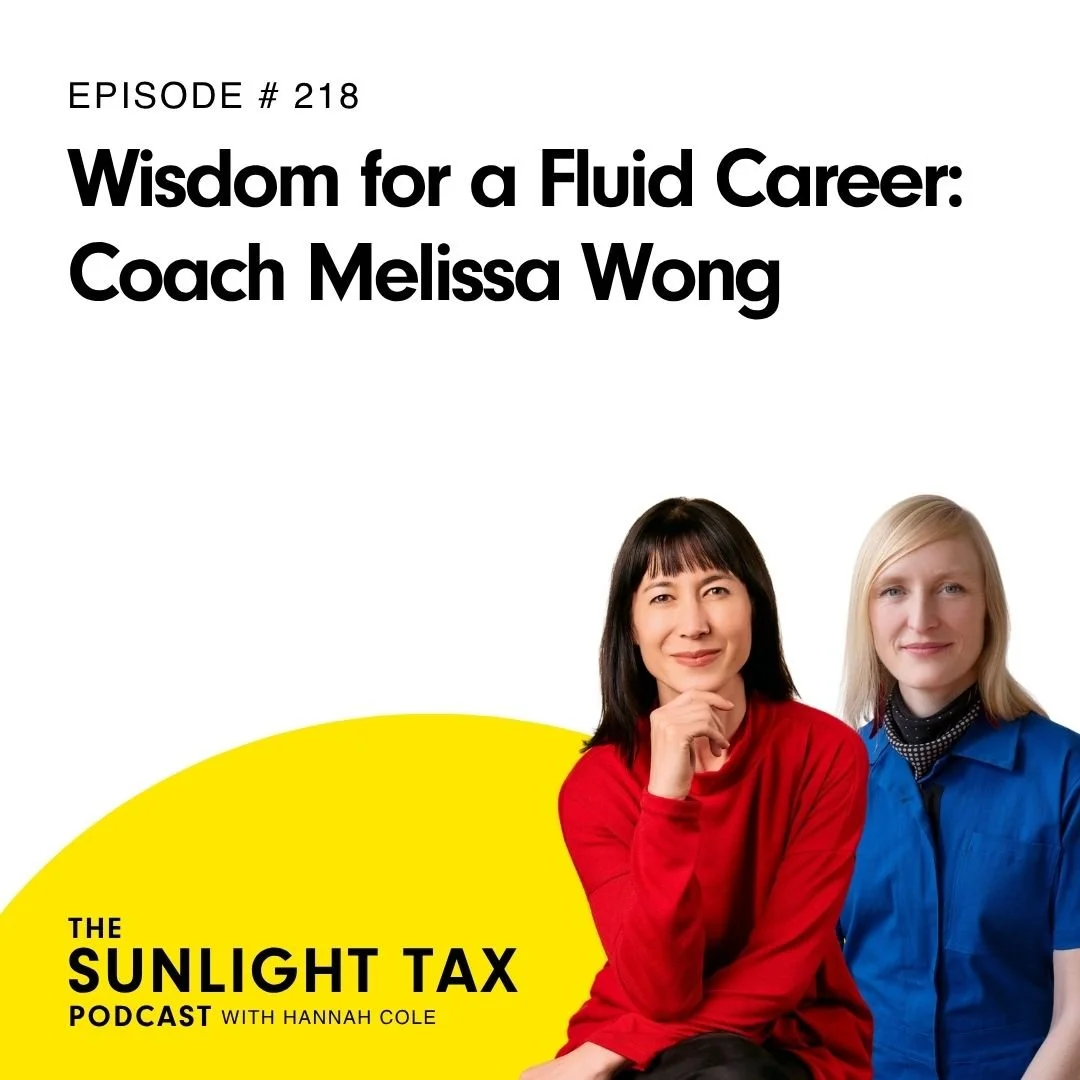
Wisdom for a Fluid Career: Coach Melissa Wong
Listen and Subscribe here
This week on the Sunlight Tax Podcast, I’m joined by Melissa Wong, career coach and author of The Fluid Career, to explore how creatives, freelancers, and knowledge workers can navigate today’s changing world of work. We talk about building a fluid career, transitioning to self-employment, managing multiple income streams, and creating a career that can adapt as your life and priorities change.
If you’re considering self-employment, balancing multiple types of work, or looking for a more intentional approach to your career, Melissa shares practical insights for building a flexible career path without feeling like you have to choose just one thing.
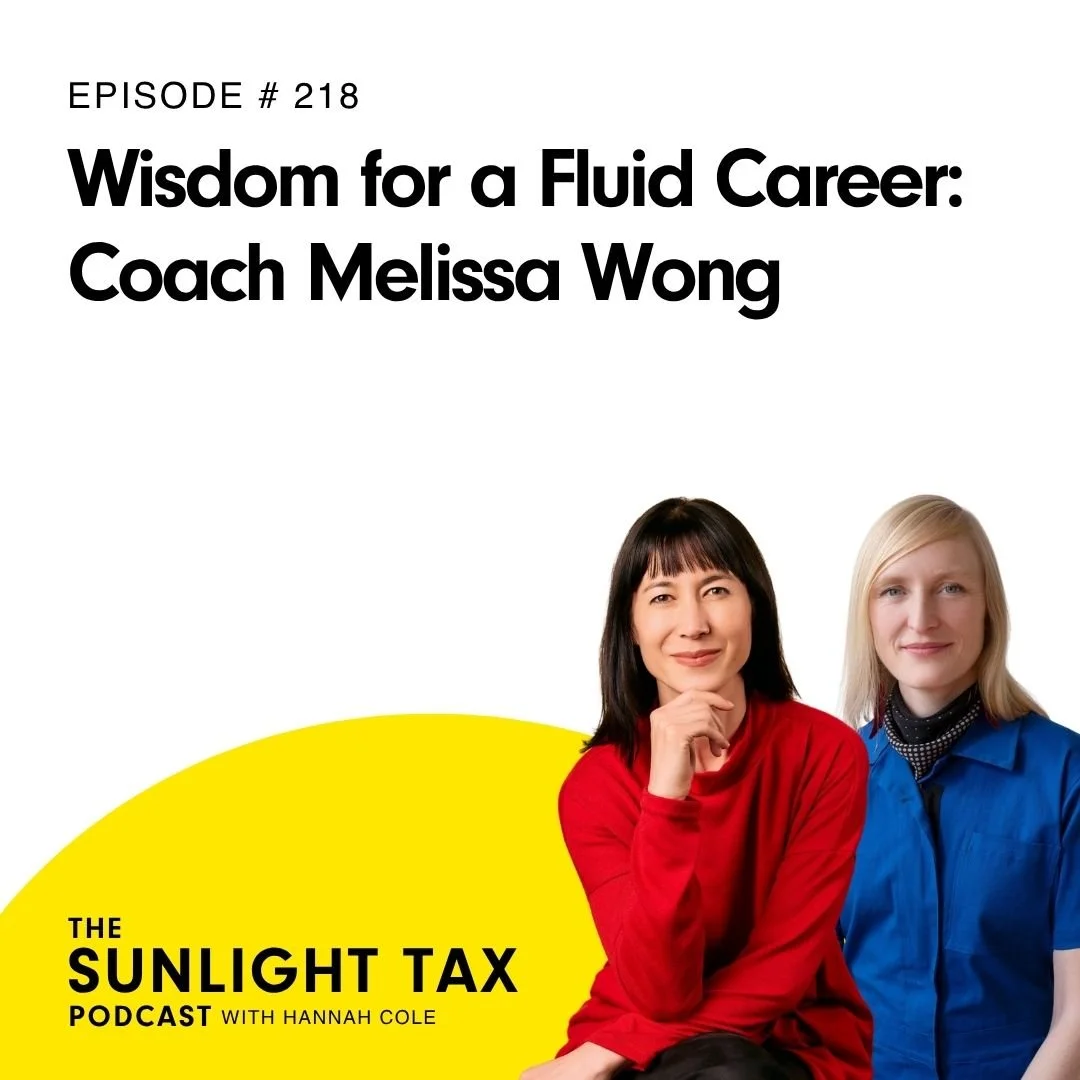
“The question is, how do you… retain a sense of core self? What are the immutable qualities about yourself… that are going to stabilize you throughout all of the motion and the change?””
This week on the Sunlight Tax Podcast, I’m joined by Melissa Wong, career coach and author of The Fluid Career, to explore how creatives, freelancers, and knowledge workers can navigate today’s changing world of work. We talk about building a fluid career, transitioning to self-employment, managing multiple income streams, and creating a career that can adapt as your life and priorities change.
If you’re considering self-employment, balancing multiple types of work, or looking for a more intentional approach to your career, Melissa shares practical insights for building a flexible career path without feeling like you have to choose just one thing.
Also mentioned in today’s episode:
00:02 Introduction to Melissa Wong and her work
02:04 Challenges of transitioning from employment to self-employment
04:11 Strategies for starting a self-employed career without data
08:00 The importance of articulating your unique offer
15:08 Practical steps for operational setup and legal considerations
23:00 Evolving passive income streams in the AI era
28:01 Building relationships and trust in a self-employed ecosystem
32:57 Managing multiple income streams and risk tolerance
39:53 Emotional and mental aspects of financial management
43:50 The core message of Melissa's book and its impact
44:59 Closing thoughts and how to connect with Melissa
If you enjoyed this episode, please rate, review and share it!
Every review makes a difference by telling Apple or Spotify to show the Sunlight Tax podcast to new audiences.
About Melissa Wong
Melissa Wong is a writer, thinker, and coach for creatives. At Coherence Studio she offers 1:1 coaching, group programs, and podcast conversations designed to help multi-talented creatives identify their unique worth and get into a place of intentional action.
For the first decade of her career, she worried about how her many roles and interests would ever coalesce into an intelligible, unified place. Now she helps creatives and knowledge workers articulate and share a coherent story of their work and design their career into an integrated multi-income system.
The Fluid Career synthesizes insights, stories, and tactics drawn from thousands of client sessions, offering a practical framework for designing modern careers to meet this moment of heightened complexity.
Melissa lives with her family in Portland, Oregon where you can likely find her attending or hosting some kind of event or elbow deep in her latest creative project.
Check Out Melissa Wong’s work:
Get a FREE download of The Fluid Career book introduction here
Website: Coherence Studio
Instagram: @coherencestudio
Episode Links:
Learn more about the Intensive
Link to join the First Official Cohort (9/23 & 9/24). Investment is $1850
Get your FREE visual guide to tax deductions
Order my book: Taxes for Humans: Simplify Your Taxes and Change the World When You’re Self-Employed
Transcript:
Hannah Cole (00:00)
everybody feels that way. The people who you look at their Instagram, you know, we look at people's part that they've curated for us. And in a way, what the money side is, it's the guts of the business. It's the actual thing. And it can often be so messy and so much more untidy, unstreamlined, unexamined than the front door.
And
People feel deeply self-conscious about that.
And
they're very
worried that everybody else knows something that they don't know.
And
Melissa (00:25)
Mm-hmm.
Hannah Cole (00:25)
everybody feels that way.
Melissa Wong is a writer, thinker, and coach for creatives. At Coherence Studio, she offers one-on-one coaching, group programs, and podcast conversations designed to help multi-talented creatives identify their unique worth and get into a place of intentional action. For the first decade of her career, she worried about how many roles and interests would ever coalesce into an intelligible, unified place. Now she helps creatives and knowledge workers.
Articulate and share a coherent story of their work and design careers into an integrated multi-income system. Her new book, The Fluid Career, synthesizes insights, stories, and tactics drawn from thousands of client sessions, offering a practical framework for designing modern careers to meet this moment of heightened complexity. Melissa lives with her family in Portland, Oregon. Welcome, Melissa, to the Sunlight Tax Podcast.
Melissa (02:05)
Thank you. Thanks for having me.
Hannah Cole (02:07)
I'm so happy you're here. And I was so pleased when you reached out because you really are talking to a very similar audience to, the Sunlight Tax podcast audience. so I'm just curious how you got here. How did you get into this work?
Melissa (02:22)
Yeah, I mean, I'll quickly say I was also very excited to get your response back because you've been on my radar for years. I feel like, truly, like when every any client comes to me and is like, I need some help with anything tax related, like you've been my go-to person to direct them to. I honestly couldn't remember when I first encountered, but I think it was maybe like a webinar or workshop. But my sense is just like a lot of my clients know about you. and so this opportunity to kind of
Talk live was you know, extra exciting. I think it's a classic, you tend to support the kind of person that you've been and you are or have been in a certain life. And I think
Hannah Cole (02:59)
Yeah.
Melissa (03:00)
I'll try summarize quickly, but I felt like I was drawn in many different directions for a long time and I felt a lot of, you know, existential angst of like, what am I meant?
to be doing with my work. And I've also just an ideas person. And while I didn't kind of like formally identify as like a creative or artist, I quickly realized when I started my coaching business that I tended to really enjoy conversations with people who were centering creativity. not just in for their income, but just in the way that they spend their time and and how they want to identify. So
I worked for companies like SoundCloud and Kickstarter in my past and kind of realized my own kind of theme and thread of helping project creators bring something to life. And I think what drew me to coaching was I've always liked supporting other people and proud prided myself in being a good listener. But with coaching, you get to be a thought partner too and kind of actually help them move forward and actually not just kind of,
like hear and digest and process emotions, but really think about okay, so what are gonna do with this now?
Hannah Cole (04:05)
Yeah, yeah. I love that. I love that. And I you know, I have touched into coaching a little bit myself. I find it very hard. So it's always like wonderful to learn from a great coach.
Melissa (04:16)
Hmm. Thanks.
Hannah Cole (04:19)
Well, I'd love to hear just like one of the things I'm particularly interested in about the people that you serve is like
When you talk about people moving from like full-time work, full-time employment into working for themselves, you know, I read the money chapter of your book, which was wonderful. And you know, it's notable, and I struggle too in my book, Taxes for Humans. I really struggled with like, okay, this is a much easier project when you have some data points, you have some months of work or years of work behind you that you can look back and see patterns.
But when you make that transition from employment to self-employment, you don't have that data. And it's really tricky to kind of move forward with any sense of confidence and vision there. So can you kind of talk to me a little bit about that particular challenge, kind of what you see and how those clients in particular feel moving into the world that you teach them about?
Melissa (05:16)
yeah, well, I feel like we could take the whole episode to talk about this. I mean, I think starting with the empathy and the emotional experience of like for some people, jumping off into self employment something they've wanted to do for a long time. It kind of is wrapped up in a lot of dreams and it's something they're actively seeking, even if it's scary. And I think for a lot of other people, you know, on the other side of the spectrum, it's like, I didn't
feel like this was my choice. Like I lost my job or I got, you know, whatever, laid off or something like that. And now this is sort of the plan B. So just kind of recognizing that there everyone's bringing in a different set of attitudes to self employment. But I think the same general tactics I would recommend for anybody, what no matter what you know part of that spectrum you fall on. and I guess maybe
As a clarifying question, do you want me to kind of talk about this in terms of like the financial side of things or just kind of general, like how do you get started?
Hannah Cole (06:15)
Well,
let's start with a general question there. yeah, how do you get started? And
Melissa (06:19)
Yeah. Okay.
Hannah Cole (06:20)
of course, because I talk about money, then I wanna land towards the money side.
Melissa (06:25)
Yes. So if anyone's heard of the idea of design thinking or the design process, I really lean on that a lot in my coaching sessions and thinking about how do we test things out, how do you prototype something and iterate on it when you don't have data? That's all you can do. You can do research from other people to see how it's gone for them. And I think that's smart. Both
Hannah Cole (06:49)
You
Melissa (06:51)
you know, whatever you can kind of learn online and also just very much talking to people doing informational interviews, which can be tricky for lack of a better word, sometimes right, where you're like, you know, for example, if we we're using you and saying, you know, say you had this full time job, now you're like, I'm gonna do my my own s business to support self employed people with taxes, right? What you do now, you might wanna understand like how have other
People who've done this price their work or how do they orchestrate and structure their offerings, right? And you can like do that online research without talking to them to a certain point. But then there's like the rich, juicy, kind of qualitative data that comes from talking to someone. And that's where it's sort of like, am I their competition? How do I reach out, you know, to people who are doing kind of the exact same thing as me? And I think that's where you can kind of like talk to other people who might be adjacent and working in partnership with those people to say, how did how did they work?
or if your business happens to be pretty like localized, I think that's another way to kind of reach out to people and not have it feel like a direct competition of like, okay, I'm building my practice in Asheville instead of like
Hannah Cole (07:58)
Yeah.
Melissa (07:58)
a New York clientele or something like that. and once you get people talking, I think they tend to be pretty open to share. Okay, this is what's worked for me, this is what what hasn't. and I see it as sort of this dance of research and trying to kind of like
not reinvent the wheel, but kind of model yourself on what you see out there. And then also
Hannah Cole (08:17)
Mm-hmm.
Melissa (08:18)
having moments where you're sitting w, you know, with yourself with a pen and paper and trying to clarify what am I really offering? Like what is at the heart of what I want? And I reference this kind of iki guy concept that I think many people are familiar with. But if you're not, it's like a Japanese concept of like, what is it
the intersection of what you're good at, what you enjoy, what people come to you for, what the world needs. And and kind of at the intersection in theory is sort of like what you should be offering. I think once you kind of like figure it out, like that's step one is like what can I actually offer and present to people that they think that they might pay for, then
Hannah Cole (08:58)
Yeah.
Melissa (08:59)
we need to kind of like test it out and see, people biting? Can I get practice clients? Do I like doing it?
I was just on a call with a client before we hopped on. and we were talking about how do you get testimonials and kind of show case studies of what you've done because when you're newly self-employed or trying to get new work, people tend to want to know like what you've done in the past. So I think another go-to component of this is like packaging and messaging what you've done in the past to
Hannah Cole (09:27)
Mm-hmm.
Melissa (09:28)
show.
truth trust and proof points to other people.
Hannah Cole (09:32)
Yeah.
Yeah, all of that so important. it's funny because even as you're saying this, I you know, I have worked for myself for a long time and everybody I serve works for themselves at least partially. But this summer my husband quit his job and went from full time W two stability into what I do, total self-employment. And it's so it's really actually funny to like
kind of with fresh eyes be going through it all absolutely again. of course now healthcare is involved since both of us are self employed. so yeah. it's on my mind. It's on my mind.
Melissa (14:59)
Yeah. Definitely.
That's so interesting. Like and and what a a much more intimate look you get when you're with this person, you know, day in and day out and
Hannah Cole (15:09)
Mm.
Melissa (15:10)
you know, have all the relational complexity between you and your your romantic partner. what are you remembering about this process just by witnessing him go through it again?
Hannah Cole (15:21)
Well, that initially there's all these questions of like just operational setup that are like, do I need a license to be doing this? do I have to register somewhere? Like, do I do I owe sales tax on what I'm doing? Like like that kind of question. Do I need an LLC? should I get a bank account? Like those little practical questions can feel agonizing if you don't know where to go. I say this because
These are the questions that I answer, and I hope to be that resource for people. but it is interesting to see how everybody has to cross those in some way or another. and and personally in my own work, I have found that people's anxiety about these things is at very different levels. People do not have one setting, and some people will operate on the fly.
And have the IRS chasing them down for unfiled taxes and like have a level of like, I'm okay with the mess here that another person is like, I am not going to take one payment until everything is nailed down, right? and the range is huge in between there. so it's just it's fascinating where people, you know, like if people could see each other, it would be fascinating to them.
yeah.
Melissa (16:40)
Right, right. Yeah.
I mean, and if I reflect on what how what I shared, it's almost this first phase of articulating and clarifying what you do. But you you're right, you inevitably hit the moment of trying to operationalize and think, what do I need to have structurally in place to legally be sound to receive income? you know, and and totally such a range of how people respond to this. But
What it makes me think of is another, know, recommendation I generally have as a person is like to feel connected to other people who are doing this so
Hannah Cole (17:14)
Mm-hmm.
Melissa (17:14)
that you don't feel so siloed. Or if any part of you is like trying to get a temperature check to say, like, do I really need this? Should I be agonizing over this? Right. Cause even
Hannah Cole (17:23)
Mm-hmm.
Melissa (17:24)
along that spectrum, there's a lot of doubt and questions along the way. So that's again why it's
So great that you offer what you offer is this kind of confirmation and reassurance of okay, worry about this, don't worry about this. But a lot of people I think feel intimidated to reach out to a professional to work with for a myriad of different reasons.
Hannah Cole (17:44)
It's so true. Do you find that people feel that way about reaching out to you?
Melissa (17:49)
I think know, coaching was on my radar like a decade before I started it and I think I arrived at it at the moment where I felt like
Culturally, the people were more open to coaching. And it just felt as commonplace, almost as commonplace as thinking about seeing a therapist or something like that. So I think there's been great strides in people's comfort level with reaching out to think about support, but it's intimidating. It's still an ambiguous process to people, I think, who don't fully understand like what is coaching. And so usually at the top of a new engagement, and we just chat for a little bit about.
this is kind of my version of it or this is how to set your expectations about it.
Hannah Cole (18:28)
Mm-hmm.
Melissa (18:28)
but I think for probably for both of us in our businesses, there's different access points that we've created and those come with also different financial levels of investment. And that's another place of course where a little bit of fear can show up.
Hannah Cole (18:41)
absolutely. And you know, and especially early days, like if we're talking about this person, this theoretical person who, you know, goes all in from total employment to total self employment, that's a very hard transition.
Melissa (18:54)
Mm-hmm.
Hannah Cole (18:54)
the unknown there can be so intimidating that you feel fearful, you can feel really fearful about spending anything. And this like mindset of making investments in your business, even seeing yourself as a business. I find that can be a challenge.
Melissa (19:09)
Yeah. And one thing I really loved about, I mean many things about just checking out your site again last night ahead of our our conversation today was you have these customized visuals and and guides for different kinds of creatives that might help direct them towards certain different structure based on what kind of services they provide, right? Like a doula versus a designer versus a I don't know, a photographer or something like that.
Hannah Cole (19:37)
Mm-hmm.
Melissa (19:38)
And it's it's nice to think about how do you create a first touch point with people to build trust with you that is customized. It isn't like a blanket statement. how have people responded to those do you call them? Guides or visuals, charts?
Hannah Cole (19:50)
yeah, my visual
guide to to your tax deduction.
Melissa (19:54)
Mm-hmm.
Hannah Cole (19:55)
they've been popular. I feel like it's a nice I mean I I made it from a practical need. mean, I feel like I sort of got into this work because I was interested in linguistics, as weird as that sounds. I'm interested in like cross-cultural communication and
I'm really transl like I'm a translator between the culture of creativity and like you know vision to the culture of accounting. Which is so they are so different from each other. And so I find it really fascinating and the personality types are so different from each other that I actually find that this like quality that I have as a human of being able to kind of like move between worlds is like that is sort of
the actual work that I do. So making
Melissa (20:41)
Yes.
Hannah Cole (20:42)
that, I feel like that's a translator. Those guides are like a translator.
Melissa (20:46)
Mm-hmm.
Hannah Cole (20:46)
meant to call in a visual person. Yeah.
Melissa (20:50)
That makes a lot of sense to me. I think, and that's probably why you've been in business as long as you have and and found the success you have is like artists and self-employed people, creatives who are speaking a certain language. I mean, out of all the languages out there, I think like taxes and the IRS language is like probably up there in terms of like intimidating to to break down. so it's yeah, it's a real service to kind of create that accessibility point.
You also offer a intensive, like a live offering. Is that
Hannah Cole (21:21)
Yeah.
Melissa (21:21)
pr pretty new or
Hannah Cole (21:23)
It's brand new. Yeah. I'm absolutely going through what I assume a lot of your clients do in just like testing, making sure I stay focused on like the minimum viable, thing that people will walk away with and not get too fancy too early. price discovery, like all these, you know, it's it's scary. but I'm
What
I find is just having some experience doing this, some track record, it's much less scary when you've done it before.
Melissa (21:54)
Yes.
Yeah. It's this the cool thing about self-employment, right, is like everything's kind of a creative sandbox and playground and you can kind of be spinning up new things and and it behooves you. It's a to your advantage as things shift, right? Like, I know something w maybe we were gonna talk about was like
Courses was one example of like a a go-to passive income structure for a lot of, you know, self-employed people who were trying to build a brand around kind of teaching people how to do something, with AI, or kind of just after that like peak moment of the pandemic and people putting out and subscribing to courses. I do think that there has been a trend of like people wanting humans, right, to
guide them through something. and that's an example of like, I'm not sure if you've like consciously thought, okay, I need to like in addition to my recorded course, do a live thing. But I think you're right on the pulse of and especially with money, right? Someone who's like, okay, I see you. I'm literally an expert talking to you live and I'm giving you this sort of custom feedback. that's kind of the ultimate reassurance they could get versus a a course that's just not going to talk back to them.
Hannah Cole (23:01)
I so agree. Well, you had a, you know, you spoke about this in your book you have a a wonderful section on creating multiple sources of income, which is a thing I'd like to bookmark anyway. But particularly that mention of passive income sources and those, you know, like a a download, a worksheet, a package, a an online course. I am curious if you're seeing that evolve because I mean I'll just say
In all honesty, in my business I've certainly seen like on online courses sales just nosedive with I think AI and people's wanting to not be on a screen as much as they can. So I'm curious what you see.
Melissa (23:42)
Yeah. You know, I don't I have anecdotal response to this, right? I'm not just so to caveat
Hannah Cole (23:48)
Mm-hmm.
Melissa (23:48)
it, like I'm not looking at big reports of of this too, but I think that checks out and just even kind of content that I listen to as well, other people who are just like you, kind of transparently sharing about how they're shifting their business. I and I think it's really important that you listed not just like a the onset of AI.
But really like people just wanting to not be on their screen as much and wanting to experience, you know, local or IRL things. I I feel that in myself.
So
Hannah Cole (24:15)
Mm.
Melissa (24:17)
it is, I can imagine, for people who have been in this business for years and seen something work and suddenly to sense, this isn't working in the same way is I don't know, destabilizing for for a moment at least to say, like, okay, what's going on?
But I think, know, what I say in my book is that passive income streams I think are always really alluring. It's like, cool, what I can put a thing out there and just keep getting, you know, sales from it. and I just try to remind people that like it does take work to manage this, to keep marketing it, to sharing it out. You gotta like direct people's attention to it. and
Hannah Cole (24:51)
Yeah.
Melissa (24:52)
maybe a question in return for you is like, we're kind of talking about
I don't know what the right language is, but sort of like
People in our field who are kind of like I guess like B2C, like having individual customers and clients come on. There's like a certain kind of like not template or cookie cutter formula, but sort of like, okay, here's the pathways we have. It's like we've got your one-on-one clients, you've got a course, maybe, you've got a community. and then there's all these other passive income streams.
you know, maybe outside of that, like licensing. I mean, ri I don't I don't know if real estate, if you would lump that in there. When you work with your clients, I guess, or people that kind of subscribe to your programs, do they tend to like mirror us, like you and my kind of style of business, or do you actually see some creative sources of passive income stream that other people might not be thinking about?
Hannah Cole (25:42)
That's a that's an interesting question. I have to think about it a little bit. I would say a lot falls into those categories that you mentioned. You know, coaching, one-on-one work, one-to-many classes, maybe like workshops. and then with that one-to-many stuff, you know, if you can record it and then sell it. And again, I think those are really nice to have, and when they're high quality, they continue to
make sales, but I do think in this environment when people are like sitting with Chat GPT open, they just ask it their questions and if they get a passable answer, it's hard for your paid offering to compete with that. so it you've really got to be offering something either custom to that person or valuable or, you know, protected by a license. I say this as a licensed tax professional that even though my work
is protected by a license, Chat APT and Claude are perfectly happy to answer your task questions. They're making things up, but the client
Melissa (26:38)
Right.
Hannah Cole (26:38)
actually it doesn't appear that way to the client. The client doesn't actually know how bad that information can be because it is offered so confidently. So that's a weird one.
Melissa (26:49)
Right. Which probably imagine
where my mind goes is like there's an interest interesting choice point on your end of like how loudly do I try to like educate people that like they shouldn't blindly follow what a Chat GPT says, right? Like I could almost envision a series of like, okay, I asked Chat GPT this question and this was the answer, and actually like this is the answer I would give, right, as the expert, or this is why this is an incomplete or maybe like an off base answer. but because we don't
really have like a unified, I know, like qualitative board helping filter out what is good advice or or not. It truly is kind of left down to the individual level to figure out how much trust they're putting in these LLMs.
Hannah Cole (27:30)
Yeah. I mean it is kind of interesting because my license, there is a due diligence requirement to my license. Anyone with a tax license, whether it's like me an enrolled agent or a CPA, you have this due diligence standard. You cannot just say something you think is true. You have to have done the due diligence to know that it is true. and typically you'll sign all kinds of things with an accountant saying like a verbal thing doesn't count as that.
Because my brain can I can have a brain fart. Like it can I can accidentally misspeak sometimes. So like if an accountant gives you something written down and you've signed an engagement letter, that's like locked in, licensed, reliable tax information. And basically short of those, you know, licensing requirements, you're not getting that. And so it is kind of weird that you can just ask these questions of this machine.
And it tells you stuff so confidently that no accountant is ever gonna behave like that. I imagine doctors might be pulling out their hair over similar reasons. Like, okay, we can
Melissa (28:36)
Yes.
Hannah Cole (28:36)
draw from Web und D and like, you know, there may be some stuff that's good out there, but maybe we're drawing from conspiracy websites and talking about drinking bleach.
Melissa (28:46)
Right.
Well, I think everyone, know if you're hearing this in your circles, right? It's just talking about trust and maybe that's where I'd I'd pull back in relationships where it's like, even if you're new, starting out with self employment, I brought up informational interviews. That's one kind of relationship. Then I also brought up like peers, right? Like other
Hannah Cole (29:06)
Mm-hmm.
Melissa (29:07)
people who are kind of doing the self employed thing for you. And maybe one other
layer to that or manifestation of a peer is someone who can be kind of like an advocate, like a a partner. whether that's
Hannah Cole (29:18)
Yeah.
Melissa (29:18)
to actually do referrals, how can you plug into other groups or partnerships that have a built-in trust already established? So whether
Hannah Cole (29:29)
Mm.
Melissa (29:30)
that's like you look up that there's like an don't know.
a summit going on and you like pitch a certain workshop for something that has like a little bit of a bigger draw or a kind of energy. or just kind of reaching out to someone who's doing something comparable, right? Like you and I are a really great example actually, because we're not offering the same thing, but our our target client is more or less the same. And so it you know, we can I refer people out all the time when I myself am not the best person.
for the task.
Hannah Cole (30:00)
Yeah. Yeah. I really love that. And also and I just have to say that that idea of the informational interview was not fully on my radar in this mode. It's hilarious because I tell my daughters to do this about career stuff all the time, but I've never thought about it like as an adult mid-career. it's so smart. but I'm curious, I wanna kind of circle back to this like theme that kept coming up in your book and in your work.
at
large, which is like the multi-income stream, multi-hat wearing component.
Melissa (30:30)
Mm-hmm.
Hannah Cole (30:30)
I'm curious about that because I sometimes with the brain that I happen to have, focus can be a challenge. And so like I do a lot to cultivate my focus and to not split it. and so sometimes I see multi on something and I'm like, ugh I can't. I can't do two things at once.
So I'm just curious,
Melissa (30:49)
Yes.
Hannah Cole (30:50)
like if you've had experiences like some people do well with that, some people do not. These are who you do think should do that kind of thing or not. Like tell me a little bit
Melissa (30:59)
Mm-hmm.
Hannah Cole (30:59)
more about like multiple income streams, like you
Melissa (31:02)
Sure.
Hannah Cole (31:03)
engage that.
Melissa (31:04)
Well, first I'd wanna maybe add to the complexity here to say like you have a focused business and it has a very, I think, clear mission statement essentially and and like a clear focus on who you're supporting. But even within your business, you have multiple income streams, right? Like
Hannah Cole (31:21)
That is true.
It's absolutely true.
Melissa (31:24)
So you're have a focused multiness and then there's someone else who could be take more or less what you have and then another universe on top of it. And then their complexity gets even more you know, advanced or or or complex. So think it would go back to this sort of like risk tolerance and trying to understand not only how your brain works in terms of how you're managing.
your to-do lists and your tasks and how distributed and broad you want to be versus focused.
Hannah Cole (31:51)
Mm-hmm.
Melissa (31:52)
when it comes to money too, it's like part of the premise of the fluid career is a little bit of heartening back to the the portfolio career idea, which is portfolio like a financial portfolio. It it benefits you to diversify your assets so that you're
protecting, you know, hedging against risk. If one of in the in in the career context, right, if one of your jobs goes away, income streams, you're not left in the lurch and you don't have this bigger moment of upheaval because you've got these other things going. You know,
Hannah Cole (32:21)
Yeah.
Melissa (32:22)
the the sacrifice of that is the energy it takes to, you know, kind of be up holding that multiness in a regular basis. So I guess I'd say like
from a risk standpoint, if someone likes to be focused with their brain, but maybe they have one or two clients and then that big client goes away for s for whatever reason, I think they just have to know that they're gonna have know, a bigger p percentage of their income that they need to replace. And
Hannah Cole (32:48)
Uh-huh.
Melissa (32:49)
that might be more stressful for them overall. So that could mean like hopefully they're making enough from these
a couple different concentrated income sources to be saving enough and you create enough of a buffer so that you can, you know, float yourself to the next bigger client. But for
Hannah Cole (33:05)
Yeah.
Melissa (33:06)
someone like me, for example, like if I have 20 to 30 clients at any given time, if one client just stops, just, you know, wraps up with me, it doesn't jeopardize my whole system. Like, you know, if I start getting maybe like five or six clients canceling or
stopping kind of unexpectedly all at once, then I'm like, okay, gotta, you know, do a push on the marketing front. so I think it kind of comes down to how your brain works combined with a bit of risk tolerance. And then of course interacting with what you are so ex hopefully excited to offer and the b structure that that kind of naturally links to, right? Someone who's
And I'd say maybe there's flexibility there. I was gonna use an example of like someone who's like an illustrator, for example. They might
Hannah Cole (33:45)
Mm-hmm.
Melissa (33:46)
think, okay, I need to get know, a lot of different or I'd I'd love to get a retainer. Like I'd love to get like one client that's always needing like, you know, illustrations from me month monthly or something like that. But if they recognize, that's that's too much risk and concentration in one place, then they might think
Okay, how do I add this other passive income stream? How do I maybe again license my my illustrations to a textile designer to use or, you know, getting creative from there?
Hannah Cole (34:12)
For sure.
Melissa (34:13)
but it is, I think that's kind of where the crux of my book is like.
helping create proposals of systems and structures that help contain the fluidity actually. So from a
Hannah Cole (34:23)
Yeah.
Melissa (34:23)
multi income standpoint, it's like, can it be as simple as maybe when you're starting out, it's a weekly end of week financial check-in just to kind of look at your streams, how are they doing, and log them in a spreadsheet? Then it can move suddenly to like every month, right? We don't want you to have to look at it every single
week.
Hannah Cole (34:42)
Mm-hmm.
Melissa (34:43)
But just that kind of initial practice of spending the time paying attention and charting, know, almost like collecting the data points to then later assess, I think is a huge part of it.
Hannah Cole (34:54)
Agreed. Yeah. I have a couple things to add to that. One is this this woman who I've done some collaborating with who has a great substack. Her name is Anna Burgess Yang. she works more on with a tech audience, but it's all about like solopreneurship. And she has this really interesting thesis from her personal experience, which is that having a job is the ultimate lack of
multiple income streams and and way riskier in her estimation and much riskier than having your own like 30 clients where one client goes away, you're fine, five go away. Okay, you have some work to do, but you're still okay, because she was laid off. And know, that's all of it gone overnight. So
there is something
Melissa (35:40)
Right. And
Hannah Cole (35:41)
to be said for that, like multiple you know, self-reliance.
Melissa (35:44)
And I I try to kind of call out this at the beginning of my book, which is this book is gonna resonate a lot with people who are already building fluid careers. But I think even people who are in a nine-to-five job and not very diversified could benefit from listening to
Hannah Cole (36:00)
Uh-huh.
Melissa (36:01)
it. And it the hard message to hear might be, okay, you're comfortable now, but how can you
Doing some of the practices that help you be primed, even for diversification. So for example, from a relationship building standpoint, like maybe it's tempting to just be working with the people on your team. But what if you took 10% of your sort of like social interpersonal networking energy at work and tried to make connections with people on different teams, people
Hannah Cole (36:33)
Mm-hmm.
Melissa (36:33)
at different companies who are on simpler teams?
Not because you're looking for a new job necessarily, but you are a in a moment of stability. You are fortifying your relationship ecosystem so that if you are laid off, you're not in a situation that a lot of clients come to me with, which is I have to like rewarm my relationship network and it feels a little forced or I don't want to come across as authentic of like I'm only reaching out because I need something, but that's kind of the situation.
Hannah Cole (37:02)
Yeah, it's hard. It's really hard.
Melissa (37:04)
Mm-hmm.
Hannah Cole (37:05)
Huh.
Melissa (37:05)
But it all takes time. So that's kind of this this trade off of like I understand if you have a full time job, many people have so much on their plate already. So to think about like, don't need another job right now, but I'm suddenly gonna be doing all these different actions that actually tee me up to do a job, like that's that's an energetic ask, right? So I
Hannah Cole (37:23)
Sure.
Melissa (37:23)
I'm aware of that and it's and it's it might not be possible for everybody.
Hannah Cole (37:27)
Yeah, heard. Actually, even just on that notion of like the multiple income streams and the sort of like focus of that, it's funny I see you doing a good job coaching like right here with me. Because pointing out that I do this thing that I'm saying I I can't imagine doing, it makes me realize that actually like my my philosophy is like, well, y you can have it all, you just can't have it all at once. And so it's
kinda like you do one focus area and then another and then another. And so you may have this accumulation of things behind you that exist and may still be working for you, even if your focus is over here.
Melissa (38:05)
Yeah, it makes me wonder, I don't know if this has come up in any kind of your intensive or or even just kind of one on one conversations with clients, but it's interesting to kind of understand the perspective that we carry with us and sort of the bias of that. Like when you almost say, like for me, it's it's really nice to feel like I'm at least focused.
Hannah Cole (38:24)
Mm-hmm.
Melissa (38:25)
So if you were to have a client come to you and saying, Hannah,
I have all these ideas and I'm so excited and I'm really diversified, but I'm also incredibly overwhelmed. And I I feel when it comes to taxes, like, is this a good idea for me? Like, should you think even though I'm in my heart of hearts, I want to be diversified, what I'm noticing is like it's being it is a kind of adding stress in terms of financial management and and a concern about how that's gonna show up at tax time. how might you
Counsel that person.
Hannah Cole (38:52)
Yeah. in a way liked what you said before that you gather data points even if you n don't necessarily analyze them till later. But you know, all those transactions kind of like building a system to capture the data, to me, that is priority number one. When you do that, you don't have to sort it out today, but you know that it's there for the day that you are gonna sit down to sort it out.
Melissa (39:17)
Mm-hmm.
Hannah Cole (39:18)
The problem comes when you don't have any tracking at all. Cause then now you really do have a beastly project on your hands. You have to go on a hunt for stuff, so I think in a really concrete way, it's just like hooking up that bank account, having a separate business bank account, making sure that every transaction is going through that and you're not using stray personal cards for business items that you'll later have to track down.
Yeah, it's it's more like a habit muscle and like a structure that you operate within. And once you do that, you really can have a lot of freedom inside that. which I think is not how people tend to think of like money management. They tend to think of it as only a chore and totally horrible. but I think of
Melissa (40:01)
Mm-hmm.
Hannah Cole (40:02)
like once you have that structure in place, it gives you a lot of mental freedom.
Melissa (40:06)
Mm-hmm.
Hannah Cole (40:06)
Yeah.
Melissa (40:07)
I I admittedly ran a group program called Savvy, which was a I ran it two times. Once was just kind of general, I'd say like personal finance with all the caveats of like I'm not a certified certified financial planner and all of that. But and then the second time I ran it, it was more specifically for people with variable income. And I think
Hannah Cole (40:27)
Mm.
Melissa (40:27)
probably the biggest takeaway I had from that experience was just how emotional.
money is. Right. I I think I just kind of naively didn't expect that part of like being in this, you know, somewhat intimate like six to twelve people container
Hannah Cole (40:42)
Mm-hmm.
Melissa (40:43)
and feeling
energy shift in the room and different people's opinions and and kind of know maybe certain people like not vibing with each other in a group because think it was just such a charged it is such a charged topic. and
So I guess I'm curious with you. So much of it is, as you said, and we both have echoed like the structures that you keep. What have you found with your self-employed or even multi-hyphenate clients that can kind of on the mental and emotional side kind of be these reminders, maybe pep talks along the way of like, okay, what if I haven't been tracking or what if I didn't start off doing it the the quote unquote right way to the begin Like
Hannah Cole (41:22)
Yeah.
Melissa (41:23)
What
do you notice yourself maybe like assuring them or trying to remind them before they get into the actual tactics?
Hannah Cole (41:29)
I think one of the most important things that I try to say as often as I can is every single client that I have, almost every single conversation, initial conversation I've ever had with a client starts with, I don't know anything about this, I'm totally behind. Which is like saying every kid in the town is above average. It's just not possible.
You can't all be behind. so everybody feels that way. Like that's a thing. The people who you look at their Instagram, you know, we look at people's outer, you know, the the part that they've curated for us. And in a way, what the money side is, it's the guts of the business. It's the actual thing. And it it can often be so messy and so much more untidy, unstreamlined, unexamined than the front door. And
People feel deeply self-conscious about that. And they're very worried that everybody else knows something that they don't know. And everybody feels that way.
Melissa (42:28)
Mm-hmm. Mm-hmm. Yeah,
that's such a nice reminder of like I'm normal or I'm not the only one.
Hannah Cole (42:37)
Yeah, so so normal. And there's no tax education in this country. So we we all end up feeling that way. Yeah.
Melissa (42:44)
Mm-hmm. Mm-hmm.
Hannah Cole (42:45)
so Melissa, I wanna ask you kind of a bigger question about your book. before we end our conversation. it's a really beautiful guide. I love how you kind of you do walk into the emotional
side and I love and agree with you that you know like knowing what your like fair, good, better scenarios financially help you understand, like, I have some time to figure this out. It like actually gives you some space to do the work. I wanted to just ask you on a larger level, like who you're really hoping to connect with with the book and like what you want like
If
you had a vision, a dream for what somebody takes away after they read your book, what that what that is to you.
Melissa (43:29)
well, I appreciate the kind words and it very much is a book, but it could also be called a handbook. Like I really it it there's a density to the book that and I'm be curious how you relate to this with your book as well. Yeah.
Hannah Cole (43:41)
Well, I wanna jump in. When you say that
I feel that people may be scared, but I wanna say it's very readable and these are exercises
Melissa (43:48)
Mm.
Hannah Cole (43:49)
that actually and I find this very humane. They say like, Well, this will take you twenty minutes, this one will take you an hour, this is five minutes. You know, it's like it's you say that it's dense and it is 'cause there's like exercises, but they
Melissa (44:01)
Mm-hmm.
Hannah Cole (44:02)
feel gentle to me.
Melissa (44:03)
Thank you. I appreciate that. Yeah. My goal in writing this book was like, I didn't want a book someone to end like finish reading the book and say this could have just been a short blog post and you just kind of like put flesh on it with like ten different case studies. Like I didn't want to follow that very go-to format, which I understand is a go-to format for a reason. I do have case studies that I thread through to try to like illuminate the concepts and practice, but I did, you know, the coach in me really wants it to be actionable. So I want people to
You know, you could read it first pass and not do the exercises, but the change it's gonna happen is actually doing the exercises and mapping it onto your own experience. So my high hopes are that it doesn't have to be every single chapter of the book. It's divided into five kind of main domains: identity, skills, relationships, time, and money.
You can just choose even one of them. And if you move one of those things forward and feel a little bit more structured or interconnected because of that, then I would say, Great, amazing. but I think the final chapters where my mind goes in answering your question, it's called center. And it's and it is more of the emotional and kind of existential side of this, which is anyone who wants to be in motion.
Have more variety, have more multiplicity, I want them to feel validated that that's totally wonderful. And it comes with challenges for sure. the question is, how do you kind of retain a sense of core self? What are sort
Hannah Cole (45:34)
Mm.
Melissa (45:34)
of the immutable qualities about yourself, whether that's values, whether that's certain relationships you kind of commit to uphold, whether that's certain rituals and practices that are going to
stabilize you throughout all of the motion and the change and can you
take a moment to say that those are just as important as figuring out how to prioritize your to-do list or figuring out your money income system because if you don't feel stabilized from the inside out, like it's all gonna feel shakier.
Hannah Cole (46:02)
Couldn't agree more. That's beautiful.
Melissa (46:04)
Mm.
Hannah Cole (46:06)
Yeah, I really appreciate that. I feel I feel your coaching. I feel I felt as I read the part of the book that you sent me, like I I felt that voice, that like guiding hand, and I felt the experience.
Melissa (46:15)
Mm-hmm.
Hannah Cole (46:16)
It's really, I think it's lovely. I hope it does really well. Is there
Melissa (46:19)
Thank you, Hannah. I really appreciate it.
Hannah Cole (46:21)
anything, is there anything you want to leave the listeners with and just tell people how they can find you?
Melissa (46:26)
Yeah, I think just on my website coherence.studio/fluid you'll find book. And if you want to poke around to different offerings I have, great as well. I do have a self-paced course. I do ha offer one on one coaching, and have like a couple one off trainings. But yeah, thanks so much if just for tuning in and thanks Hannah for giving me this space to share a little bit more about my book and and the exchange that we had today. It was
It was a pleasure.
Hannah Cole (46:52)
Awesome. Thanks for being here.
What are your money concerns?
Suggest a blog topic for Hannah here.