

THE SUNLIGHT TAX BLOG:
Tax and Money Education for Creative People, Freelancers and Solopreneurs
search A TOPIC
Categories
- Business Management 22
- Creative Specific 3
- Estimated Quarterly Taxes 8
- General Economy; Tax Policy and Legislation 52
- Get to know Hannah Cole 8
- Interviews and personal stories 36
- Personal Finance 26
- Personal and Career Development 22
- Practical and Tactical Tax 57
- Retirement and Future Success 28
- Sunlight Podcast 149
- Tax Deductions for Freelancers and Self-Employed 9
- the Sunlight Tax Podcast 67
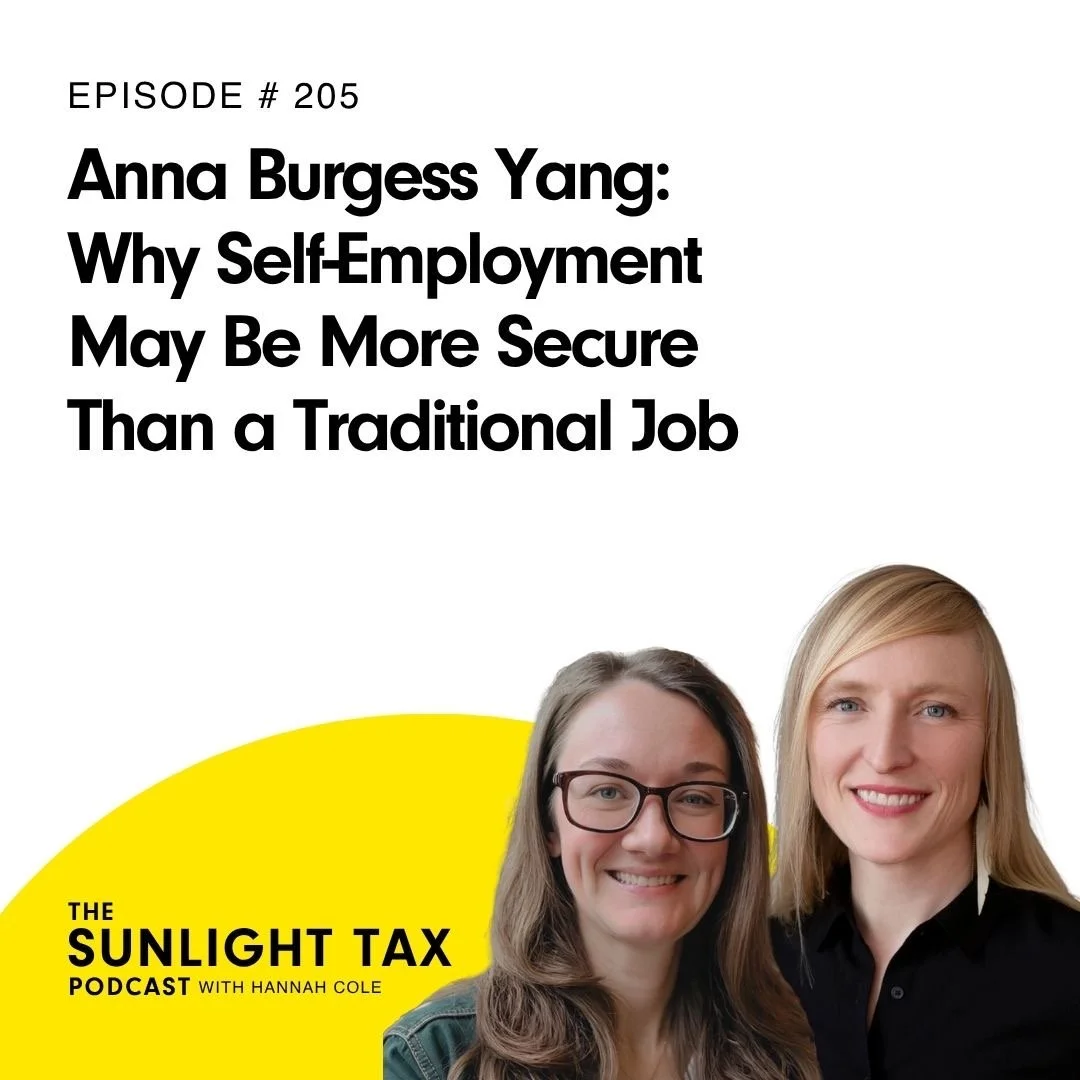
Anna Burgess Yang: Why Self-Employment May Be More Secure Than a Traditional Job
Listen and Subscribe Here
In this episode of the Sunlight Tax Podcast, I sit down with Anna Burgess Yang to discuss her journey from corporate banking to solopreneurship. We explore the skills that helped her make the leap, how she approaches business decisions and financial management, and what it really means to navigate risk as a self-employed business owner. Anna also shares practical insights on freelancing and building a sustainable solo business while having effective financial planning.
Listen and Subscribe Here
“It's stressful to work for an employer and it's stressful to work for yourself. It's just like choose your stress.” – Anna Burgess Yang
In this episode of the Sunlight Tax Podcast, I sit down with Anna Burgess Yang to discuss her journey from corporate banking to solopreneurship. We explore the skills that helped her make the leap, how she approaches business decisions and financial management, and what it really means to navigate risk as a self-employed business owner. Anna also shares practical insights on freelancing and building a sustainable solo business while having effective financial planning.
Also mentioned in today’s episode:
00:10 Introduction to Solopreneurship
06:01 Transitioning from Corporate to Freelance
10:25 Common Mistakes Solopreneurs Make
12:26 The Risks of Employment vs. Self-Employment
17:10 Current Economic Landscape for Freelancers
22:20 Navigating Career Pivots
28:04 Financial Management for Solopreneurs
If you enjoyed this episode, please rate, review and share it! Every review makes a difference by telling Apple or Spotify to show the Sunlight Tax podcast to new audiences.
About Anna Burgess Yang:
Anna Burgess Yang is a freelance content marketer and journalist specializing in B2B SaaS and fintech. She is also a solopreneur educator focused on back-end business operations. A former corporate executive, she now writes long-form content for clients. She also maintains her own blog, newsletter, and a tutorials site. Within her content, she teaches other solopreneurs and marketers how to use AI and automation to work more efficiently.
Check Out Anna’s Work:
FREE RESOURCE: Budget Health Check
Episode Links:
Join the Workshop:Save Like a Millionaire: Using Tax-Smart Accounts
Get your FREE visual guide to tax deductions
Order my book: Taxes for Humans: Simplify Your Taxes and Change the World When You’re Self-Employed
Transcript:
Hannah Cole (00:00)
Anna Burgess Yang, thank you so much for being on the Sunlight Tax Podcast. Welcome.
Anna Burgess Yang (00:05)
Thank you so much for having me.
Hannah Cole (00:07)
I'm super excited to talk to you. I feel like we have a lot in common, but I really wanted to start by just asking you to give the listeners of the Sunlight Tax podcast a little bit of your story. Will you tell us kind of what the journey is that brought you into solopreneurship?
Anna Burgess Yang (00:25)
Sure. and it's not a traditional path or or the place
Hannah Cole (00:28)
Yeah.
Anna Burgess Yang (00:30)
or the place that I really thought I would end up. so
Hannah Cole (00:32)
Yeah.
Anna Burgess Yang (00:33)
I started my career in banking. I actually worked at a bank for six years. and then
right out of college went to work at a financial technology company that worked with banks. So I was still in the space, but working as a technology provider and helping banks and credit unions across the US implement enterprise software. And I stayed at that company for 15 years. So long time.
Hannah Cole (00:59)
Wow.
Anna Burgess Yang (00:59)
Right around or during the pandemic, like many people, I was kind of thinking, what else could I do with my life? and it really wasn't something I had considered up until that point because the company, it was small, it was very had very flexible work. that was it was just a great fit for me that way. But during the pandemic, I really started to just rethink like what do I want to do? Is this is this what I want to be doing? Is this the company I want?
to be at. The answers to all those things were no. I didn't want to do that anymore. And so I started thinking what else can I do? Because I that was my first job out of college. I hadn't done anything else. So I don't know how exactly, but I somehow landed on content marketing that people would actually pay me to write for companies. So I got a job at a marketing agency and quit my tech job.
And so I was writing mostly for other technology companies in kind of a variety of spaces through this agency. I was only at the agency for about eight months. The agency just was not a good fit, and I got a job at a different agency, but in more of an account manager role. So doing different type of work and not writing. And I was at that company for about a year and got laid off. And
At that point, I had been considering going out on my own. Something I'd really never thought about at any point in my life, because with a banking background, I'd always been told that self-employment was risky. But
Hannah Cole (02:33)
Mm.
Anna Burgess Yang (02:34)
at the time that I got laid off, it seemed like full-time employment was risky. in the tech industry in particular, people were getting laid off right and left. And so
I thought I'd I'd started thinking, like, what would this look like if I went out on my own and and did that? And so when I got laid off, I'm like, well, here's the chance. The
Hannah Cole (02:56)
Yeah.
Anna Burgess Yang (02:57)
opportunity has presented itself. The timing wasn't my decision, but I think it was a direction I was headed anyway. So I started
Hannah Cole (03:03)
Mm-hmm.
Anna Burgess Yang (03:04)
my own freelance writing business, writing for technology companies. And on the side, I
Create resources for fellow solopreneurs
because that is something that I'm just very passionate about. I feel like my background coming from company they came from and the the banking experience and things like that give me a really unique perspective on starting a business. I didn't I didn't make some of the same mistakes I think some solopreneurs make just because I had that background. And so I really wanted to kind of
provide education, talk a lot about tools and technology and things to make work easier. So I create resources and host webinars and workshops and things like that for fellow solopreneurs.
Hannah Cole (03:51)
I love it. I really love the way that it does feel like you are helping to kind of lead people through the terrain of solopreneurship. Like this article, gosh, there's so many that I want to ask you about. But I was just reading this article you wrote about skills that you got from working in a corporate environment and how helpful they were in being a solopreneur. And you just reference like the mistakes that you see people make. So
Can you just outline some of those mistakes that you see solopreneurs make or just struggles that people have when they strike out on their own? because I think your kind of experience is really has a lot to bring to
Anna Burgess Yang (04:27)
Yeah. and yeah, and one one thing
one thing in particular that I'll that I'll add to my corporate experience was when I left, I was an executive. So not I wasn't an individual contributor anymore. I was part of the team that was making decisions about the finances of the company, about the strategy of the company. And so one of the things I see solopreneurs struggle with is decision making. Like suddenly you are in charge.
And everything falls on you, which has benefits. You can change direction. You can try something new. You're not stuck in like red tape that often comes with corporate decision making, but also you're assuming all of the risk. And so some things I see solopreneurs struggle with is they're just not comfortable making decisions, so they don't act quickly, or they just take too long, or they don't make it at all because they're afraid. or that they make decisions like kind of
too quickly and then they're constantly shifting and they're not letting like a decision settle and really decide is that the right thing and getting data. They're just they're constantly bouncing between decisions. So that's something I think solopreneurs struggle with a lot. Another one
Hannah Cole (05:39)
Yeah.
Anna Burgess Yang (05:40)
is like investing in your business. And that it's but I what I mean by that is I pay for a lot of tools
that make my work more efficient because I recognize trade-off is more time for me to do higher value work or spend time with my family or take a nap or whatever you know, but but I think a lot of times solopreneurs they're so they they want to keep their money, right? You know, they and so paying for tools seems like they something that seems like a risk or they just don't want to, they want but they don't recognize that that lets them do other things that could bring more money into the business.
and a third thing, which I know you talk a lot about is just being uncomfortable with money.
Hannah Cole (06:19)
Mm-hmm.
Anna Burgess Yang (06:20)
and not knowing how to budget around unpredictable income or not even sure like how to keep track of like income and expenses and some things. If you've never done it before, there's not a good foundation for it. So those are some of
Hannah Cole (06:34)
Yeah.
Anna Burgess Yang (06:34)
the big things that I kind of talk about a lot is, you know, kind of those executive skills, kind of those
operations skills and then financial skills.
Hannah Cole (06:45)
Yeah, I appreciate that a lot. I think both you and I have served some time as a project manager and I feel like
Anna Burgess Yang (06:51)
Yes.
Hannah Cole (06:52)
that's a really useful I've never been an executive, but I I mean except of my own company, but that project management was so difficult and so valuable. Like I really appreciated managing other people timeline and budget and that being so clearly something that I needed to keep careful control of. because man, is it helpful.
When you work for yourself.
Anna Burgess Yang (07:16)
Yes. And I was a a
product manager, which is a lot of project management as part of my job. And so I knew when I started my own business, like the day I had two clients, I'm like, I need to figure out how to project manage more than I need to build a system that can handle more than one thing. And it has to be able to continue
Hannah Cole (07:36)
Wow.
Anna Burgess Yang (07:36)
to grow with me. You know, I can't just wing it anymore with making sure that things are done on time and, you know, keeping track of
multiple client preferences and ways of delivery and all of that. So for sure, project management is a whole big thing that a lot of people, if you've never done it before, it's it's a very kind of foreign concept.
Hannah Cole (07:58)
For sure, for sure. I was just also reading another one of your articles. By the way, I haven't mentioned your sub stack. It's called Work Better. and it's great and anybody who's listening should definitely subscribe to it. but one of the articles like a headline that really grabbed me was the that people don't talk enough about the risks of employment.
Anna Burgess Yang (08:19)
Yes.
Hannah Cole (08:19)
and I just
I found that so interesting. I I mean, I am an artist and I'm not just an artist by training, but also like in my heart and soul. And I think like the strictures of a corporate environment have always graded on me. But it seemed like to me personally, like when studio time was this thing I really preserved fiercely that the timelines of corporate environment, like just a day job,
And it especially as a woman, things like maternity leave and the complete lack of it. w it seemed like the only way I would ever get the kind of leave that I really thought was, you know, fair and good was to have my own company. So would you be willing to just sort of talk a little bit about those the risks as you see them in having a job?
Anna Burgess Yang (09:10)
Yeah, so because
I worked in banking for a long time and I was a mortgage un I was a mortgage underwriter really early and so I was part of
assessing risk in borrowers in banking it is drilled into you that self-employment is inherently risky. And to a bank it is because you can't, you know, you want W-2 income because then you know how much the borrower is earning. And it's hard to tell with self-employment. So that that had always just been part of the framework that I grew up with or that I learned as a young adult was that self-employment is risky because the income is unpredictable.
But when the but the day I got laid off, I lost a hundred percent of my income. I went from salary to zero.
And you know, unemployment in this country is a joke. it was I had it was a a painstaking process to file for unemployment in my state. it was a fraction of what I had been earning. And and as soon as I
got a freelance role that paid me one week, they kicked me off of unemployment. Even though the next week I was back to having zero again. So it was just
Hannah Cole (10:23)
So awesome.
Anna Burgess Yang (10:24)
it was a real you know, it's not built for that type of thing. It's built for you get another job and now you're done with unemployment. So any but that aside, the risk of employment is that you're at the mercy of the employer.
there we have you know at will employment in the almost every part of this country where they can get rid of you for any reason. And so when I lose a client, it's a fraction of my income. It's it still stinks. You know, my clients their budgets change, their needs change, all kinds of things change. And sometimes without a lot of warning
you know, I I may they may just be like that, you know, we're indeed the eng engagement at the end of this month. it's just a f it's just a portion of my income. It's not my whole income. And so that's part of the reason why I prompted that article is because, you know, from my former banking perspective, I was like, well that's the more stable income
is when you only lose maybe twenty percent or some something like that rather than all of it. and you know, with with getting laid off for most people, I mean it it's immediate. There's no notice period. In a vast majority of cases, there's no notice period. And so even providing a two weeks notice, the employer doesn't have to honor that. You I've told people before you have to be prepared that your employer may say, Well we're just gonna be done today.
And that's the it and that's it. You have no recourse and you have no protection. so self-employment to me puts me in more control.
I have to save, you know, to plan for things like f lower client months, but I can choose to do that. And that's just part of how
Hannah Cole (12:04)
Yeah.
Anna Burgess Yang (12:04)
I run my business.
Hannah Cole (12:06)
Yeah, for sure. Whew, yeah. I'm we my husband has worked for startups for his whole career and he just just this year was at a company that closed overnight. Like in the morning everybody had a job and at five PM nobody had a job anymore. The company ended and there was no notice and no severance. I was like, that was scary. we're okay, nobody needs to cry for us, but
Still, it was it was terrifying and I felt really bad for everyone at the company.
so I am curious, like, just because I think that your I don't have a great sense of like what part of the f of the world your clients are operating in, kind of like what their concerns are and stuff, but I I have been just speaking of that like risk of self employment versus employment, is like the job landscape really feels like it is in a lot of flux right now.
and I think that is true if you are an employee and you're just looking at these LinkedIn posts of like massive amounts of layoffs at larger companies. Or if you're self-employed and you're just like your clients are all kind of suffering from work that's drying up from AI replacement as as mine are. so I'm just kind of curious from you, Anna, like
Do you have a sense of like the lay of the land? Like what does it look like from where you stand right now? What are you seeing in the economy based on who you serve?
Anna Burgess Yang (13:30)
so I work mostly with tech companies.
and
Hannah Cole (13:33)
Uh-huh.
Anna Burgess Yang (13:34)
you know, their their work
What they do for their customers, I think, is changing. It hasn't really impacted me and the type of the type of work that I do for them, because I do a lot of like interview-based work. So I talk to people and like write, you know, write up a journalist style article about it and things like that. So there's still, I think, a need for that type of writing. but I I I do kind of wonder, you know, at what point some of the things that are I'm seeing from other people are going to
Trickle down and hit me in some shape or form. A lot of my friends are in similar writing type of roles, but maybe internal at a company. Many of them have been laid off, or their roles have changed substantially as the company itself has pushed employees to use more AI. So they're like, this isn't what I signed up for. And I
a little bit feel like I'm waiting for the other shoe to drop and maybe it's going something's gonna hit me at some point, but so far it hasn't. and which is great. But I
Hannah Cole (14:42)
Yeah.
Anna Burgess Yang (14:43)
it's it's hitting so many people I know in so many ways that are heartbreaking because again if you're working for an employer
it's just you know, the impact is kind of immediate if if something happens to your job and then, you know, some some freelancers I know are struggling to find the type of work that they were doing before.
Hannah Cole (15:05)
Mm-hmm.
Yeah. Yeah, it's interesting. what I have been noticing is it's so individual. Like there are people who are doing fine and the maybe they're in an industry that's relatively untouched and they kind of aren't noticing all of this stuff. And then there's people like me, like my income dropped very dramatically this year, and I have just been like, What's happening? What's going on?
And it's hard to even get the data about it, you know. My brother works in Washington DC at a he worked at a large nongovernmental organization funded by the State Department and you can you can imagine what happened to him six months ago. He he lost his job because of Doge. he was actually personally doxxed by Elon Musk.
Anna Burgess Yang (15:47)
Out more.
Hannah Cole (15:49)
His name and salary tweeted, by Elon Musk. So that that was a little voyage for him. So like yeah, I mean there's like people in government, people in the creative economy, it's just tech workers. It's it's interesting how it's spotty,
Anna Burgess Yang (16:03)
And it puts everyone on edge, I think, because you
Hannah Cole (16:06)
Yes.
Anna Burgess Yang (16:07)
wonder, I one one of my siblings works for a very large tech company that kind of has rolling layoffs and every single time I have to send a text message like, are you okay?
Hannah Cole (16:19)
Wow.
Anna Burgess Yang (16:19)
Because it just kinda and it just kind of keeps everybody scared all the time, wondering if they're gonna be in the next round of cuts, maybe if they made it through this round. And so we're all operating I I actually wrote about this recently too. We're all kind of operating in a culture of fear and like
Hannah Cole (16:39)
Yeah.
Anna Burgess Yang (16:39)
that we can't quite settle, or it's hard to make plans like even in your personal life, because you're worried about what your professional like is your professional.
Hannah Cole (16:54)
Yeah, yeah, I agree. and yet, you know, I do find as especially as a as a business owner, I want to approach the world and my work with a sense of optimism. it's getting harder. It's like actually kind of hard to be optimistic. I think it's not unreasonable and it's absolutely possible, but I'm just noticing that in myself. There is a gloom like around us and a fear. yeah.
Anna Burgess Yang (17:18)
And I I talk to people quite a bit who are maybe considering starting, you know, going out on their own. Maybe they lost their job or they just can't take it anymore. And you know, I'm very upfront about you know, the ups and downs of running a business by yourself. but also try to say like your your current employer is
causing you a lot of stress. It's just a different type of stress. Like it's it's stressful. It's stressful either way. It's stressful to work for an employer and it's stressful to work for yourself. It's just like choose your stress.
Hannah Cole (17:51)
For sure. Yeah. Choose what you want to have control over. Yeah. Yeah, for sure. So I know you have like a download that you offer that's about career pivots, helping to coach people through that. You have certainly been through s a pretty major one yourself. I'm curious if you just have some wisdom to share about pivoting.
Anna Burgess Yang (18:13)
Yeah, the the resource you're referring
to, I kind of break out what are different ways that people end up pivoting. 'Cause I consider that I had several pivots. You know, I pivoted from the industry, you know, there's a cold like I'm gonna just do something completely different and got out of a direct tech job and started writing. there's kind of the boredom, like you feel like you've reached
the top of maybe what you can do at a company. And I think that partially led to me leaving the company that I was at for 15 years was just I there wasn't anywhere else for me to go.
Hannah Cole (18:46)
Yeah.
Anna Burgess Yang (18:48)
you know, there's kind of curi curiosity, like I I just really want to grow and change and just see what I can do. And that's maybe what leads people to self-employment.
and then there's there is a fear based pivot. Like I'm not sure that this job or this type of work is going to be there anymore. And maybe I need to upskill or get into a different field or something
Hannah Cole (19:17)
Mm-hmm.
Anna Burgess Yang (19:18)
before it hits me. And I don't know that we can all predict that and certainly not everybody's in a position to do any of those things and I recognize that as well. Like I had to take
pretty large cut in salary moving from an executive at a tech company to basically the lowest level writer at a content agency.
Hannah Cole (19:37)
Huh.
Anna Burgess Yang (19:37)
and had to plan for that. Like can't is that even feasible? What do I need to earn
Hannah Cole (19:43)
Mm-hmm.
Anna Burgess Yang (19:44)
versus what can I earn in like a year or two, which is much different.
Hannah Cole (19:49)
What an interesting decision making process to go through. Cause I think a lot of people would just take those two data points. What am I earning right now? What will I be earning tomorrow when I start this venture? But you're wise to think it through a year, two years down the line. How did that look different from day one?
Anna Burgess Yang (20:07)
And I told my husband when we when I made that, you know, 'cause we knew what the offer was and what I was going to be making. and then when I went self employed, I said, Give me six months.
Like if I can't not not to replace my salary, but to have enough momentum that this seems possible. But if
Hannah Cole (20:25)
Yeah.
Anna Burgess Yang (20:26)
I hadn't been able to get clients or like that seemed like that it this wasn't gonna work, I would have gone out and found another job. Like, you know, we have a mortgage and we have kids and things like we have things to pay for.
Hannah Cole (20:36)
Yeah.
Anna Burgess Yang (20:36)
but I knew that what I was going I had to I we had enough cushion or we kinda planned enough to kind of float the difference until
Until my earnings got back up to what they were previously. So but you have to think about that math, right? Like w what can you f if you can of if you can afford to take less, how mu how long can you afford to take less?
Hannah Cole (20:58)
Yeah.
Yeah, and I think planning those timelines is really I've been thinking a lot about predicting the future. Partly 'cause the whole world is trying to do it right now with AI and nobody can. And yeah, just like
Okay, well realistically in three months will I have figured out this problem that I'm currently working on. And like, you know, I think the first year you try something, that's really hard math. But once you've kind of been in it, like I have had my company for ten years now, I kind of have a good sense of like how long a project might take me. that's getting easier, I guess, is my point. Yeah.
Anna Burgess Yang (21:35)
Yeah. And I always tell
people also when I talk to them about that math of of changing from corporate to solopreneur is like
Hannah Cole (21:44)
Mm-hmm.
Anna Burgess Yang (21:45)
what you need is not the same as what you're earning today. Like what are your what are the non essential things that you can cut for
a period of time and still be okay to kind of get you
Hannah Cole (21:58)
Yeah.
Anna Burgess Yang (21:58)
through that initial six months period or or however long it might be. And it's not saying cut these things forever. It's saying what could how how much could you scale back? And
Hannah Cole (22:10)
Uh-huh.
Anna Burgess Yang (22:10)
what do you absolutely need to pay for until
Hannah Cole (22:14)
Yeah.
Anna Burgess Yang (22:15)
your business kind of picks up and you find your rhythm and your clients and things like that.
Hannah Cole (22:19)
For sure. Yeah, that is really it's a good exercise to do. I mean, we we have done it as a family in these last few months, just like cut things as much as we can. and it's not at a place where we absolutely need to be doing it, but it actually feels really good to do anyway. to just be like because we've both been having this conversation of
What what is happiness? You know, like we we can't not earn money. That's off the table for us. But we don't have to
Anna Burgess Yang (22:46)
Right. Shoot capitalism.
Hannah Cole (22:50)
Yeah, right. It would be nice. But I feel and I I love I love my work, really, truly I do. Sometimes I just need like a little rest. But, you know, it's to me like it's a dosing problem, you know. I don't wanna have to work so hard that I don't get to sleep or enjoy weekends. But you know, if I
work a reasonable number of hours. I love what I do. So I think it's a really interesting question of like, well, what is actually I find that digging into your budget can actually be a real question, a real discussion about what brings you joy. And that is a really good conversation to have, whether it's, you know, alone
Anna Burgess Yang (23:28)
Yeah.
Hannah Cole (23:29)
w with yourself or with a partner. because man, it's
Funny how much you can kind of autopilot
on your spending and then not really think about, well, is this actually bringing joy and value to my life? Or is like, I don't know, grinding my coffee beans and having a really wonderful coffee at home every day rather than out co totally pleasant.
Anna Burgess Yang (23:52)
Yeah. And I because I've come from, you know, banking background and I worked in that space for so long, both
Hannah Cole (24:00)
Mm-hmm.
Anna Burgess Yang (24:00)
like for my business and for my home life, I basically have three budgets, like a worst case scenario. And then kinda
Hannah Cole (24:06)
Wood. Uh-huh.
Anna Burgess Yang (24:09)
like here we operate all the time and then like well what happens if
I have a really good month in my business. Like what w what might we do with extra money? Do I do something in my business? Do I do we do something as a family? but that way I'm not making decisions
out of like snap decision or an emotional reaction. I'm like, okay,
Hannah Cole (24:28)
Yeah. For sure.
Anna Burgess Yang (24:30)
if I lose a big client and I can't get one I right away, I just move down to the bare minimum, you know, budget and operate on that for a while, but that's already planned out for me. so that it's
Hannah Cole (24:40)
That's really smart.
Anna Burgess Yang (24:42)
yeah, so they just I have this spreadsheet of like low, medium, high, operating on medium all the time, and then could easily move to low or high and just know exactly
Exactly what I need to cut or what I need to change if I'm in that s situation.
Hannah Cole (24:56)
Mm-hmm. That's
great. That's great. I love it. I actually wanna you know, it's it strikes me as I was reading through some of your posts on Substack that you really do feel
comfort in the financial realm. Like you were talking about one of the skills you had in your corporate job was reading a profit and loss statement. And a lot of people that I work with don't know, maybe don't even know what a profit and loss statement is. It's one of the three financial statements that you get from accounting software. the one that tells you how much profit you made.
in a given period. So I'm just curious, where you learned how to do that?
Anna Burgess Yang (25:40)
So some of it came from working at
a bank, even though I was on mortgage, which is on the consumer side, but I often
Hannah Cole (25:48)
Mm-hmm.
Anna Burgess Yang (25:48)
had to look at a borrower's tax return. And so if they were self employed, I was looking at the part of their tax return that was base, you know, income and versus expenses. So I had
Hannah Cole (25:58)
Yeah.
Anna Burgess Yang (25:59)
kind of a baseline understanding of what a self employed person reported on their taxes. And then when I started working for the financial technology company, part of the software was entering a profit and loss
statement. So was the bank taking the tax return from their borrower, plugging the numbers into the product that I was teaching them how to use, and then getting
Hannah Cole (26:22)
Mm-hmm.
Anna Burgess Yang (26:23)
all the numbers. So they were analyzing commercial borrowers, so all business. And so I was I was teaching bankers how to they knew how to analyze. I was teaching them the data entry part to get it into the product so that they could you know look at ratios and things like that. So through that I kind of backwards learned it. Like I knew
how the software worked. The bankers
Hannah Cole (26:45)
Yeah.
Anna Burgess Yang (26:45)
knew how the bankers knew how to teach the profit and loss. And just in conversation with them and in having to teach the product, I learned about balance sheet, profit and loss, different cash flow statements and things like that. and so by the time I went out of my own, you know, I knew I managed my own finances for several years before I finally hired a bookkeeper, but I was comfortable doing it because I'd seen it
hundreds and hundreds of times before.
Hannah Cole (27:14)
Wow. Yeah, that's awesome. It's so good. I mean, it's really powerful. It's like a really great knowledge base to have. so mentioned or you've you've come close to mentioning a few times mortgages and self employment being risky to the bank.
And I just from the opposite side of that equation fits me, somebody who, you know, used to do taxes. I now I teach taxes exclusively, but I used to also do the taxes for self employed people. And there's this really interesting conversation that would really shift the way that people orient towards their taxes and their deductions when they were interested in getting a mortgage.
And it was because of how yes, conservative banks are and that you they're, you know, maybe you just started your business this year, you are not getting a mortgage with only one year of
Anna Burgess Yang (28:06)
Two years.
Hannah Cole (28:07)
Yeah. And it's like much more conservative timelines that you need to show the bank when you're self employed. Like I s I've seen banks that required three years of profit and loss statements. and of
Anna Burgess Yang (28:18)
'cause us usually
they'll want two full years. So nobody starts their business on January first. So you
Hannah Cole (28:24)
There you go. Mm-hmm.
Anna Burgess Yang (28:26)
that's why it ends up usually trickling into three years, because you don't have two full years of returns. So
Hannah Cole (28:33)
Yeah.
There's a real temptation when you're self-employed to more or less get your income reportable, taxable income as low as humanly possible. And of course, we all understand why that temptation is there. You want to pay lower taxes. Life is risky when you're self-employed and you want to, you know, report as little income and pay as little tax as you can. But there is another side there. When you want a mortgage
When you want to draw on your social security and Medicare, you need to have been paying into the system at a higher rate, at a higher level. You need to have been reporting a higher amount of income in order to get a mortgage or a bank loan. And so it is not always the right answer. Sometimes it feels like the right answer is only report maximum expenses, put everything on that Schedule C that you possibly can. And that isn't always the right answer. This is the time where you want to be really cautious and sometimes be like,
you know, you have some leeway in how many expenses you actually report. You don't have to put every expense you had on your tax return. You can report a higher
Anna Burgess Yang (29:40)
Yeah. And I was very
Hannah Cole (29:41)
Thousand.
Anna Burgess Yang (29:42)
lucky. My husband and I had just refinanced our house like a couple of months before I got laid off. So at the time I
Hannah Cole (29:50)
wow.
Anna Burgess Yang (29:51)
was a W two employee and
Hannah Cole (29:53)
Whoa.
Anna Burgess Yang (29:55)
because that was when interest rates were really low. They're not so much anymore, but we really got lucky in that regard 'cause it would have been probably a non starter.
for to put our house on just my husband's income without any real support from me because I we would have had to wait years to be able to show that.
Hannah Cole (30:14)
Yeah.
Man. It's so it's so good to know and it's really like it's not that many people who know three years in advance that they're going to in three years be applying for a mortgage. But it is just good. If we can if Anna and I right now, dear listener, can put that tickle in your brain. It's good to be aware of it.
Anna Burgess Yang (30:35)
Yeah, or if you're thinking about leaving your job and also thinking about refinancing or buying a house, maybe do that before you become self-employed. Because the bank can't do anything once the loan is closed. Like you can do whatever you want, they'll never they don't follow up. you don't have to reprove your income at all ever again until you refinance. So you're fine. You could literally lose your job the next day and the bank won't know.
Hannah Cole (30:59)
Wow, that's kind of incredible, isn't it?
Anna Burgess Yang (31:02)
And it's so different for consumer versus business because part of the reason I saw so many tax returns is businesses have to reprovide income or their profit and loss and all that every year to the bank.
Hannah Cole (31:13)
Mm-hmm.
Anna Burgess Yang (31:14)
it's part of their loan agreement, it's not for consumer for more personal mortgages. You you whatever it is on the day of close, that's it. So unless unless you're financed to
Hannah Cole (31:25)
Wow. That's so interesting.
Anna Burgess Yang (31:27)
buy a different house, you don't have to do it again.
Hannah Cole (31:29)
Wow, that is kind of incredible. Wow, this has been so interesting to me. I I really think there are some juicy things, especially about the financial side of managing your self-employment. And I encourage everyone to go check out Anna's Substack, which really has some great pieces about the journey of self employment and some real skills that you can obtain. Anna, can you tell people where they can find you?
Anna Burgess Yang (31:55)
Yeah, so my Substack, as you mentioned, I'm sure you'll link in the show notes, but that's work better not media. I'm on LinkedIn, Anna Burgess Yang. There's only one of me. So I'm easy to find there. and my website, Annabyang.com, has links to everything. I've got a blog on top of I write kind of an obsessive amount. And so I have a blog, I have a newsletter, I have a Substack, I have a tutorials website, I have a YouTube, like there's a lot.
I produce a lot of content.
Hannah Cole (32:24)
It's amazing. It is really amazing. Wonderful. Well, thank you so much for sharing your wisdom with us here on the Sunlight Tax Podcast. It's a pleasure to have you.
Anna Burgess Yang (32:32)
Yeah. Great to chat with you.
Hannah Cole (32:34)
Bye.
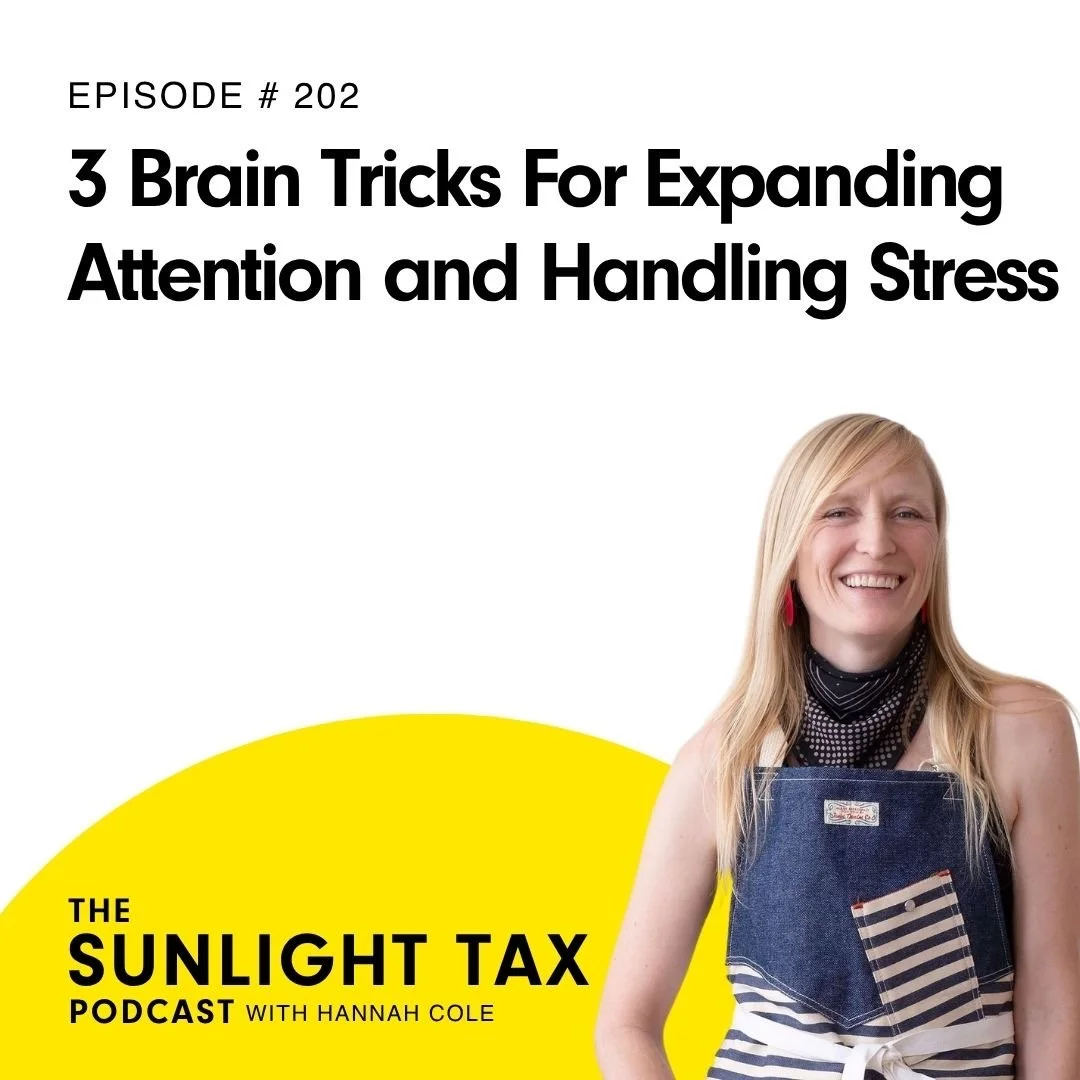
3 Brain Tricks For Expanding Attention and Handling Stress
Listen and Subscribe here
This week, I’m sharing my personal journey of resetting my mind and business, and the three simple brain shifts that have helped me expand my attention and handle stress in a more sustainable way. If you’ve been feeling overwhelmed, I walk you through practical, grounded tools you can start using right away to feel more focused and in control.
In this episode, I explore how I’m learning to manage overwhelm and embrace humility through powerful metaphors. My hope is that this conversation gives you permission to slow down and make small, meaningful changes that support a more intentional life and work.
“Let’s stop imposing my idea of how things should be, how people should behave, how things should work, and let’s just look at what’s there, right?”
This week, I’m sharing my personal journey of resetting my mind and business, and the three simple brain shifts that have helped me expand my attention and handle stress in a more sustainable way. If you’ve been feeling overwhelmed, I walk you through practical, grounded tools you can start using right away to feel more focused and in control.
In this episode, I explore how I’m learning to manage overwhelm and embrace humility through powerful metaphors. My hope is that this conversation gives you permission to slow down and make small, meaningful changes that support a more intentional life and work.
Also mentioned in today’s episode:
00:10 A journey on how I’m embracing the Reset
12:08 The Power of Reading
15:24 Building a Supportive Community
If you enjoyed this episode, please rate, review and share it! Every review makes a difference by telling Apple or Spotify to show the Sunlight Tax podcast to new audiences.
Episode Links:
Take the 2-minute survey here.
The Sunlight Tax Podcast Episode 201: Amelia Hruby: How to Build a Successful Business Without Social Media
Get my Tax Help onSubstack.
Get your FREE visual guide to tax deductions
Order my book: Taxes for Humans: Simplify Your Taxes and Change the World When You’re Self-Employed
TAKEAWAYS:
Taking a pause can improve mental clarity and productivity.
Reading more and reducing screen time enhances sleep and attention.
Using accountability tools like co-working sessions can reduce task avoidance.
Where To Put Your Money: First, Next and Last
Listen and Subscribe Here
In this episode of the Sunlight Tax Podcast, I share core personal finance strategies for creative entrepreneurs, artists, and business owners. Learn the right order of operations for managing money, why an emergency fund is essential, practical debt management tips, and simple ways to start investing with low-cost index funds.
Join me today to hear some basic steps to control your finances and how you can start investing today.
Listen and Subscribe Here
In this episode of the Sunlight Tax Podcast, I share core personal finance strategies for creative entrepreneurs, artists, and business owners. Learn the right order of operations for managing money, why an emergency fund is essential, practical debt management tips, and simple ways to start investing with low-cost index funds.
Join me today to hear some basic steps to control your finances and how you can start investing today.
Also mentioned in today’s episode:
00:23 Navigating Life's Unexpected Challenges
01:19 Understanding Personal Finance Order of Operations
04:01 The Basics of Personal Finance
07:55 Debt Management Strategies
08:48 Prioritizing Savings for Retirement and Education
10:13 Investing Basics and Strategies
13:25 Empowering Financial Education and Resources
If you enjoyed this episode, please rate, review and share it!
Every review makes a difference by telling Apple or Spotify to show the Sunlight Tax podcast to new audiences.
Links:
Join my free class: Make Taxes Easier and Stash an Extra $152k in Your Savings
Check out my program, Money Bootcamp
Order my book, Taxes for Humans: Simplify Your Taxes and Change the World When You’re Self-Employed
The $100K Financial Literacy Reward, and The Hidden Costs of Buy Now, Pay Later
Listen and Subscribe Here
In this episode of the Sunlight Tax podcast, I dig into the real impact of Buy Now, Pay Later (BNPL) services on spending habits and financial health. These “pay-later” plans may seem harmless, but they can quietly lead people, especially young consumers—into cycles of debt and financial stress.
I break down how BNPL changes the way we think about money, what the long-term risks are, and why financial education is one of the most effective tools for protecting yourself. Research shows that learning even the basics of personal finance can save you tens of thousands of dollars over your lifetime.

Listen and Subscribe Here
In this episode of the Sunlight Tax podcast, I dig into the real impact of Buy Now, Pay Later (BNPL) services on spending habits and financial health. These “pay-later” plans may seem harmless, but they can quietly lead people, especially young consumers—into cycles of debt and financial stress.
I break down how BNPL changes the way we think about money, what the long-term risks are, and why financial education is one of the most effective tools for protecting yourself. Research shows that learning even the basics of personal finance can save you tens of thousands of dollars over your lifetime.
Also mentioned in this episode:
02:00 Introduction to Personal Finance and Consumer Culture
04:15 The Dangers of Buy Now, Pay Later Services
06:37 The Importance of Personal Finance Education
09:49 The Value of Financial Literacy
12:28 Building Wealth Through Smart Financial Habits
If you enjoyed this episode, please rate, review and share it!
Every review makes a difference by telling Apple or Spotify to show the Sunlight Tax podcast to new audiences.
Links:
New York Times Article: They Got To Live A Life Of Luxury. Then Came The Fine Print 'Buy Now, Pay Later' has built a delirious new culture of consumption — and trapped users in a vortex of debt.
CNBC Article: You can put a price tag on the value of a personal finance education: $100,000
Link to pre-order my book, Taxes for Humans: Simplify Your Taxes and Change the World When You’re Self-Employed.
Link to pre-order my workbook, Taxes for Humans: The Workbook
Get your free visual guide to tax deductions
Join my free class: Make Taxes Easier and Stash an Extra $152k in Your Savings
The One Habit That Gets You to Financial Security
Listen and Subscribe Here
In this episode of the Sunlight Tax podcast, I reveal the #1 habit that sets successful freelancers apart: consistent saving. Discover why saving is like a muscle you need to train, how small, steady contributions to retirement accounts can snowball into long-term financial security, and why waiting for the "perfect" moment to save holds you back.
I share my personal journey, real success stories from my community, and practical tips to overcome the psychological barriers that keep many creatives and freelancers from building wealth. Whether you’re just starting out or have been self-employed for years, you’ll learn how to take imperfect but powerful action toward your financial goals and harness the power of compound interest to create a more secure future.
If you’ve ever felt behind on saving, this episode will give you the motivation and strategy you need to start today.
Listen and Subscribe Here
In this episode of the Sunlight Tax podcast, I reveal the #1 habit that sets successful freelancers apart: consistent saving. Discover why saving is like a muscle you need to train, how small, steady contributions to retirement accounts can snowball into long-term financial security, and why waiting for the "perfect" moment to save holds you back.
I share my personal journey, real success stories from my community, and practical tips to overcome the psychological barriers that keep many creatives and freelancers from building wealth. Whether you’re just starting out or have been self-employed for years, you’ll learn how to take imperfect but powerful action toward your financial goals and harness the power of compound interest to create a more secure future.
If you’ve ever felt behind on saving, this episode will give you the motivation and strategy you need to start today.
Also mentioned in this episode:
01:11 The Key Habit of Successful Freelancers
03:40 Overcoming Perfectionism in Saving
06:37 The Power of Consistent Savings
09:12 Building a Safety Net with Small Contributions
11:51 The Psychology of Financial Habits
14:54 Real Success Stories from the Community
18:26 The Importance of Habits Over Windfalls
21:10 Encouragement and Resources for Financial Security
If you enjoyed this episode, please rate, review and share it!
Every review makes a difference by telling Apple or Spotify to show the Sunlight Tax podcast to new audiences.
Links:
Join my free class: Make Taxes Easier and Stash an Extra $152k in Your Savings
Check out my program, Money Bootcamp
Link to pre-order my book, Taxes for Humans: Simplify Your Taxes and Change the World When You’re Self-Employed.
Link to pre-order my workbook, Taxes for Humans: The Workbook
Get your free visual guide to tax deductions
What are your money concerns?
Suggest a blog topic for Hannah here.