

THE SUNLIGHT TAX BLOG:
Tax and Money Education for Creative People, Freelancers and Solopreneurs
search A TOPIC
Categories
- Business Management 22
- Creative Specific 3
- Estimated Quarterly Taxes 8
- General Economy; Tax Policy and Legislation 52
- Get to know Hannah Cole 8
- Interviews and personal stories 36
- Personal Finance 26
- Personal and Career Development 22
- Practical and Tactical Tax 57
- Retirement and Future Success 28
- Sunlight Podcast 149
- Tax Deductions for Freelancers and Self-Employed 9
- the Sunlight Tax Podcast 67
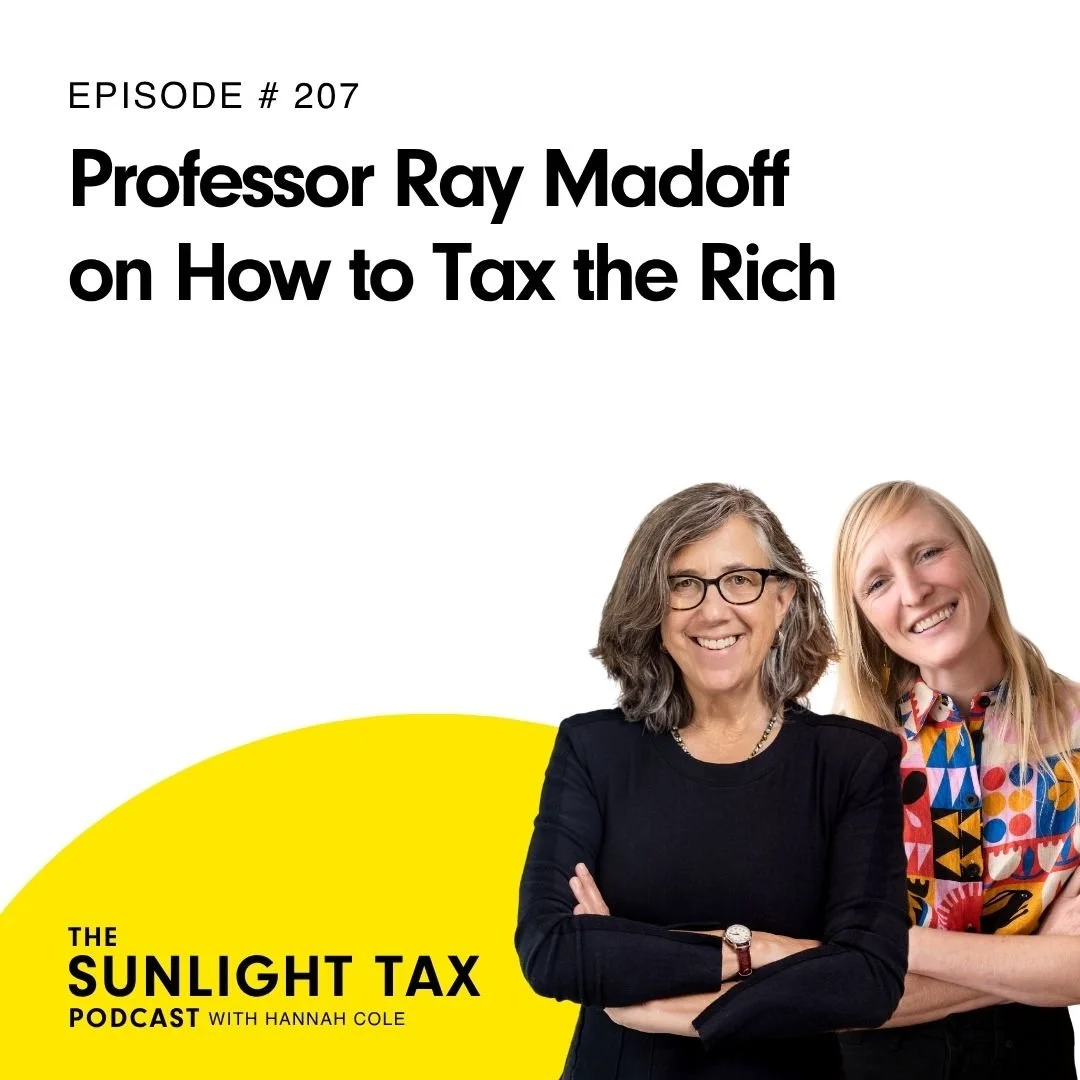
Professor Ray Madoff on How to Tax the Rich
Listen and Subscribe Here
Why do billionaires often pay lower tax rates than working Americans?
In this episode of the Sunlight Tax Podcast, I sit down with tax policy expert and professor, Ray Madoff, to explore how income, wealth, and inheritance are taxed in the United States, and why the current system often favors the ultra-wealthy.
We discuss wealth inequality, estate taxes, billionaire tax strategies, and the most promising proposals for tax reform. If you've ever wondered how the tax code shapes who builds wealth in America, this conversation offers a clear and accessible look at what a fairer tax system could look like.
“Somebody who is self-employed and earned sixty thousand dollars will pay about thirteen thousand dollars in income taxes and payroll taxes.”
Why do billionaires often pay lower tax rates than working Americans? In this episode of the Sunlight Tax Podcast, I sit down with tax policy expert and professor, Ray Madoff, to explore how income, wealth, and inheritance are taxed in the United States, and why the current system often favors the ultra-wealthy.
We discuss wealth inequality, estate taxes, billionaire tax strategies, and the most promising proposals for tax reform. If you've ever wondered how the tax code shapes who builds wealth in America, this conversation offers a clear and accessible look at what a fairer tax system could look like.
“Let’s say that you’re Mark Zuckerberg. What he has is a growth in value of his stock. And even though that growth in value of his stock has made him very, very rich, it is not treated as taxable income.”
Also mentioned in today’s episode:
02:30 Background on Professor Ray Madoff and her work
05:40 How the tax system favors the wealthy
07:19 The impact of growth in stock value and tax treatment
09:02 Living off wealth, not income
10:04 Inheritance, gifts, and the lack of taxation
12:15 The estate tax and loopholes
16:20 Public perception and fairness in the tax system
17:21 How the wealthy avoid taxes: borrowing against assets
23:02 Political feasibility of tax reforms
25:46 Wealth taxes and their challenges
29:56 Legal and constitutional issues with wealth taxes
31:46 Potential benefits of well-designed tax policies
If you enjoyed this episode, please rate, review and share it! Every review makes a difference by telling Apple or Spotify to show the Sunlight Tax podcast to new audiences.
About Professor Ray D. Madoff:
Ray D. Madoff is a professor at Boston College Law School and the cofounder and director of the Boston College Forum on Philanthropy and the Public Good. She is the author of Immortality and the Law: The Rising Power of the American Dead and lead author of The Practical Guide to Estate Planning. Her writing has appeared in The New York Times, The Wall Street Journal, The Washington Post, and The New York Review of Books, among other outlets.
Episode Links:
Professor Ray Madoff’s Book: The Second Estate: How the Tax Code Made an American Aristocracy
My FAQ page on how to Tax the Rich
Get your FREE visual guide to tax deductions
Order my book: Taxes for Humans: Simplify Your Taxes and Change the World When You’re Self-Employed
Transcript:
Hannah Cole (00:07)
Hello, beautiful. I am so excited to bring you a guest I have really wanted to get on to the Sunlight Tax podcast ever since I read her incredibly readable, incredibly educational book, The Second Estate: How the Tax Code Made an American Aristocracy. So today on the podcast, I am here with Dr. Ray Madoff. She's a professor at Boston College Law School, where she teaches and writes in tax law and policy.
Wills and Trusts Law and Estate Planning. She is co-founder and director of the Boston College Law School Forum on Philanthropy and the Public Good, a nonpartisan think tank that convenes scholars and practitioners to explore questions regarding whether the rules governing the charitable sector best serve the public good.
Hannah Cole (00:55)
Professor Madoff, thank you so much for joining me on the Sunlight Tax podcast.
Ray Madoff (00:59)
Thank you for having me. It's very fun to be here.
Hannah Cole (01:02)
so I'm a tax educator, but I come at it from the practitioner side, kind of boots on the ground with really most of my expertise developed around my clients who are decidedly not the 1%. And so when it comes to higher level things and policy and where, you know, our taxes as self-employed people primarily kind of
Ray Madoff (01:23)
Rosal.
Hannah Cole (01:24)
in to the larger system, I need help. And that's why I was so excited to talk to you.
Your book is outstanding. I hope everyone listening gets a copy of The Second Estate. It is fantastic.
Ray Madoff (01:38)
Thank you so much.
Hannah Cole (01:40)
my gosh. So can you start us off by just giving us a little background on a big question that I think is confusing for people is income versus wealth.
Ray Madoff (01:51)
Sure. so the question is it's sort of it's interesting. Income is the thing that you know, we get from our jobs and we get it from a lot of different places, but it's basically about the flow of money that somebody acquires. And wealth is more of a static number. It's how much how much do you own? So
Hannah Cole (02:14)
Mm-hmm.
Ray Madoff (02:14)
income is what are you taking in and how much do you own?
The reason it's little bit complicated in the tax world is that the word income in income taxes, the definition of income,
Hannah Cole (02:27)
Mm-hmm.
Ray Madoff (02:27)
excludes lots of income that ends up being the income of the wealthiest Americans.
Hannah Cole (02:33)
So you just touched something that really unlocked, think, for me, what I think is going to be the core of.
the learning from your book for people, which is what counts as income is a key to who we actually tax and who pays the most tax. And I think when I'm giving workshops about how self-employed people's taxes work, I'll write the rates on the board, 0 to 37%. And 37%, that looks kind of high. And then you add self-employment tax to that.
it looks even
Ray Madoff (03:07)
Yeah.
Hannah Cole (03:08)
higher. And so people are thinking, well, I guess the wealthy really actually pay quite a high tax rate. So could you kind of share with us, Professor Madoff, like why that is not quite how it works?
Ray Madoff (03:21)
Exactly. So first of all, your clients are right. They are the ones that are self-employed people are hit the heaviest with taxes. So they have income taxes, as you said, up to 37%. And on top of that, they have payroll taxes that are at about 15.3%. And those payroll taxes start right away at the first dollar earned. Unlike income taxes, which have pretty large exemptions.
In addition, payroll taxes can't be offset by things like charitable giving or other deductions. It's a so we call those the hidden taxes because people don't really they haven't really been educated about them. They're very surprised that they have them. They're kind of hidden. And even for employees of somebody else, people who aren't self employed, they are in some ways doubly hidden because they show up not as taxes on your
pay stub, but as these sort of funny FICA and FUTA and they're called contributions. They make it seem like people are saving for their own retirement, but this is actually money that is currently being used to pay for the Social Security and health care of current retirees. And so it is a tax just like any other tax, but it it's kind of hidden from the public. So
so people so somebody who is self employed and earned sixty thousand dollars will pay about thirteen thousand dollars in income taxes and payroll taxes. That's just to the federal government. That's a lot of money for somebody who's trying to get by on sixty thousand and then they pay state taxes on top of that. So
Hannah Cole (05:01)
for sure.
Ray Madoff (05:02)
now to answer your question, let's move over to other Americans, not people who work either for themselves or for others, but people who have
wealth and they've acquired it either through their investments, their investments have gone up in value, or through their inheritances. And here the tax system is very, very different. so for people who have, let's say that you're Mark Zuckerberg, right, who was many times over now centi billionaire, right? He's got the probably more than two hundred billion dollars.
But all of his wealth has not come from salaries, right? He's just a dollar a year guy, so he doesn't pay very much in income taxes or payroll taxes. What he has is a growth in value of his stock. And even though that growth in value of his stock has made him very, very rich, it is not treated as taxable income because we have a rule that gains.
are only subject to tax when they are sold. You have to sell the property and somebody like Mark Zuckerberg doesn't have to sell the property. He can simply borrow against his property and not sell it and therefore not have any taxable income.
Hannah Cole (06:23)
Amazing. Yeah, I think just to underline in case someone was listening and kind of missed the quick hit of that, he isn't paying based on earning, right? We who listening, you, me, everybody listening, we earn the money that we live on. Mark Zuckerberg is doing this other thing and living off the growth of his wealth, right? Yeah.
Ray Madoff (06:43)
Yes. And arguably
it is an earnings, right? But we don't in the tax code we treat it as a nothing until it's actually sold. As if
Hannah Cole (06:51)
Mm-hmm. Yeah.
Ray Madoff (06:54)
as if his life is the exact same as somebody who has nothing because financially, right? Because
Hannah Cole (07:01)
this.
Ray Madoff (07:02)
he because he hasn't sold it. And that's
Hannah Cole (07:04)
Yeah.
Ray Madoff (07:04)
a kind of a weird thing. It gets even weirder when we look at the income tax of inheritance or
Hannah Cole (07:11)
Yeah.
Ray Madoff (07:11)
somebody who
gets money from either a gift or an inheritance or a life insurance policy. If you were given ten million dollars
Hannah Cole (07:21)
...
Ray Madoff (07:22)
you're treated as if you have nothing. You don't have to tell anybody, you don't have to report it. it's just yours. It's your own private thing that somebody gave you ten million dollars. On the other hand, if you and I were to enter into a barter exchange, right? You were to make you know many fantastic silkscreen bags for me and I was to make sourdough bread for you
We would
Hannah Cole (07:48)
Okay.
Ray Madoff (07:48)
each be required to pay income taxes on the value of what we had received for our services.
Hannah Cole (07:57)
Yes.
Ray Madoff (07:57)
We'd have to we'd have to tally and report it to the government. But yet if we're handed ten million, that's just for you to know, private.
Hannah Cole (08:05)
Just unbelievable to me. I have to teach people this and sometimes
Ray Madoff (08:09)
Yeah.
Hannah Cole (08:10)
the example that I give, and it's frankly kind of ridiculous and I feel bad saying that this is how it works, but like a musician, and I've known many who basically like play session music in an Irish pub, like there's one in Boston that I used to go to all the time, the Burren in Somerville.
Ray Madoff (08:26)
Yeah, of course.
Hannah Cole (08:27)
And I was friends with a lot of the musicians there who would basically just pay for pints, right? So
Ray Madoff (08:32)
Right. Yeah.
Hannah Cole (08:33)
those...
Heinz, that beer that they're drinking all night, that's their only pay. That is a pretty meager living for very accomplished
Ray Madoff (08:40)
Yeah.
Hannah Cole (08:40)
musicians. And yet it is taxable income, the value.
Ray Madoff (08:44)
It was taxable, even the beers were taxable.
Hannah Cole (08:46)
Well, what I'm saying is that is a barter exchange. So technically, the tax code, that is barter. Yeah.
Ray Madoff (08:49)
Yeah. Right. Of course. Yeah. That's what it's all taxable to them. That's right. Yeah.
Hannah Cole (08:55)
So yeah, to
a point of ridiculousness, when you compare that to your example, if that's shocking. if somebody gives you $10
Ray Madoff (08:59)
Yes. Yeah. You find ten
you find a hundred bucks on the street, you're supposed to report it to the IRS, but somebody hands you ten million. Well that's your business. Now for the the non-taxation of gifts and inheritances and things like that, the theory
The reason that that exclusion was originally provided was on the assumption that we have an estate tax. An estate tax is a whole separate tax system that was supposed to apply to the richest 1% of Americans. Right now it imposes a tax at a flat 40% rate on all transfers in excess of a pretty big exemption, $15 million. So our $10 million gift wouldn't be captured by it.
Here's the thing about the estate tax. The estate tax so it looks like we have a system that's gonna do some pretty serious damage, right? If all of our rich people paid a 40% tax on everything that they owned when they died or that they gave away, that'd be a lot of money. But the problem
Hannah Cole (10:04)
Agreed.
Ray Madoff (10:05)
is that it has been 36 years since Congress has closed a single loophole in the estate tax. 1990 was the last time. And that's because
The estate tax was really essentially killed through a campaign that was funded by eighteen of the country's richest families. And many of your listeners might know the phrase death tax and a double tax that hurts family farms and businesses, right? There was this very powerful campaign that really turned the public against the estate tax, making them think it was unfair.
Because of course people didn't know about the lack of income tax. They just know, like, maybe this is a second tax on top of it all. And and because it loopholes haven't been closed, the estate tax raise is essentially nothing. And it's really just more something that people have to plan around rather than something people have to pay. And the evidence of it is in the fact that the
the estate tax, so estate tax supposed to apply to the richest one percent. Right now that group owns fifty-five trillion dollars. Fifty-five trillion dollars. This is a time when the total revenue the government takes in in 2025 was five trillion. And the wealth of the richest one percent was fifty-five trillion. Okay. How much estate and gift taxes did that one percent pay? Twenty-eight billion dollars.
nothing. Absolutely. Or point
Hannah Cole (11:37)
So that's moving that.
Ray Madoff (11:40)
zero six percent. Sorry, point zero six percent, yeah.
Hannah Cole (11:43)
Moving that decimal point from 40 % way, way down to under way under 1%. That's
Ray Madoff (11:47)
Yes, exactly. Yeah.
Hannah Cole (11:50)
shocking.
Ray Madoff (11:51)
Yeah. And so in and the reason that we know that the estate tax doesn't impose any harm on people, is that if in case you need any further inf reason than that number, but is the fact that when Trump had it in his full command to enact whatever tax rules he could, right, in the his most recent tax bill,
The Republicans had consistently been running on that we have to repeal the death tax because it's so immoral. He had the chance to do it and he didn't bother. And it's
Hannah Cole (12:20)
That's it.
Ray Madoff (12:21)
because he they know that it provides more cover for the rich because it allows for this very unfair income tax system that otherwise wouldn't withstand scrutiny. People would be like, Well, that's crazy. Why can you receive ten million dollars tax free but we have to tax the Burron guy on the on his pints?
Hannah Cole (12:40)
Yep.
Ray Madoff (12:40)
Doesn't make sense.
so I think that's how we kind of have gotten into that situation of not taxing inheritances.
Hannah Cole (12:47)
Man, it's just shocking that inheritances are not taxed. And I was just rereading the early chapters of your book this morning and reminded myself that a third of Americans on the list of 400 richest families are there simply because they inherited the money. That's not even them working ever.
Ray Madoff (13:05)
That's right. That's right.
Hannah Cole (13:08)
Unbelievable. So I think the arc of this conversation that I would really love, because I think
I'm seeing culturally so much of a sense of unfairness that people actually begin to check out and nihilistic, which I actually think is the enemy of progress.
Ray Madoff (13:24)
Yeah, yeah. I totally agree. I think that there is reason for hope.
Hannah Cole (13:30)
Yeah, I do too. So I do want to touch on how the wealthy actually avoid tax because I do think, you know, my company is called Sunlight On Purpose. Let's shine some sunlight on that one.
Then I, and I do have some questions for you because there is a midterm election coming up. A lot of people are proposing wealth taxes. There are
Ray Madoff (13:50)
Mm-hmm.
Hannah Cole (13:50)
some out there that may be better than others. And I would love to kind of land the plane near what you think we should do. So if you wouldn't mind just doing the sketch first. So I just want to warn the listener. not going to go down a black hole of how terrible things are and stay there. We're going to come out.
Ray Madoff (14:09)
No. Yes.
Hannah Cole (14:10)
But could you sketch
Ray Madoff (14:10)
Right.
Hannah Cole (14:11)
for us how the wealthy are avoiding paying taxes?
Ray Madoff (14:14)
Yeah. So basically there's just two main things. It's the so when you think about how most people listening to this podcast probably get their money, is they probably work for it, right? That's how most Americans get their money and they're subject to heavy taxes. People who already have wealth, either they were given it or they have been given stock and they you know they or they have stock in their companies. so they don't pay tax as their property goes up in value.
And if they need to access that property, they can borrow against it instead of selling it. So they can you know, many people are in the business of lending money and they are happy to lend money to very rich people who can provide a lot of security for their borrowing. Right? These things are f these loans are fully secured, nobody's worrying about not getting paid back. And so they
Hannah Cole (15:04)
Right, I'm the banker
and I'm looking at all of Mark Zuckerberg's
Ray Madoff (15:07)
Yeah.
Hannah Cole (15:07)
money. I'm not worried about him defaulting, really.
Ray Madoff (15:09)
Exactly.
And you're you're and you're thrilled to lend the money because you get interest and you know you have to offer them very favorable rates, but still the the loan is very strong. So that's that's your business model. So
Hannah Cole (15:20)
Sounds like easy money. Yeah.
Ray Madoff (15:22)
you want to be lending money and these are the perfect people to lend the money to. And so they don't pay any taxes. we call this buy, borrow, die, right? You you have an asset, it goes up in value, you borrow against it, and then you die.
It for those people who pass the property at debt there's like a little added benefit, which is that all the gains get wiped away.
Hannah Cole (15:45)
Yes, can we talk about that? I want to name it. It's called the step up in basis. But
we hide it behind this accounting term that most people don't know. So yes, will you explain that giveaway, step up in
Ray Madoff (15:55)
Yeah. So let's take our ten
million dollar person. Let's say that what I gave you, you got the ten I gave you ten million dollars of stock. I bought NVIDIA stock, Apple stock, something for very low. Now it's worth ten million dollars. And if I die and give it to you, you are treated as if you had purchased it for ten million dollars. So that ten million dollars of gain, I'm never subject to tax on it.
and you're never subject to tax on it. We sometimes call that the angel of death loophole, the step up and basis. But it it's a very, it's a rule that is, you know not really very fair given the numbers of our system, given the amount that can pass tax free, right? but people shouldn't think that fixing step up and basis will solve the problem.
Because that's just the frosting on the cake. The bigger problem is the fact that people have massive amounts of wealth that they've never paid taxes on and they never have to pay taxes on it. So I think a better rule would be the rule that they have in Canada, which says that whenever you transfer the property, whether by gift or at death, you just tally those gains. That's when you pay the gains. So that the person who had the run-up in value.
is the one who pays the gains, the same as the rest of us pay taxes on our other forms of income. Because so that would be that's one proposal for addressing that particular problem.
Hannah Cole (17:30)
Would that be called
a transfer tax?
Ray Madoff (17:33)
No, it would be called a it would basically be saying that it's a realization event.
Hannah Cole (17:39)
Okay.
Ray Madoff (17:40)
and so it's just saying that you realize gains not just when you sell, but also when you give the property away. Whenever you no longer own the property, that's when you tally those gains. Yeah. Yeah.
Hannah Cole (17:52)
Got it. Okay. Yeah, that sounds really fair. And they do it.
I love hearing that they already have this rule in Canada. It's hard to make
Ray Madoff (18:00)
Yeah. And
Hannah Cole (18:01)
it, but it's impossible.
Ray Madoff (18:02)
and there's also something kind of fun about this rule, which is that it was proposed both by President Obama and by President Richard Nixon. Yeah. It's
Hannah Cole (18:15)
Interesting. Huh.
Ray Madoff (18:16)
a it's really something that's kind of like a basic fairness thing, like why should we never tax those gains when we're taxing the barter exchanges? We're taxing found money on the street.
Right. So we should tax it to that person, we should tax it upon transfer. The other issue is about people who inherit money or receive it by gifts or because lots of this money is some of it is received at death of somebody, but a lot of it is that money is put into trusts. These trusts are huge. The trusts make distributions and basically much of those distributions are received entirely tax free. And why should that be the case?
Why should we say that somebody that is given five million dollars a year from their trust, why should they be treated as the same as somebody who has nothing? It doesn't make sense. So so
Hannah Cole (19:07)
Agreed. Agreed.
Ray Madoff (19:09)
that's what we should do and we and and we should get rid of the estate tax because it's not doing anything. And
Hannah Cole (19:15)
Hm.
Ray Madoff (19:16)
yeah.
Hannah Cole (19:17)
I have a question for you about that. So I agree with you. It is providing cover to the more educated person who even is aware that it is there for tax fairness, or in theory is there for tax fairness. It provides some cover for an unfairness elsewhere in the system. But do you think politically that it would be possible fix the estate tax?
Or is it an easier fight
Ray Madoff (19:43)
No.
Hannah Cole (19:43)
to get rid of it?
Ray Madoff (19:44)
The reason I don't think it's possible to fix the estate tax is that
Hannah Cole (19:48)
Mm-hmm.
Ray Madoff (19:48)
there is a little bit of incoherence built into the estate tax. For somebody who has worked their whole life and has had a lot of taxable income, right? Let's say Paul McCartney, right? He's probably he's very, very rich, right? But he's probably paid a lot of taxes on that money because
It's from, you know, things that are all taxable, I assume, mostly. and the way the estate tax is structured, the way it it is, and so the way it looks to the American public is now you're dead and now we're slapping on an additional tax. It just doesn't it feels weird in that situation, right? To be taxing that person. Now, of course what people don't focus on is who really is.
Getting the economic benefit of it, and that's whoever is receiving this property. But the tax is imposed based on the amount of wealth that the person has, right? As opposed to the amount of wealth that of the people who receive it. An income tax system is a much more coherent system and one that people can understand because now we're not talking about double tax. We're talking about the fact that an entirely different person has been handed.
you know, couple of million dollars. And
Hannah Cole (21:09)
Mm-hmm.
Ray Madoff (21:10)
we should decide how much people should be able to inherit entirely tax free. If we want to have a preference for inheritances, that's fine. I understand that we want people people want to have, you know, they people want to be able to provide for their families. And so it makes sense
Hannah Cole (21:27)
Of course.
Ray Madoff (21:27)
that we can say, fine, we'll have a preference for a certain amount of inherited income, but we should recognize that it's a preference. And then when we say
How much should inherited income be preferenced over income from work? Then we we'll get a different type of number rather than this other discussion about well how much should the second tax be on somebody who's already paid a lot of taxes? Does that make sense?
Hannah Cole (21:51)
Yeah. Yeah, I
feel like in the tax code, you see this a lot. Look over here, not over here. And it kind of falls in that category.
Ray Madoff (21:57)
Yes, exactly. Exactly.
And that's why I think that by simplifying the system, right, and bringing it all into the income tax, then everybody can understand a little better how the system works.
Hannah Cole (22:11)
Yeah, I like it. I like it. And it makes it simple, and it makes it feel fair. So there's a lot of buzz. California has a wealth tax proposal. Everybody's talking wealth taxes. And
Ray Madoff (22:23)
Yeah.
Hannah Cole (22:24)
I think that's the easy kind of go-to phrase that makes you understand what the project is. But there's some issues with the wealth tax. Can you kind of talk about what the issues are, and maybe talk about if you are able?
What do you think of the California wealth tax? What do you think of Mamdani's Pied-a-Terre tax in New York City? And what would work better?
Ray Madoff (22:47)
Right. Okay. So the wealth taxes, we first heard about them from Elizabeth Warren and Bernie Sanders, right? We should have wealth taxes. A wealth tax is a tax on the amount of wealth that a person has. So it in some ways makes a lot of sense, right? Because we have a lot of very, very rich people. Many of them have not have been able to avoid taxes on them. Some people have paid taxes on it, right? But most of them
haven't. So the idea is, well, let's just tax the wealth if that's the problem, that they're able to acquire the wealth tax-free. And the problem is that when you it it's sort of like a lot of answers that like, well this makes sense, like I call these kind of round one answers, you know, it's the one that makes the most sense and let's just do it. They often
When you push them a little further, they often are a little less satisfying. And so the wealth tax has some pretty significant problems. on the state level, the problem is that very it's very, very easy for people to leave states. And so I live in Massachusetts, you know, Massachusetts, New York, California, we've all lost population to Texas, Florida, you know, tax free states. There's competition among the states. So it's very hard.
for states to impose these sort of taxes that are disproportionate to their sister states. It's just a fact that people can easily move out of a state. Not
Hannah Cole (24:19)
Yeah.
Ray Madoff (24:19)
everyone's gonna move, but I think it could still have an effect on decisions of others whether to set up shop there or in another state. You know, we have to I live in Massachusetts, I love Massachusetts, I'm happy to pay Massachusetts taxes. But
I appreciate that not everybody's gonna feel that way. And so we probably lose business to New Hampshire, you know, and so
Hannah Cole (24:42)
Yeah, for sure.
Ray Madoff (24:43)
and so that's a problem for states. Yeah.
Hannah Cole (24:46)
Yeah. You're speaking
to someone who is the product of the Massachusetts public school system, for which I'm very grateful. It's actually who I dedicated my book to, is the taxpayer But I do,
Ray Madoff (24:55)
Wow, that's great. That's wonderful. Yeah.
Hannah Cole (25:00)
as an accountant, someone who's very aware of how my industry profits off of people's lack of education about how their taxes work, I picture such a ballooning mega industry of wealth calculation.
wealth valuation from accountants,
Ray Madoff (25:16)
Well there's another yes.
Hannah Cole (25:18)
know, valuing the amount of wealth you have is quite a heavy burdensome task. That's kind of a lot to ask much harder than meets the eye.
Ray Madoff (25:27)
I totally agree. It's also, I think, going to feel even to the people who aren't subject to it, it's going to feel invasive. Because
Hannah Cole (25:36)
Mm-hmm.
Ray Madoff (25:37)
we are h as a country, we have not been used to doing annual assessments of people's wealth. We do certain things, we assess the value of their homes and their cars, but that's very different than tell us the value of everything that you own. And so it has a type of an intrusive aspect of it. I think
I'm not sure the public is there yet in supporting it. one other thing to note is that on the federal level, we have an even bigger problem, which is that the federal are the constitution has a provision against direct taxes and there's some question about whether wealth taxes would violate this provision. And the Supreme Court had a case in a couple of years ago where they basically said, Yeah, we might very well find this unconstitutional.
They didn't say it in so many words. So I think given the makeup of the current Supreme Court, if we spent all of our political capital to get a wealth tax, it could be a very sad end if a year later the Supreme Court found it unconstitutional and then we had not solved the problem through other means.
Hannah Cole (26:43)
Bingo. I couldn't agree more. And I love your solution, which feels inherently fair to bring income into the income tax system that is currently just given a pass as though it's not income. Yeah.
Ray Madoff (26:55)
Yeah. Right. Exactly.
Hannah Cole (27:00)
I love it. So in a little lightning round, do you have any kind of pros or cons about the California wealth tax, the New York City tax?
Ray Madoff (27:09)
Yeah, so
I mean the Califor you know, look, I'm there's certain things about the California Wealth Tax that I love, which is that I feel that it's educated the public about this issue.
Hannah Cole (27:16)
Mmm.
Ray Madoff (27:17)
And so, you know, I'm I'm a fan of that. And I think that one thing I learned from my book is how good tax reform proposals came about when there was fear by others that worse proposals would take place. So in the time it was like really so when
When socialism was a very big threat in this country in the early part of the twentieth century, and when communism was a very big threat in the nineteen thirties, right? That's what enabled us to get the modern day income tax, estate tax, and then the whole system of Social Security. So, you know, so in some ways I'm all in favor of more aggressive proposals being out there because I think that they increase the likelihood of having more sensible.
practical proposals actually being adopted. So
Hannah Cole (28:08)
Agreed, agreed. I
love it. Any thoughts on the New York City tax?
Ray Madoff (28:13)
the Pied Terre tax?
Hannah Cole (28:15)
Yeah.
Ray Madoff (28:15)
Yeah. Not I mean that's you know, people like to live in New York and so it's a little and it of course it's and it's just housing. Housing is already subject to tax. So you know Right.
Hannah Cole (28:24)
And it's only second houses. It's not primary residences, which.
Ray Madoff (28:28)
Right. So it seems like it's it's fairly well targeted for the thing they're trying to get at, which is people who don't live in the state, so they're generally not paying taxes in the state, but they want to enjoy the benefits of New York City. So
you know, I don't I don't have really strong feelings about it, but it certainly seems like something that's less likely of course it's not gonna raise the revenue of the California wealth tax. So it's a little bit of a s it's a kind of a a small a small bore item, but you know, but it seems like it's could work for something.
Hannah Cole (29:01)
Yeah, I hear you. Yeah, and I like, you said well targeted. And I do want to kind of double click on that term because I do think there's this idea out there that, we're going to do some ham-fisted, really unintelligent tax proposal. And actually, you can make a well-tailored tax law that hits the right people.
Ray Madoff (29:19)
Absolutely. Absolutely.
Hannah Cole (29:21)
We have a capital gains exclusion when you sell your primary residence on purpose because people have to do that. But if you sell a
second home, third home, fourth home, that's when bigger taxes kick in. So you can tailor things. Yeah.
Ray Madoff (29:35)
Right. Absolutely. Yeah.
Hannah Cole (29:38)
I love it so much. So first, I just want to thank you so much, one, for taking the time, Professor Madoff, being with us today. And also just this book, The Second Estate, How the Tax Code Made an American Aerosocracy. You know, I don't have the visual. But I read it twice.
Ray Madoff (29:50)
You have a do you have the book there or you or you're looking at a piece
Hannah Cole (29:56)
I read it twice. It's only five hours And it's so enjoyable.
Ray Madoff (29:56)
He thought wonderful. Yes. It's very short, yeah.
Hannah Cole (30:00)
I think a lot of people are scared of a tax book. So let me just say
Ray Madoff (30:04)
Yeah.
Hannah Cole (30:04)
to the listeners, it's so pleasant, enjoyable, accessible. It explains things. And so it's a great way to get educated. I could not believe in that more. So thank you for your effort on that. I feel like you've really put some great ideas out there into the ether. And now I want people to eat them up.
Ray Madoff (30:23)
Thank you
so much. It's wonderful meeting you and thanks for all the great
Hannah Cole (30:26)
Awesome.
Ray Madoff (30:26)
work you're doing.
Hannah Cole (30:27)
Thank you so much. I really appreciate And keep in touch. Maybe we'll see each other in Boston sometime. All right. Thank you so much. Take care.
Ray Madoff (30:31)
Yes. Wonderful. Okay. Bye bye. Okay.
Yeah.
Hannah Cole (30:37)
I hope you enjoyed that conversation with Professor Madoff as much as I did. I really highly recommend her book, The Second Estate. I read it twice. It's only five hours on audio format and super readable. So highly recommend. And I also want to just point you once again to my Tax the Rich Quick Facts website. So if you want to
Push the needle forward, build a movement with me, with Professor Madoff. go to sunlighttax.com/taxtherich. And I have a bunch of quick facts in case you want to pull out nuggets from today's conversation to talk to your friends about, just to have at the ready some some stats, some knowledge, some quick facts, and some next steps. I have put that all together for you on a website, sunlighttax.com/
taxtherich. Also, while you're there, if you want to sport the message to your friends, as you know, I live in Asheville, North Carolina, and my studio was completely destroyed in all 20 years of work that was inside it during Hurricane Helene. And I am running a small fundraiser selling tote bags that say tax the rich. You can buy one.
For $25, or you can buy five for a hundred dollars and be mega super studio supporter, and that will help me buy the supplies that I lost and get started making art again. I've had a lot of friends buy the five tote bags, and I have seen people on Instagram tagging me as they give the totes away to people on the school board, people at the arcade as a prize for game night.
so it's really exciting to me to start seeing those tote bags out in the world. They're really fun. And I printed them by hand right here in my office at Sunlight Tax. So if you want one of those and you want those tax facts to share with your friends, please share this website with anyone and buy a tote bag if you feel moved to support me rebuilding my studio at sunlighttax.com/taxtherich. Thanks.
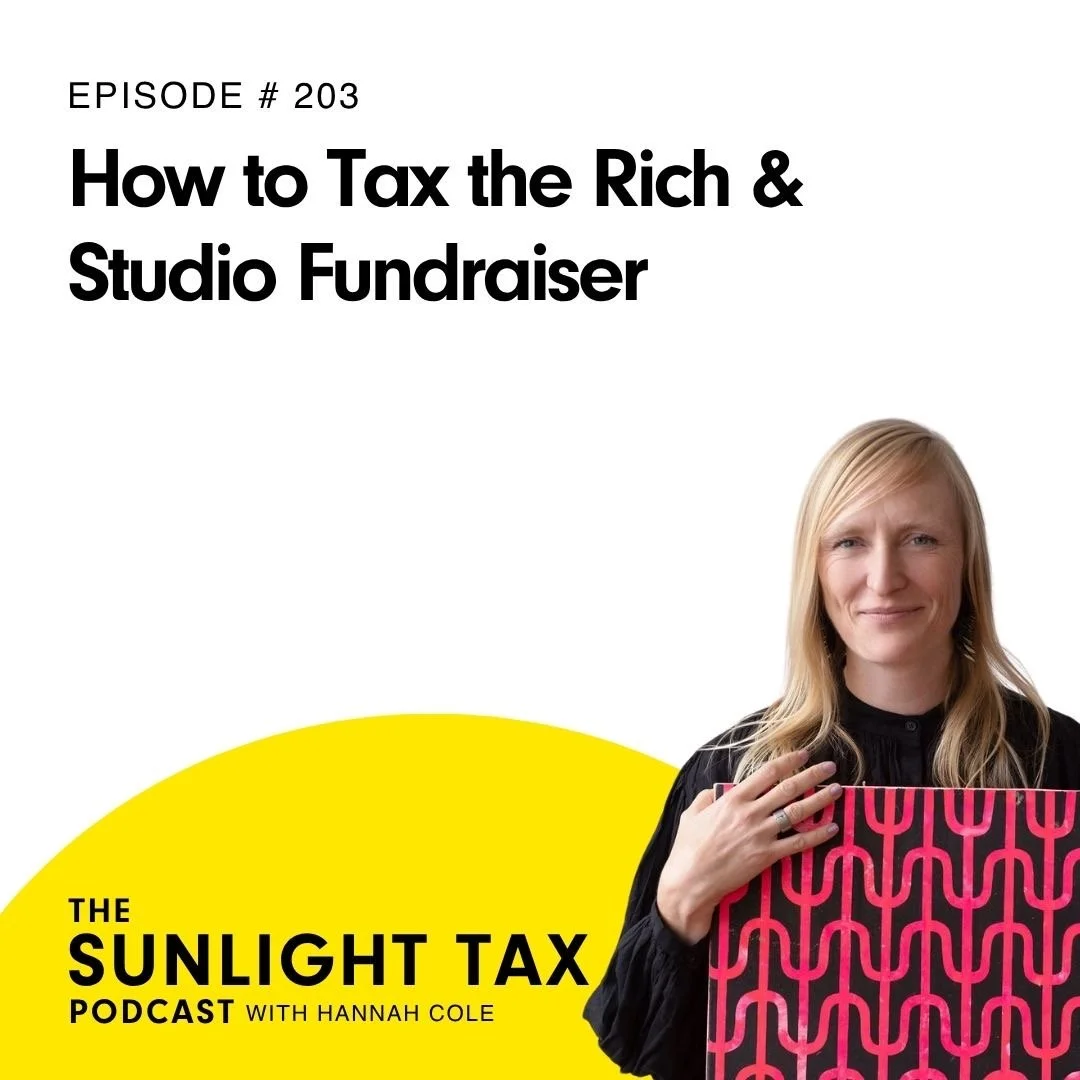
How to Tax the Rich and Studio Fundraiser
Listen and Subscribe Here
This week on the Sunlight Tax podcast, I share why tax fairness matters and how current tax policies disproportionately benefit the wealthiest Americans while placing a greater burden on working people and small business owners. I break down the growing gap between wealth and taxation, explain how these policies affect everyday life, and discuss why a more equitable tax system is essential for a stronger economy and society.
I also share the story behind my latest art project – a fundraiser to rebuild my Helene-destroyed studio that doubles as what I do best: Helping you understand & spread the word about a key issue that’s complex, fact-based, and offering real solutions. With a touch of handmade vibes. And spread the word (before the midterms), and buy a hand-printed tote that helps me rebuild.
“Everyone should feel that their taxes are fair.”
This week on the Sunlight Tax podcast, I share why tax fairness matters and how current tax policies disproportionately benefit the wealthiest Americans while placing a greater burden on working people and small business owners. I break down the growing gap between wealth and taxation, explain how these policies affect everyday life, and discuss why a more equitable tax system is essential for a stronger economy and society.
I also share the story behind my latest art project – a fundraiser to rebuild my Helene-destroyed studio that doubles as what I do best: Helping you understand & spread the word about a key issue that’s complex, fact-based, and offering real solutions. With a touch of handmade vibes. And spread the word (before the midterms), and buy a hand-printed tote that helps me rebuild.
Also mentioned in today’s episode:
00:10 Introduction and Personal Reflections
02:49 The Taxation Debate: Fairness and Advocacy
08:30 Understanding Wealth Inequality
10:09 Misdirection in Taxation
20:02 Strategies of the Wealthy
22:25 Systemic Failures in Taxation
25:27 Proposed Solutions for Tax Fairness
If you enjoyed this episode, please rate, review and share it! Every review makes a difference by telling Apple or Spotify to show the Sunlight Tax podcast to new audiences.
Episode Links:
Support me in rebuilding my studio
Ray Madoff, author ofThe Second Estate: How the Tax Code Made an American Aristocracy.
Katherine Anne Edwards, economist, and co-host of the podcast The Optimist Economy
Get my Tax Help onSubstack.
Get your FREE visual guide to tax deductions
Order my book: Taxes for Humans: Simplify Your Taxes and Change the World When You’re Self-Employed
What are your money concerns?
Suggest a blog topic for Hannah here.